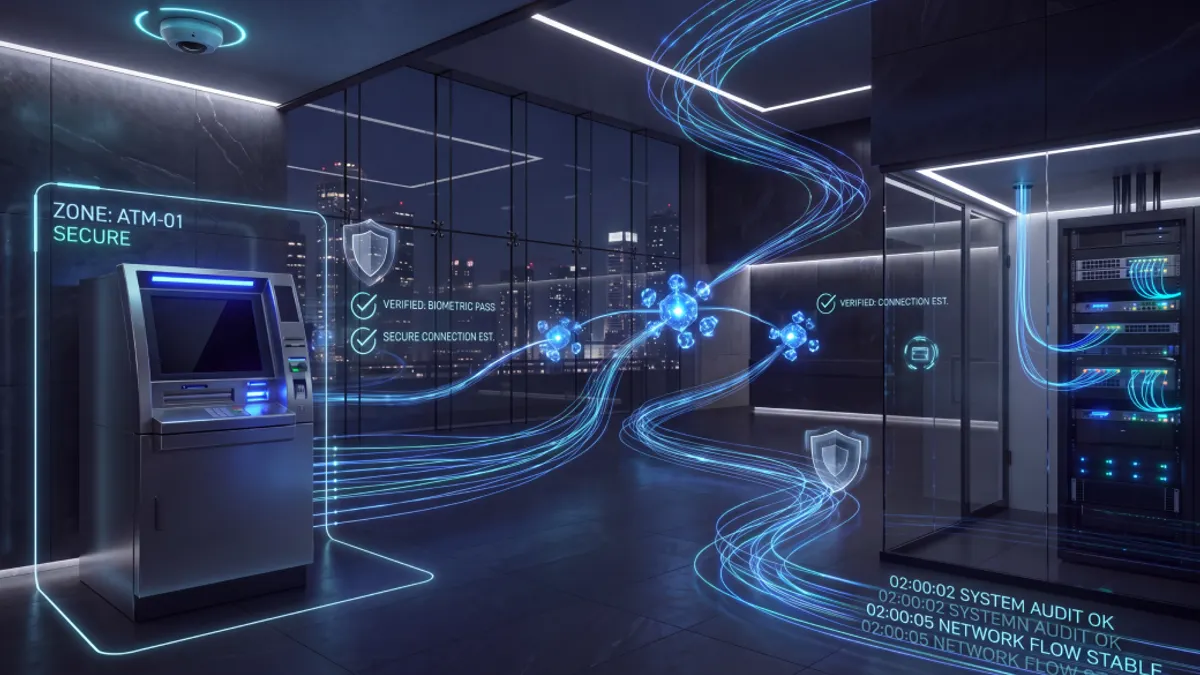

It's 2 a.m. and the branch is empty. There’s a lobby ATM humming quietly, a security camera blinking in the corner, and somewhere in the cloud, an AI agent is finishing a batch of overnight fraud scores. All of them are inside the bank's trust boundary, but each is managed as an isolated security problem.
That fragmentation is no longer sustainable. Protecting every device, login, and autonomous script requires something different from standalone, bolted-on cybersecurity. Banks need one architecture with security and visibility built into every layer. Resilience comes from unifying tools, not adding more of them onto existing architectures.
AI agents expand the unmanaged attack surface
Devices like ATMs, badge readers, and Internet of Things (IoT) devices lack the memory capacity and proper operating system (OS) to run powerful security features like endpoint detection and response (EDR) and host-based firewalls. It’s a vulnerability that banks have lived with for years. Now add the complexity of safeguarding AI agents, which access systems and execute application programming interface (API) calls without a human in the loop. Their "unlisted" entry points add new openings for attackers.
It's no wonder 79% of financial services respondents say AI has already expanded their network's attack surface and 85% have already added security controls, specifically for AI workloads1. That's encouraging, but adding more controls to an old architecture is like adding extra locks to a house with no foundation. It buys time, not resilience.
Security fused into the network instead of bolted on
Routing all traffic through a centralized inspection appliance introduces latency that breaks apps like real-time fraud detection and creates single points of failure. In an industry where milliseconds separate a legitimate transaction from a blocked one, that delay is a major risk. A slow fraud check can mean a declined card or a fraudulent transfer that clears before it's flagged.
Security fused into the network solves this. Protection is built directly into the switches. Traffic is checked and security enforced instantly, with the same safeguards, whether the request comes from a teller terminal, an ATM, or an AI agent.
Action control plus access control
Traditionally, zero-trust security was focused on controlling access to the network. Now it must also control actions within the network perimeter. A security camera should connect and send data only to its recorder. An AI agent should read transaction history but be blocked from executing a fund transfer or accessing sensitive data, even if a hacker tricks it into misbehaving.
For physical devices like ATMs and IoT sensors, action control relies on microsegmentation: isolating zones so each device can only reach what it’s allowed. For AI agents, enforcement must be at an even more granular level, governing individual API calls and tool requests so permissions are tied to specific actions instead of broad system access.
Verified trust for compliance
Banking executives struggle to prove their AI and IoT environments are compliant with regulatory mandates because these systems are largely invisible to traditional monitoring. ATMs and IoT devices can't run endpoint agents. AI agents act autonomously with no port, no agent, and no asset tag to track. Regulations now demand continuous, real-time proof of resilience, but fragmented tools make it hard to produce one unified record of what happened and whether it was authorized.
Integrating network telemetry with security operations fused into the network closes that gap. Every action is logged in real time against policy, creating a defensible, continuous audit trail.
Meet your new trust officer—the network
The network is one of the only control points with visibility into every device and agent in the bank. It doesn't replace a data scientist validating a model or a compliance officer signing off on governance, but it provides the secure execution environment that makes observability, security, and innovation possible and allows you to run branches like an extension of your digital business.
As AI agents and IoT devices multiply, an AI-ready, secure network architecture becomes a single, unified witness to every transaction and action, human or machine, turning infrastructure from a risk to be managed into a competitive advantage.
References