

What actually happened to community institution funding, and why the answer is sitting in data you already own.
On September 16, the Fed raised a quarter point, the first increase since July 2023, with one more projected before year end. If that second one lands, banks are funding 50 basis points above where they sat in August.
Let’s start with what is at risk, because it is more than most people think. The last two years were good to you. Median net interest margin at institutions under $10 billion went from 3.36% in 2024 to 3.66% in 2025.
There were two things that helped to produce this: loans booked in 2020 and 2021 kept maturing into higher rates, so loan yields rose from 6.35% to 6.47% even while the Fed was cutting. Second, deposits repriced down with those cuts, so funding costs fell from 2.32% to 2.13%.
That first tailwind has run out. In the first quarter of this year, with the Fed sitting still, loan yields fell 18 basis points while funding costs eased only 13. Median net interest margin gave back four, the first down quarter after three straight up. Now the Fed is pushing on the funding side too, and funding reprices faster than a loan book does.
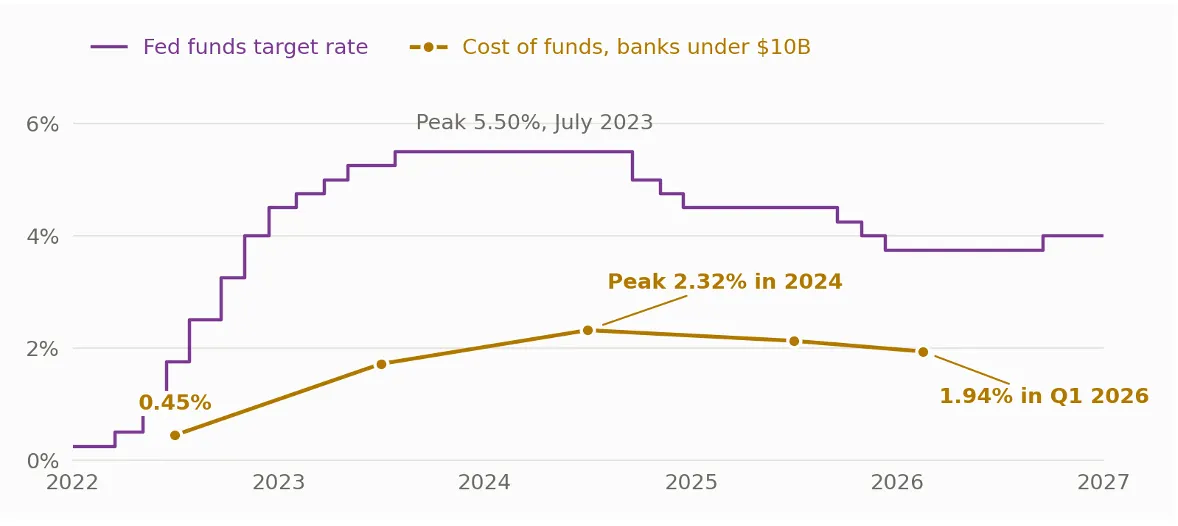
Funding costs also do not come back the way they went out. Cost of funds at institutions under $10 billion rose from 0.45% in 2022 to a 2.32% peak in 2024, roughly 36% of the Fed's 5.25-point increase. Since that peak, the Fed has cut 175 basis points and cost of funds has come down 38, closer to 22%. It passes through faster going up than coming down.
If we see the same 36% increase to COF as related to the Fed increase, that is 0.18%. On a billion dollars of earning assets, $1.8 million a year in added interest expense. At half a billion, $900,000. That is what the move costs before banks do anything.
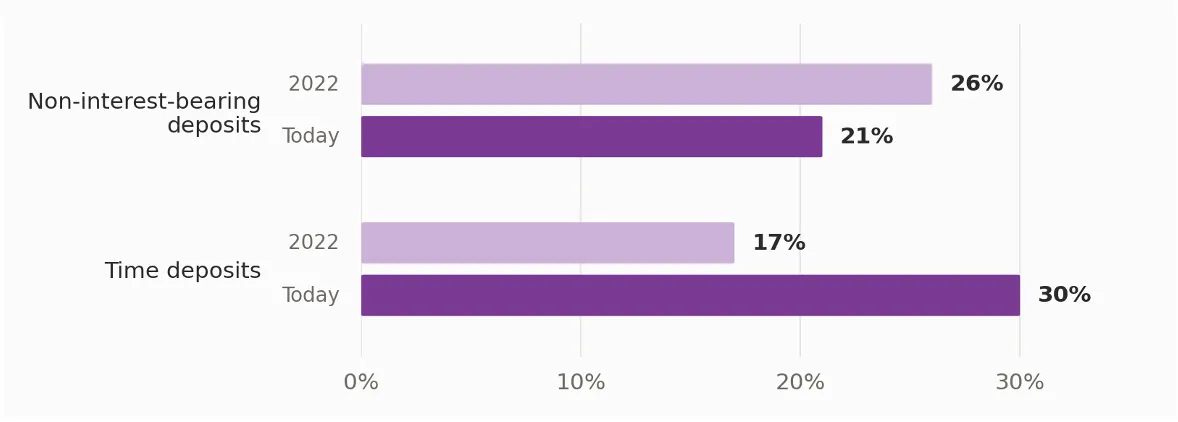
Also, I would argue that 36% may be light this time. Non-interest-bearing deposits fell from 26% of deposits in the third quarter of 2022 to 21% in the first quarter of 2026, while time deposits went from 17% to 30%. That is nearly double the share of funding that is sitting in money that reprices to the market. The same Fed move now reaches more deposits than it did last cycle.
And the risk is no longer only repricing. In 2022, most of the money stayed, but leaving has gotten easier every year since, and a monthly report is too slow to catch it.
That leaves three familiar doors, and none are painless. Pay up: which buys a balance without buying loyalty. Borrow: which has short-term benefits but is usually expensive. Or shrink the loan book: giving up the growth banks are measured on.
Most institutions will do nothing until the CD cliff arrives, then pay up, because rate is the only lever that works on a two-week timeline.
There is a fourth option, and it is one banks actually can control.
In a recent Marquis client analysis, the average household holds nine financial products across five providers. Most banks hold two and a half. The other six sit elsewhere, with institutions they trust with their checking.
The catch is that the answer is buried across the core, LOS, card processor and digital channel, tied to account numbers instead of people. Ask which households show signs of moving money, and at most institutions that is a three-week request for the data. By then, much of it is gone.
Nobody owns the number. The CFO tells the marketing manager to grow deposits, with no list and no view of who is at risk or holding money elsewhere. So, they do the only thing the job leaves them: a CD special on the website and a banner out front. That is door one, run by someone who never had a second option. If there is an attempt to use data and model things out, it takes three weeks to produce and much of the money is already moving at that point.
Make it visible first. Unify the data at the household level, enrich it to see what sits outside, and put that number in front of both marketing and finance monthly. Then point it at four things:
- Who is likely to move on rate, so you price the few and not the whole book.
- Balances already drifting, because behavior shows before the money does.
- New accounts in their first 90 days, when the lifetime balance is set.
- Mail alongside email, direct mail reaches balances email does not.
Rates will turn again and then turn back. The institutions that weather it best will not be the most reactive on rate. They will be the ones who already know which households to call.
About Marquis
Marquis helps banks, credit unions and mortgage lenders transform customer data into actionable intelligence. Serving more than 700 financial institutions nationwide, Marquis provides customer data, analytics, marketing automation and engagement solutions that help organizations strengthen relationships, improve customer experiences and drive growth.