Dive Brief:
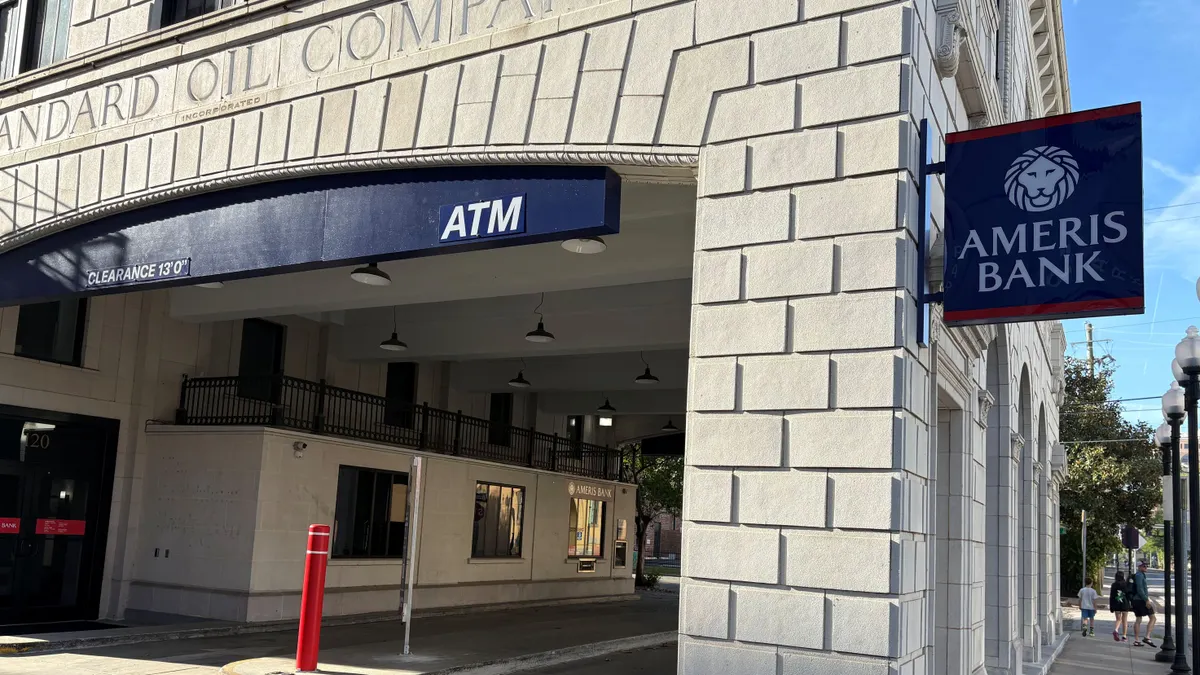
- Ameris Bank intends to appeal a federal jury’s verdict that sided with a former bank executive who had sued the lender for wrongful termination, Ameris said Friday in a securities filing.
- After a jury trial that began June 1, Atlanta-based Ameris was found liable June 12 for wrongful termination, whistleblower retaliation, unpaid wages and breach of contract. With the verdict, plaintiff Patrick Byrne will be awarded $16.525 million in compensatory damages and statutory penalties, and about $62.9 million in punitive damages.
- The $28.1 billion-asset bank “disagrees with the verdict and believes that it is not supported by the facts or applicable law,” it said in the filing. “We believe Mr. Byrne was paid all compensation to which he was entitled under his agreements with the company, and we plan to appeal the decision,” an Ameris spokesperson said Wednesday.
Dive Insight:
Byrne was the co-founder and CEO of Costa Mesa, California-based Balboa Capital, an online lender for small and medium-size businesses, which Ameris acquired in December 2021 for $187 million.
He was employed by Ameris from December 2021 through June 2024 as the CEO of the equipment finance division of the bank.
Byrne sued the bank in September 2024 in U.S. District Court for the Central District of California. He alleged the bank was “improperly calculating” Balboa’s earnings so the bank wouldn’t have to pay performance-based cash bonuses under a long-term cash incentive plan, according to his initial complaint. He repeatedly complained about this to the bank, and was fired in June 2024 as a result, he said.
In February, Ameris sued Byrne for breach of contract and misappropriation of trade secrets, which the bank said it discovered in September 2025. Ameris alleged Byrne sent thousands of pages of confidential, proprietary and trade secret information belonging to the bank from his Ameris email account to his personal email account.
The Ameris spokesperson did not say when the bank plans to appeal the decision. In last week’s filing on the jury verdict, Ameris said it “is evaluating the potential impact of the verdict, including whether an accrual is required for financial reporting purposes and the amount thereof.”
“While the Company intends to continue to vigorously defend its position in this matter, the ultimate outcome of this matter is uncertain,” the bank said. “The final resolution of this matter could have a material adverse effect on the Company’s results of operations, financial condition and liquidity.”
The bank’s first-quarter net income jumped 26%, to $110.5 million, according to an April earnings release.
In a Monday press release, Byrne’s attorneys with the law firm Allen Matkins said Ameris “willfully and maliciously failed to pay what was owed under the [long-term cash incentive plan] and then fired Mr. Byrne when he communicated his corrections to Ameris’s leadership.”
“I spent my career building Balboa Capital and stood up for the people who built it with me. I’m grateful the jury listened to the evidence and held Ameris accountable,” Byrne said in the release.