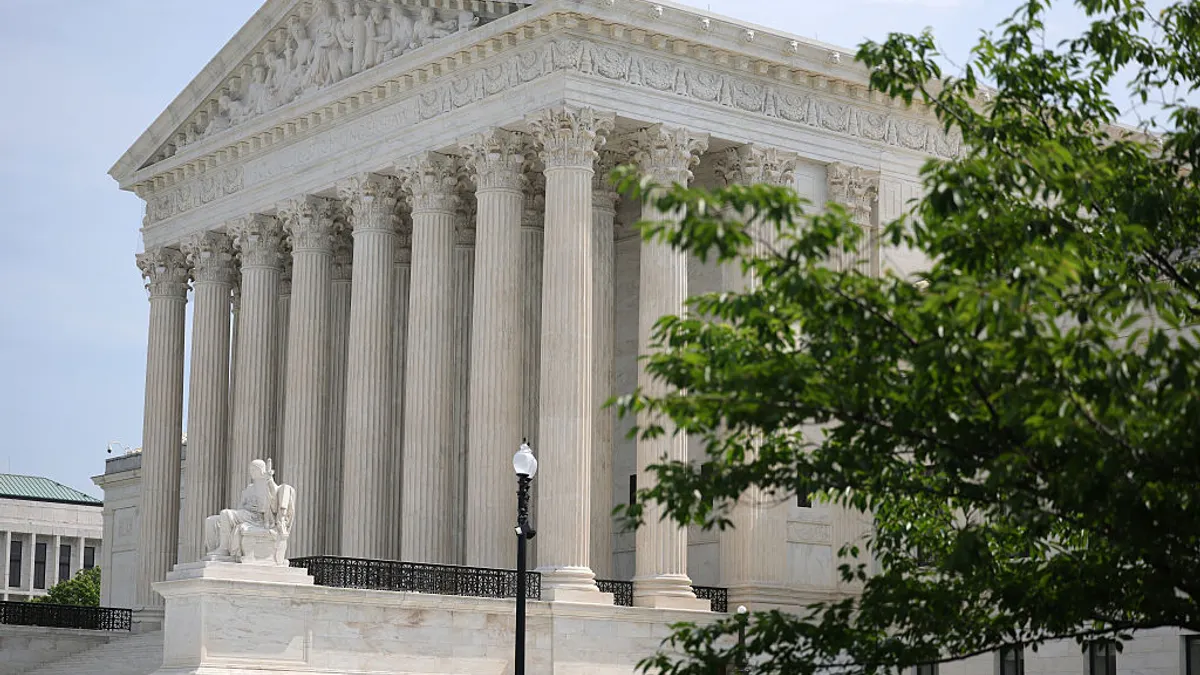
Federal Reserve Gov. Lisa Cook can stay in her job at the central bank for now, the Supreme Court ruled Monday.
The court voted 5-4 against President Donald Trump, who attempted to fire Cook for cause last August. Chief Justice John Roberts and Justice Brett Kavanaugh joined the court’s three liberal justices in siding with Cook’s argument.
“Acceptance of the Government’s position would in effect transform the Federal Reserve’s for-cause protection into at-will employment – an interpretive leap out of step with the statute Congress enacted and our Nation’s tradition of central banking protected from political interference,” Roberts wrote for the majority.
Cook’s lawyers – and several past Fed chairs and Treasury secretaries – pressed the importance of maintaining the central bank’s independence. The Supreme Court, too, noted that Monday.
“For present purposes … any definition of ‘cause’ … must reflect the Federal Reserve’s unique historical status and role,” the court wrote Monday. “The Federal Reserve operates at a deliberate remove from the ordinary political process. … Not only the fact of independence but also the appearance of independence is key to the Federal Reserve’s design.”
Trump reasoned in August that mortgage fraud allegations raised by Federal Housing Finance Agency Director Bill Pulte were sufficient cause to remove Cook.
“The American people must be able to have full confidence in the honesty of the members entrusted with setting policy and overseeing the Federal Reserve,” Trump wrote in an August letter to Cook. “In light of your deceitful and potentially criminal conduct in a financial matter, they cannot and I do not have such confidence in your integrity.”
Cook sued Trump, and a district court and appeals court sided with the Fed governor.
Cook’s lawyers argued the “cause” Trump gave was a pretext to remove the Fed governor and install a replacement who would be more agreeable to raising interest rates, as the president had consistently demanded.
The lawyers also asserted Trump gave Cook insufficient notice and failed to allow her to explain the situation at issue.
During oral arguments with the Supreme Court in January, conservative and liberal justices alike expressed skepticism surrounding cause and due process. That was reflected in Monday’s opinion, too.
“The key issue is whether ‘[t]he cause assigned’ truly ‘impl[ies] an unfitness for the place’ – or whether it simply represents an effort to secure a ‘more congenial’ replacement,” the court wrote Monday. “Without such constraints in place, any perceived or alleged misstep (past or present) could provide a ready pretext for a Governor’s removal. Nothing could be more corrosive of the independence that Congress sought to preserve.”
While Roberts’ opinion reinforced the Fed’s exemption from presidential powers, the Supreme Court on Monday separately backed Trump’s firing last year of a Democratic commissioner at the Federal Trade Commission.
On social media Monday, Trump hailed the FTC case ruling as a “BIG WIN” but appeared to indicate the Cook fight may not be finished.
“We will take appropriate action immediately to make sure that someone who has committed wrongdoing will not be making vital decisions concerning the Welfare of the United States of America!” Trump wrote on Truth Social, naming Cook specifically.
Pulte, too, stuck to his August allegations.
“As I have repeatedly said, I believe Lisa Cook will be indicted for mortgage fraud,” Pulte wrote Monday on X.
Across the political aisle, Sen. Elizabeth Warren, D-MA, hailed the decision.
“Even a Supreme Court stacked by Donald Trump agrees that his attempt to fire Lisa Cook was illegal,” Warren wrote Monday in a statement. “Trump’s effort to take over America’s central bank is far from over, and we will keep fighting back.”
In his opinion Monday, Roberts held out the importance of setting monetary policy, apart from political constraint.
“The Court declines to sow doubt as to the status of one of the Nation’s (and the world’s) most important financial institutions, and would not so quickly unsettle this ‘special arrangement sanctioned by history,’” he wrote.
Beyond addressing Fed independence, the court asserted Trump “failed to afford Cook the procedural protections to which she was entitled by statute.”
“The Court rejects the Government’s halfhearted contention that Cook in fact received due process,” Roberts wrote. “At minimum, Cook was entitled to some explanation of the evidence at issue, some avenue for a response, and a deadline by which a response would be due. Only after Cook has had the opportunity to respond to the charges made against her may a final decision be made. And only then can the courts assess the validity and sufficiency of such charges.”
The Cook case came as Trump and other administration officials arguably sought to force then-Fed Chair Jerome Powell to resign over renovations at two central bank buildings that went over-budget. Powell’s term as chair ended last month, but he remains on the Fed board.