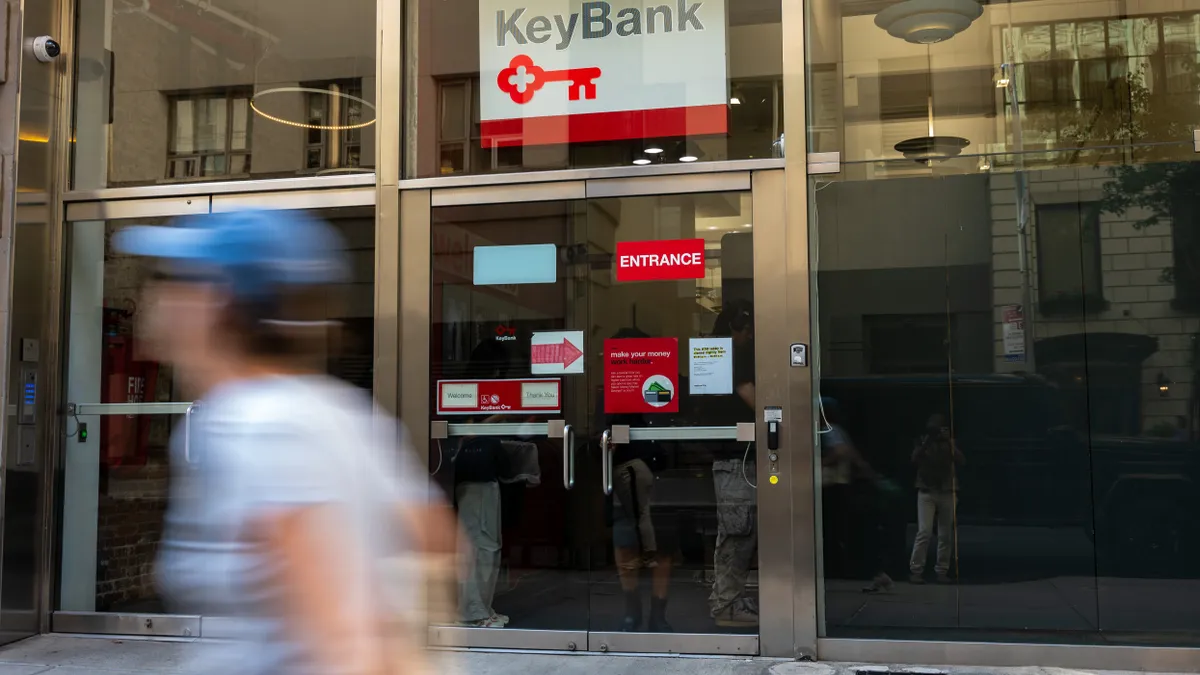
KeyBank aims to grow its commercial banker roster by an additional 10% this year, the head of the lender’s commercial bank said.
If the goal sounds familiar, the Cleveland-based regional bank targeted a similar increase last year – and followed through, boosting its workforce in commercial by 11%.
To help repeat that, KeyBank this month hired a five-person family office and private capital team based in the Kansas City area. The lender currently has 181 commercial bankers.

Two banker teams in Chicago and Southern California, onboarded last year, have already driven new customer growth, core deposits and loan production at roughly twice the rate of the rest of the portfolio, Ken Gavrity, the head of Key’s commercial bank, said during a conference appearance this month.
Key’s commercial bank includes its middle-market segment – serving businesses generating between $10 million and $1 billion in revenue – and its commercial payments platform.
The lender pairs relationship-focused bankers embedded in local communities with a sophisticated platform offering anything middle-market companies need, Gavrity said.
The commercial bank generated about $2.1 billion in revenue last year, which is just under one-third of the bank’s total, and counted about $58 billion in average deposits, about 40% of Key’s total, Gavrity said.
The bank grew commercial and industrial lending by 9% last year, and grew clients 4%, to about 5,000. The middle-market business has bankers in 30 markets across the country, with a presence in 11 of the 20 largest metro areas.
In Chicago and Southern California, as well as New York and Colorado, the $186 billion-asset bank doesn’t have the density it would like, so picking up bankers or teams of bankers holds appeal, Gavrity said.
He’s also looking to build the bank’s Southeastern presence.
“I really do have a desire to get into the Southeast, and I've been looking at the Atlanta market, but … at the right time with the right team,” he said.
Another angle Gavrity considers: bringing on bankers who own their market, even if it’s not a high-growth area. Akron/Canton, Ohio, may not be the hottest metro area in the country, but it’s been one of the commercial bank’s highest-growth markets in the last 12 to 24 months, because the banking leader there is plugged into everything, Gavrity said.
Whether it’s deep market ties or vertical expertise, “when we come across, truly, a differentiated talent, then we’ll lean into those opportunities,” he said during a recent interview.
To attract talent, Key seeks to stand out with a robust platform and the ability to connect clients with other areas of the bank like capital markets or payments and treasury services, Gavrity said.
The family office team that joined Key has “these unbelievable relationships in a very large and growing segment. And their view was, we’re so excited about the rest of the platform we can bring,” he said.
To be sure, many banks are chasing middle-market growth. Key has more to offer than other regionals, Gavrity asserted, and while bigger rivals might have all the services and capabilities, their attention on the middle market comes and goes in favor of larger corporate clients.
“People see that, and they know it,” he said. “Across the top 20 banks, almost everybody is saying they’re going to grow their commercial bank or middle-market franchise … The reality is, it’s very easy to sell against.”
Gavrity has prospective hires connect with bankers who’ve joined the lender to gather input.
“That's been one of the best selling mechanisms we have, is just letting them talk to each other,” he said.
Later this year, the bank will roll out a full digital refresh for commercial clients, with enhanced analytics and reporting, different payment modules and easier access to information, Gavrity said.
Those features can set Key apart, as the bank seeks to understand through market research and customer input, “where does the client just need good enough and that’s all they care about, versus where do they want it to be differentiated?” he said.
Constant investment in improving digital platforms is “a must. You can’t take years off,” he said. But the bank also leans on fintech partners.
“Banking has become a world where you can't be the builder of all things,” Gavrity said. “You just can't be dynamic enough. You can't be fast enough. So it's why, over the last decade, we’ve just built our ties into that whole ecosystem where the biggest [venture capital] investors we have such tight relationships with, they're always telling us what they're looking at.”
Although pent-up client demand fueled the 9% loan growth last year, the bank is expecting growth of about 5% to 6% for 2026, Gavrity noted. While the expected pickup in middle-market mergers and acquisitions will benefit the bank on the fee side, it will serve as a headwind against balance building, as it targets companies Key seeks to foster relationships with, he said.
That M&A uptick is something the bank noted in its recent survey of middle-market clients, which revealed two-thirds are planning M&A activity within three years, and almost half seek increased access to capital to fund growth.
“We're constantly surveying them to help understand what the overall sentiment is, and that's what helps us then give them a point of view across the whole portfolio,” Gavrity said.