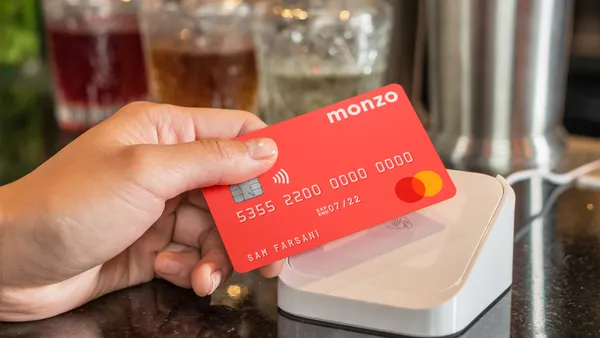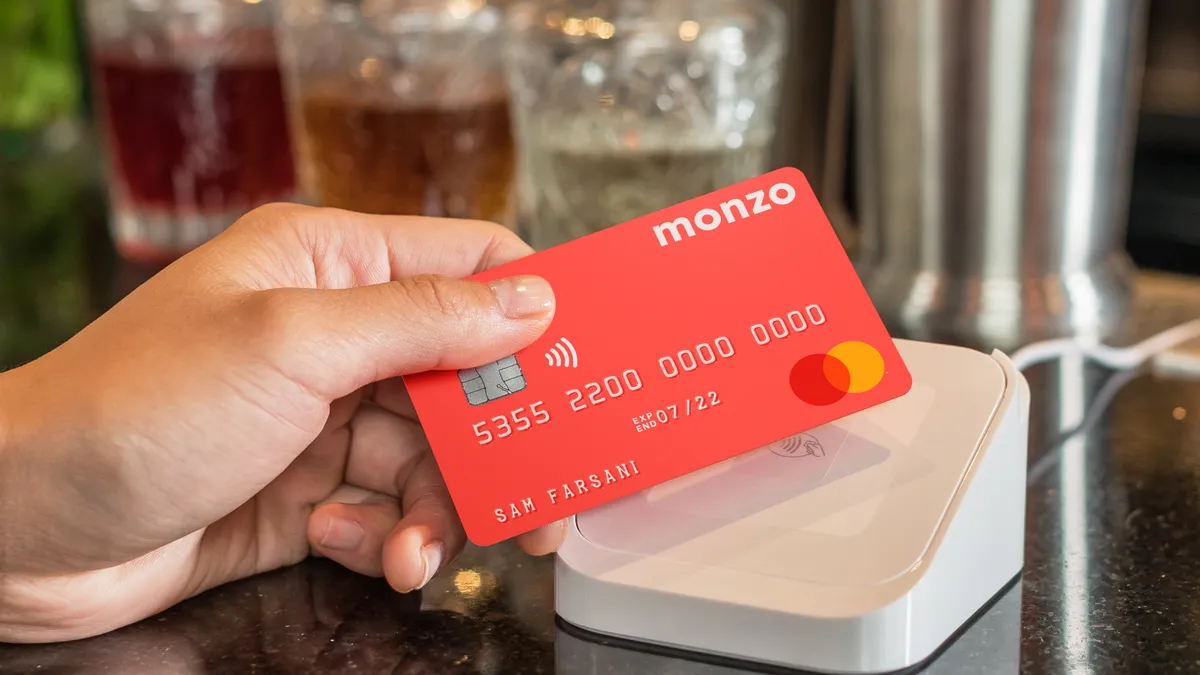
Monzo is closing its U.S. operations and accounts, the U.K.-based fintech said in a statement Tuesday, as well as a notice to customers seen by Banking Dive.
The digital bank will lay off roughly 50 employees and stop onboarding new U.S. customers – though existing U.S. users can access their accounts through June, a representative of the company told Bloomberg.
In its statement, Monzo cited its receipt, in December, of a full banking license through the European Central Bank and Central Bank of Ireland.
“With a fast-growing customer base of 15 million in the UK and the growth opportunity our European banking licence creates, we're making a deliberate, strategic decision to focus on scaling in our home market and Europe and to step away from the US," the company said Tuesday.
The move is a marked departure from the strategies of several of Monzo’s peers, such as Revolut, Nubank and Bunq – international platforms all angling for U.S. banking licenses amid a perceived relaxation of regulations and uptick in charter applications.
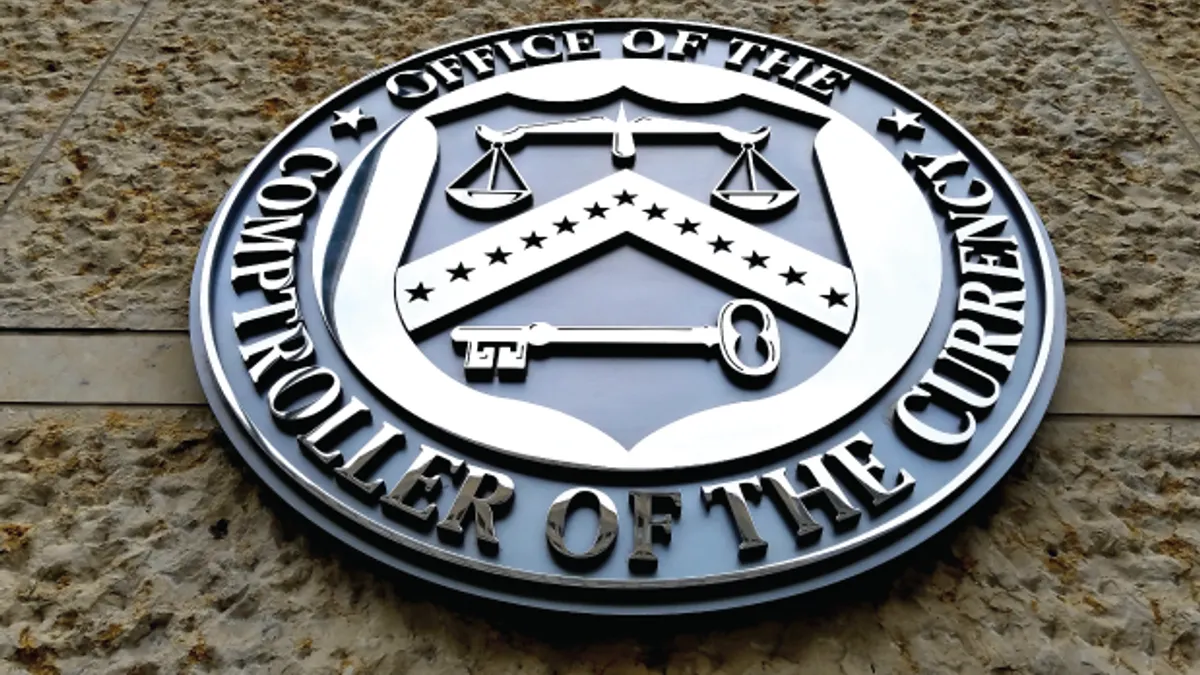
Revolut last month applied for a U.S. banking charter with the Office of the Comptroller of the Currency – and received full license approval in its home country, the U.K.
Brazilian digital bank Nubank received conditional approval for an OCC charter in January.
And Bunq re-applied for an OCC charter in January. The Dutch neobank had initially applied in 2023 but withdrew its paperwork after a 301-day wait.
Monzo, too, once applied for a U.S. banking license – in April 2020. But, much like Bunq, it withdrew its application after 17 months, having determined that the OCC likely would not approve it.
Monzo didn’t give up on the U.S. market. In fact, the digital bank named a new U.S. CEO – a Cash App alum – in 2023.
“We know this isn’t the news you were hoping for, and we’re really sorry,” the company wrote to its U.S. users Tuesday. “We’re incredibly grateful you chose us for digital banking.”
Monzo noted that it would share a timeline for account closure in the coming days, along with information on how to transfer money, change scheduled payments and direct deposits, and access statements post-closure.
“We’ll guide you through each step to make this as smooth as possible,” Monzo wrote to its U.S. customers. “Your money is safe. Your deposits remain FDIC-insured and fully accessible.”
Monzo isn’t alone among fintechs abandoning the U.S. market. German neobank N26 curbed its U.S. ambitions in 2021.
The strategic shift comes months after a change in leadership at Monzo. The U.K. fintech’s CEO, TS Anil, said last October he would step aside to make room for former Google and Standard Chartered executive Diana Layfield.
Anil was asked to step down by Monzo’s board, the Financial Times reported in December, over disagreements about the timing of a planned initial public offering, as well as the market in which the company would be listed. Anil reportedly favored New York, while the board opted for London.
Anil remained on Monzo’s board as a vice chair after some of his loyalists threatened to rebel, Finextra reported.
Monzo in February said it would boost its Irish headcount to 70 over the next 18 months.
The neobank last June reported revenue of more than $1 billion for the first time, and posted a profit of £60.4 million in the 12 months ending March 2025, according to Reuters.