
Dive Brief:
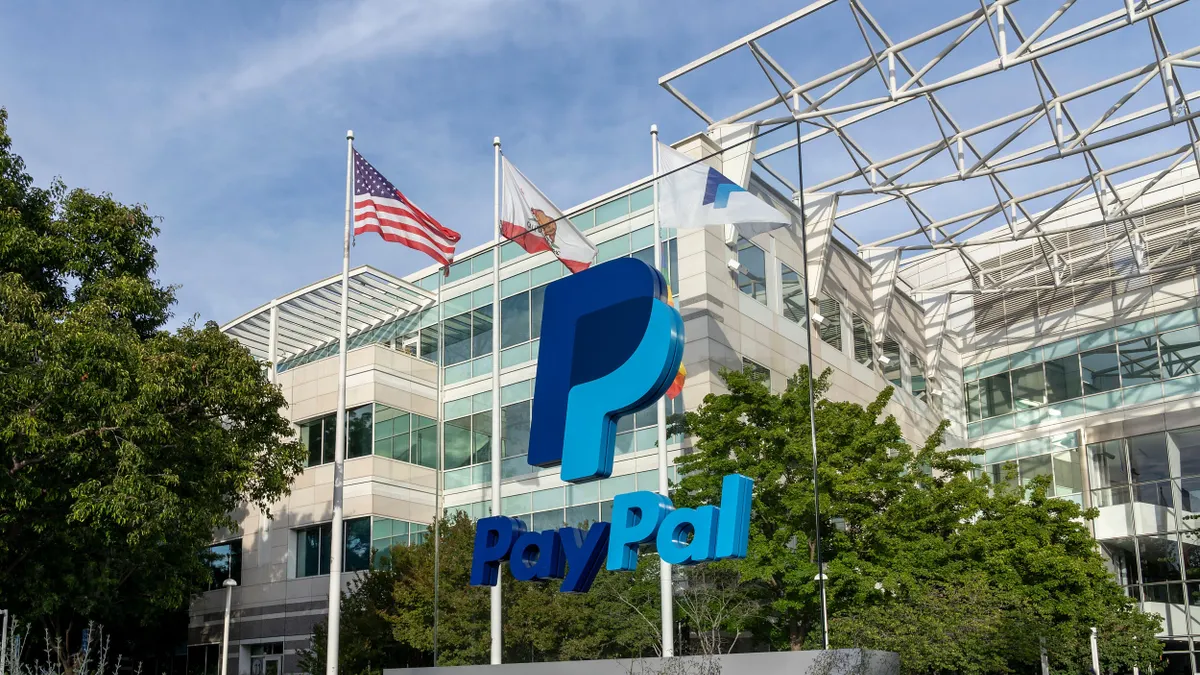
- PayPal has applied with the Federal Deposit Insurance Corp. and the Utah Department of Financial Institutions to establish a Utah-chartered industrial loan company, according to a press release Monday.
- The digital payments pioneer said it’s seeking the charter so it can expand the financial services it offers to U.S. small businesses under a proposed PayPal Bank brand. The company has extended $30 billion in loans and working capital to small businesses, but this move would let it knock third parties out of some arrangements.
- “Establishing PayPal Bank will strengthen our business and improve our efficiency, enabling us to better support small business growth and economic opportunities across the U.S.,” PayPal CEO Alex Chriss said in the release.
Dive Insight:
San Jose, California-based PayPal is hardly the only company to seek an ILC charter this year. Automaker Nissan made a similar argument to PayPal in its own ILC charter application in June.
“Forming Nissan Bank U.S. gives us greater flexibility to serve dealers more efficiently and competitively – so they can better serve their customers,” Kevin Cullum, president of Nissan’s financial services arm, said at the time.
Some lawmakers, however, have long argued the ILC designation exempts companies from the definition of a “bank” under the Bank Holding Company Act. As long as industrial banks don’t offer demand deposit accounts, they can bypass oversight by the Federal Reserve, opponents have said.
“The Rakutens and the Googles of the world shouldn’t be able to circumvent the Fed,” Sen. John Kennedy, R-LA, said in 2019, introducing a bill to close that “loophole.”
“If they’re allowed to handle your banking services, they’re going to turn into continents,” he said.
To that end, Sens. Elizabeth Warren, D-MA, and Andy Kim, D-NJ, proposed a moratorium on commercially owned ILC charters until such entities are defined as “banks” under the BHC Act.
Still, FDIC Acting Chair Travis Hill has touted the ILC charter as one of a handful of ways to boost the establishment of new banks. The FDIC, in the Biden era, acted more skeptically toward ILCs, proposing that charter applicants let the agency evaluate whether an an industrial bank would meet its community’s lending needs. The Trump-era FDIC board scrapped that proposal.
The general easing of financial regulations expected under Trump may have prompted some previous ILC charter applicants to try for the license again. GM Financial resubmitted its application for an ILC charter in January. The automaker had applied for an ILC charter in December 2020 – and gained conditional approval from the Utah regulator in June 2024. But it pulled the application from FDIC consideration later that month “to address feedback” from the regulator, the company said.
Likewise, investment firm Edward Jones resubmitted its ILC charter application in April. It had previously applied in 2020 but withdrew two years later, citing the “environment” at the time.
PayPal, for its part, has been offering bank services to some 420,000 small businesses worldwide since 2013, according to Monday’s release, but it’s had to rely on banks and other partners for assistance. The new charter would let it pursue additional opportunities and bolster its business with new revenue streams.
The company said it has tapped Mara McNeill to be the bank’s president. She was formerly the CEO of Toyota Financial Savings Bank, and earlier in her career, worked as general counsel in auto finance for JPMorgan Chase, according to her LinkedIn profile. She has been a vice president at PayPal since September.
In a LinkedIn post Monday, McNeill said she was “honored” to lead the ILC effort.
“PayPal Bank will operate with a clear mission, strong governance, and a lending strategy designed to responsibly serve small businesses — in Utah and across the country,” McNeill wrote. “Our experienced bank team and board of directors are excited for the opportunity to help build an institution dedicated to expanding access, strengthening communities, and supporting the entrepreneurs who power our economy.”
Aside from lending to small businesses, PayPal said it could offer interest-bearing savings accounts. The company would also seek direct connections in the U.S. to card networks for processing and settlement activities. PayPal was clear in saying that those new ties to networks would “complement” its existing banking relationships.
If PayPal were approved for the bank charter, its bank would be able to access FDIC insurance for its customer deposits, the release said.
It’s not the only payments company considering applying for a bank charter, and some payments players already act as banks. Buy now, pay later company Klarna Group operates as a digital bank in Europe, offering financial services.
Minneapolis-based buy now, pay later company Sezzle is also interested in securing a bank charter, as the regulatory outlook changes. The potential for onerous state oversight is one reason Sezzle is exploring an ILC, said the company’s CEO, Charlie Youakim.
Obtaining the charter would put Sezzle “one step further away from the fight” over state-level BNPL regulation, Youakim said in a November interview. Sezzle may apply for the charter in Utah next year, he said.