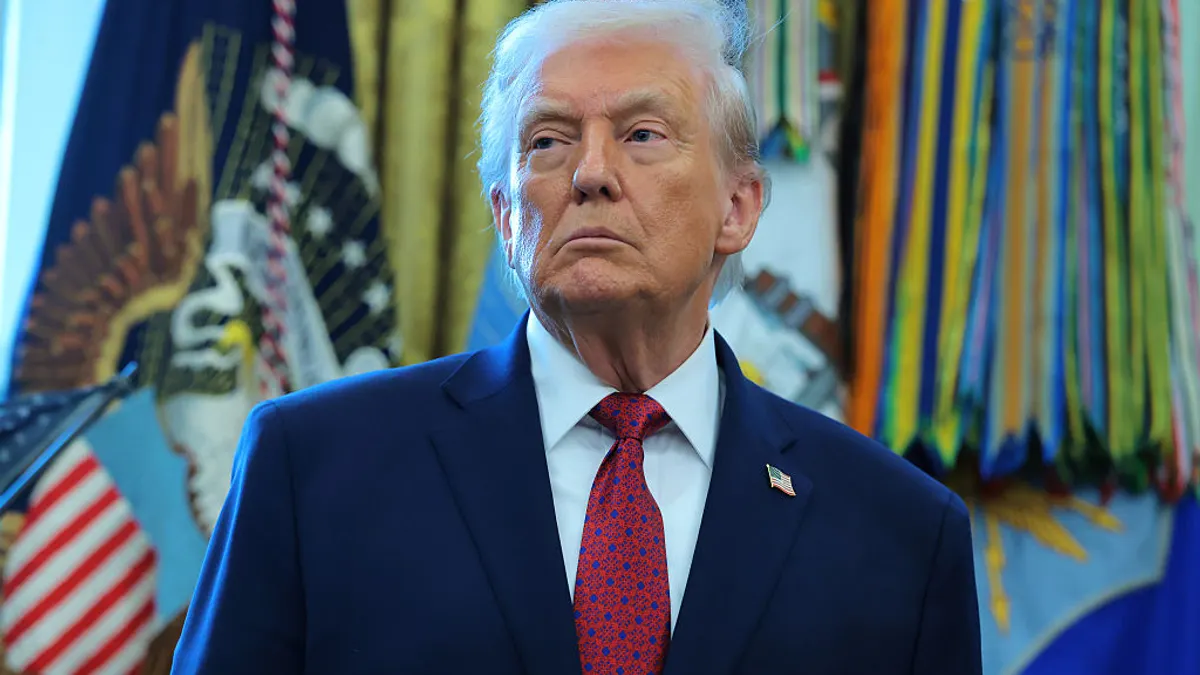

President Donald Trump called for a 10% cap on credit card interest rates for a year, starting Jan. 20, but trade groups for banks that issue the cards distanced themselves from the idea.
Late on Friday, Trump issued a statement on the Truth Social social media platform calling for the cap, pointing to a need for affordability for American consumers. He took a swipe at the industry as he made the pronouncement.
“Please be informed that we will no longer let the American Public be ‘ripped off’ by Credit Card Companies that are charging Interest Rates of 20 to 30%, and even more,” Trump said in his post.
While Trump didn’t explain how the measure would be accomplished, he said he was calling for the cap as the U.S. president, and then thanked some unidentified party for “attention to this matter.”
The president’s proclamation revives similar campaign rhetoric from his 2024 campaign. “We’re going to cap [interest rates] at around 10%,” Trump said during a Sept. 18 rally that year, calling it a “temporary” fix while Americans “catch up.” “We can’t let them make 25 and 30 percent.”
Shortly after the president was inaugurated last year, Sens. Josh Hawley, R-MO, and Bernie Sanders, I-VT, locked arms in February to introduce legislation that would cap credit card interest rates at 10% over five years. Nonetheless, the bill has gotten little traction in the year it’s been pending in the Senate, with just two additional Democrats signing on.
In a response to the president’s cap suggestion, the American Bankers Association and four other trade groups that represent banks that issue credit cards, referred to Trump’s proposal as an “executive order,” but immediately discouraged it.
No such order has been issued, at least based on the White House website.
“We share the President’s goal of helping Americans access more affordable credit,” the bank groups said in their Friday statement. “At the same time, evidence shows that a 10% interest rate cap would reduce credit availability and be devastating for millions of American families and small businesses who rely on and value their credit cards, the very consumers this proposal intends to help.”
The bank groups said they looked “forward to working with the administration to ensure Americans have access to the credit they need,” but offered no details on any such discussions. They also suggested any such cap would result in less credit availability for consumers and force some to use more costly alternatives.
The Electronic Payments Coalition, which represents card industry companies, said it “share[s] the President’s goal of making everyday essentials more affordable for American families and agree hardworking households are already under real financial strain as a result of corporate mega-store price hikes. But, a one-size-fits-all 10% cap risks making things worse by reducing access to credit and limiting choice.”
A spokesperson for JPMorgan Chase, the largest U.S. bank, deferred to the trade groups’ statements. A spokesperson for card issuer Capital One didn’t immediately respond to a request for comment.
Spokespeople for the biggest U.S. credit card networks, Visa and Mastercard, didn’t immediately respond to requests for comment. Rival American Express, which acts as a bank and network in issuing its cards, also didn’t respond to a request for comment.
Analysts who follow the industry doubled down on that notion of unintended consequences if such a rate cap were to happen, saying that low-income households would be disproportionately impacted.
“We believe a hard cap could lead to a disproportionate reduction of available credit to those [subprime] cohorts as it would drastically limit the ability for issuers to price for the higher risk associated,” investment analysts at Wolfe Research said in a Monday note.
Subprime balances make up about one-fifth to one-fourth of overall balances, the analysts said.
The Wolfe analysts also pointed to additional repercussions.
“There could be significant adverse economic effects and political consequences for both parties if a meaningful percentage of the US population's access to revolving credit lines were dramatically reduced or cut off,” they said.
The Wolfe analysts said there was a “lack of a credible path towards legislation,” and also called the “likelihood of regulation going into effect is low.”
Nonetheless, Trump seemed set on pushing the idea forward, noting that it should happen on Jan. 20, the one-year anniversary of his inauguration.
Analysts at the financial firm Piper Sandler weighed in with context on Trump’s recommendation in a note to investment clients Sunday. They said the average interest rate in 2024 on general purpose credit cards was 24.9%, with private-label cards’ rates averaging 31.3%. They also noted U.S. card companies’ collective interest charges rose 52% between 2022 and 2024 to $160 billion, as the number of cardholders climbed 9%.
“We have trouble seeing this going anywhere,” the Piper Sandler analysts wrote. “But (as with all things President Trump) it should be taken seriously.”