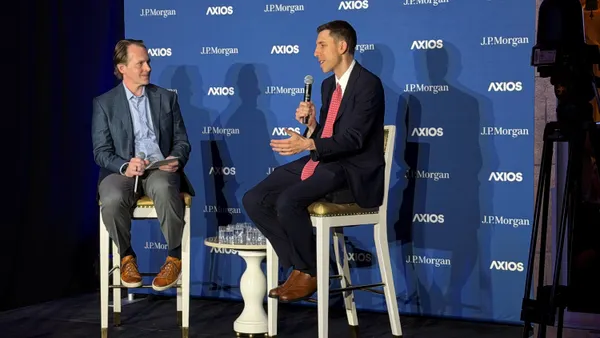
The contact center has become “one of the most ripe places” within banks for artificial intelligence-driven transformation, said Lauren Littlefield, a managing director for Deloitte Consulting.
“But it has to be done thoughtfully and with respect to enhancing the experience, as opposed to just taking out costs, which is – a lot of times – where the conversations that we have with clients actually start,” said Littlefield, one of the authors of a report on the topic published late last month.
Otherwise, banks run the risk of frustrating customers and straining relationships, she said in a recent interview. The report on considerations for AI use included polling of bank executives and customers between November 2025 and January 2026.
On the positive side, AI can give human agents “a power that they had not previously had, to have personalized conversations with their customers because they are being served tips, context, etc. in real time,” Littlefield said.
That’s a capability Bank of America, for one, is rolling out to its customer service agents.
Editor’s note: This interview has been edited for clarity and brevity.
BANKING DIVE: What struck you about the survey results regarding banks’ contact centers?
LAUREN LITTLEFIELD: Even before you start talking about AI, there is a meaningful gap between the way bank executives think their customers feel about the experience, and the way customers actually feel about the experience. And my executive-level clients are always saying, “We got this. Where we need to focus is on cost reduction.”
The survey gave me a new frame to challenge our leaders with, when they start thinking about deploying AI – almost always initially in service of efficiencies – to be able to say, “Wait, let's make sure that we're not taking existing gaps in the experience and making them worse.”
The implementation of AI is a potential magnifier, in that it can take what is already broken and make it worse if you're not being thoughtful about where you're deploying it.
What types of customer service experiences can break a banking relationship?
One of the fundamental points of friction for a lot of banking customers is disconnectedness between channels. Because AI is so reliant on core data being passed from one system to another, when you talk about multichannel interactions, you can actually make that worse if you start implementing AI in your chat with one model, in your interactive voice response with another model, assisting the human agent with another model.
AI models are like people in the way they reach out to a knowledge base to answer questions. When you have one AI in chat, for instance, and one AI in voice, if they're set up and trained on different knowledge bases, you can create a situation where customers are getting conflicting information between channels. Banks are infamous for poor hygiene in their knowledge management.
If the two models are referencing different knowledge bases, it's a huge risk for the bank because you're giving inappropriate information, but it's a huge opportunity to really fragment trust with a customer. As we do testing for some of these rollouts, it is common to uncover conflicting knowledge bases.
What’s a misconception around AI use in bank customer service?
The idea of, how do you strategically delegate to either the AI or the human agent? There are two extremes, and the right answer is somewhere in between. A client who's a large financial institution believes their high-net-worth customers should never interact with AI. They should get 100% human touch, all the time.

Based on what I've seen in data, for the simplest use cases, even high-net-worth individuals often would prefer an automated channel that is faster and more efficient, versus waiting and talking to folks.
Understanding where AI can be accretive to what you're trying to achieve, as opposed to making blanket statements such as “This whole category of customers will be human touch only” is important.
So AI use should be driven by customer need rather than client tier?
Correct. If they're calling to inquire about a mortgage or business loan, very likely, that requires human touch. But if they're calling to say they've lost their debit card and need another, it takes longer and it's less efficient to speak to a human. And because a lot of these banks tier their agents, the most expensive, oftentimes nearshore agents are assigned to take calls from the highest-value customers. So it's like a double whammy, in that you're having them serviced for things that don't really require a human, and by the most expensive human employees.
Obviously, there will be some customer segmentation, but the differentiation of who's interacting with AI should be driven by intent, task, use case.
Everybody has the same basic human needs of wanting to be heard, comforted, educated in times of high stress. So if you want to keep those customers, especially if they're lower on your value scale, you need to deliver the same excellent experience to them, or you're going to lose them if they have a frustrating customer experience.
Where have some banks missed the mark in implementing AI with customer service employees?
It's a huge change-management challenge to take employees who are used to using the same eight screens to do their job, and give them one screen prompting them in real time by a model suggesting additional context or next best action. I’ve seen usage challenges, and the uptake is not what banks would have hoped.
One client, instead of giving their agents a full new desktop experience with all the bells and whistles, took an incremental approach. They gave them one capability first and started with summarization, got them excited about that and then rolled in another, and another. And they gamified it, and there were rewards and prizes. Just like all of us, contact center agents don't want to wake up the next day and do their job completely differently.
Do you think we’ll see the human in the loop disappear soon?
The corner is being turned a little bit with respect to banks being more open to taking the human out of the loop. That is happening, increasingly, with generative AI capabilities being deployed to customers with the right guardrails around them.
Is there a world where human agents go away? Absolutely not any time in the next five years. But the profile of what agents need to do will be fundamentally different as they become increasingly focused on empathy in high-stress situations, problem-solving, advice-giving – a different profile than someone who is conducting rote, procedural tasks.
As AI can do more, when you actually get to a human, the expectation is going to be that that human knows a lot about you and has access to personalized decision-making, recommendation generation.