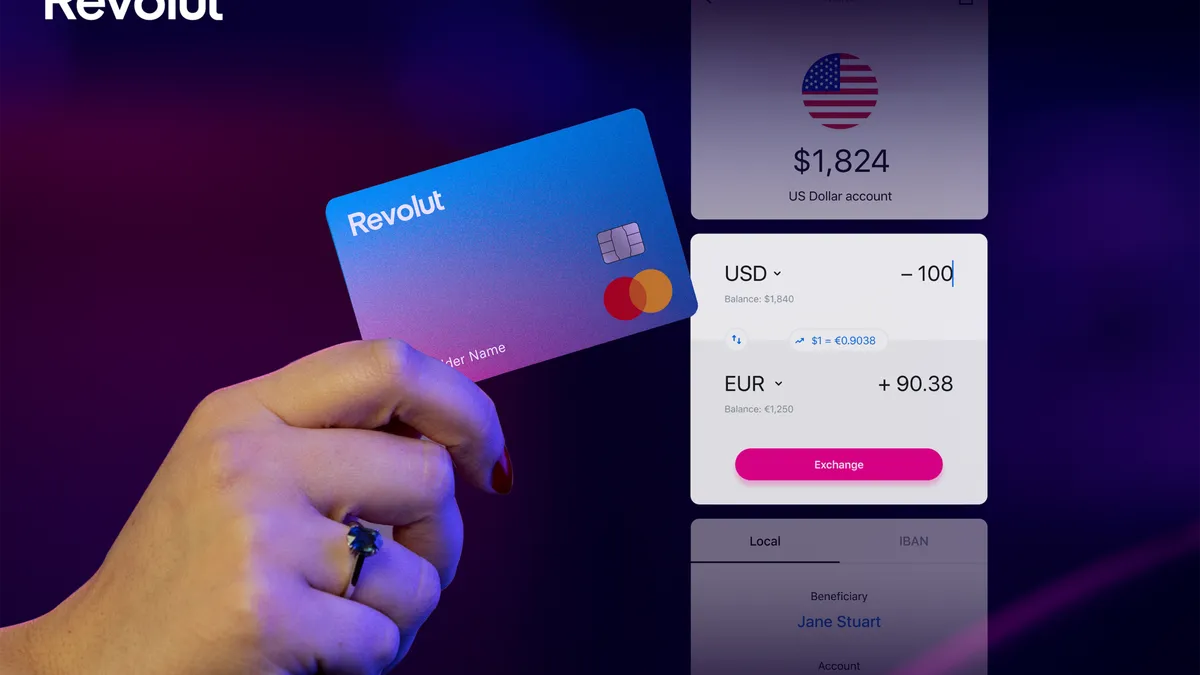
British neobank Revolut has gained conditional approval from the Office of the Comptroller of the Currency to launch a full-service bank in the U.S.
The nod comes roughly six months after Revolut applied for an OCC charter, and almost a year after then-U.S. CEO Sid Jajodia said a bank charter would give the firm “a seat at the table” with U.S. regulators.
“Conditional OCC approval is an important first step towards establishing the proposed Revolut Bank US,” founder and CEO Nik Storonsky said in a press announcement Thursday. “It gives us the foundation to build in the world's largest financial market and bring the full Revolut experience to millions of Americans.”
The bank’s initial paid-in capital, after deducting all organizational and pre-opening expenses, must be at least $95 million, the OCC said in its conditional approval letter. Revolut must maintain a tier 1 leverage ratio of no less than 10% through its first three years after opening. It must also gain approval from the Federal Reserve and the Federal Deposit Insurance Corp.
The preliminary conditional approval does not include Revolut’s proposed retail foreign exchange business, the OCC said. Revolut must submit required information for the OCC’s supervisory non-objection prior to launching that business, the agency said.
“We're grateful for the OCC's open and transparent dialogue throughout this process,” said Revolut U.S. CEO Cetin Duransoy, who took helm in March when Jajodia became Revolut’s global chief banking officer. “They were both diligent and expedient with our application, allowing us to remain on track for a 2027 launch of our proposed national bank.”
Last September, Revolut committed $13 billion toward global expansion, including $500 million toward U.S. expansion alone.
The company recently launched its Mexican bank and said it has been making regulatory progress in Brazil, Colombia, Peru and Argentina. This year, Revolut has obtained bank licenses in France, Australia and the U.K., and a payments license in the UAE. In May, the company said it had surpassed 70 million customers globally.
Since launching 11 years ago as a way for consumers to sidestep foreign exchange fees abroad, “every product we’ve built and every market we’ve entered has reinforced the same belief: money doesn’t stop at borders, and banking shouldn’t either,” Storonsky wrote on LinkedIn.
“[Y]ou can’t build a truly global bank without becoming a full-service bank in the United States,” he wrote.