A Senate Banking Committee hearing Tuesday on the topic of affordability drew renewed criticism of overdraft fees, including from a Republican lawmaker.
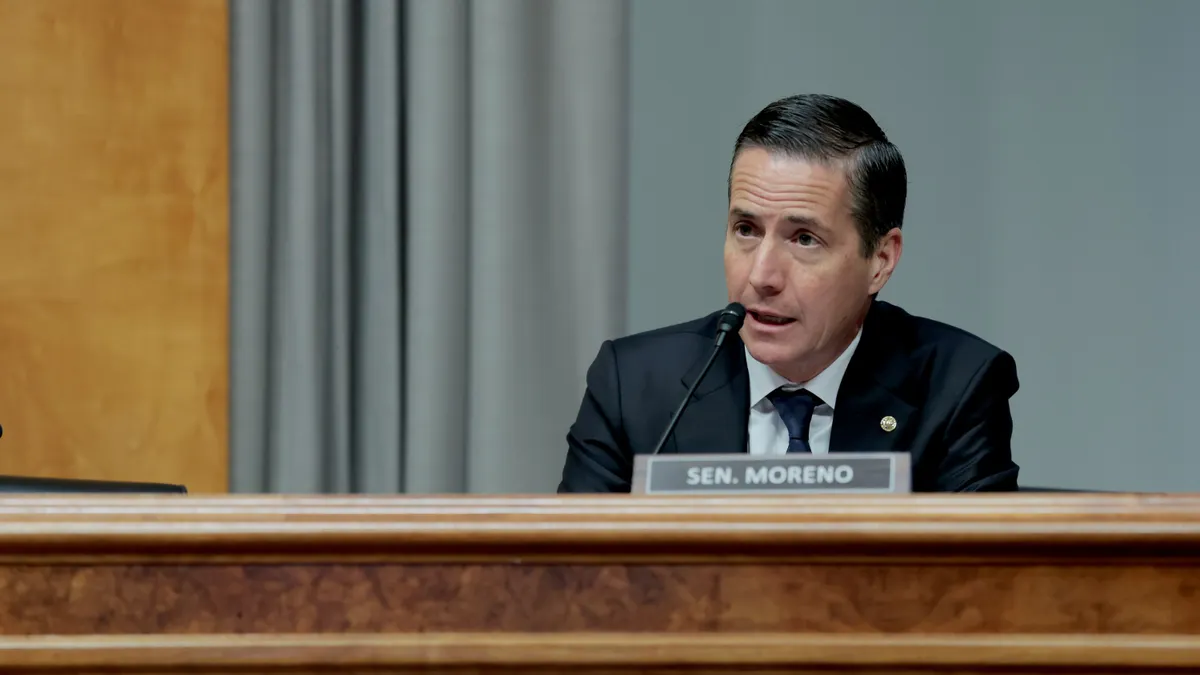
Sen. Bernie Moreno, R-OH, needled Lindsey Johnson, CEO of the Consumer Bankers Association, over banks posting customer deposits after withdrawals, saying the order those show up in a bank ledger ends up saddling consumers with overdraft fees.
“Most banks, for example, in Ohio, that receive deposits – those deposits don’t credit the person’s account until after withdrawals happen, and a lot of that results in overdraft fees,” Moreno said Tuesday during a hearing that highlighted rising prices and Americans’ ability to shoulder those.
“That’s something that you guys can either do voluntarily or you’re going to make us pass a law to do that, because it’s crushing working Americans and it’s fundamentally unfair,” he told Johnson.
Johnson started to refer to banks’ back-end technology before Moreno cut her off.
“Just do it the right way, though,” he said. “It’s just bad practice. Just don’t do bad things.”
Sen. Chris Van Hollen, D-MD, said consumers paid about $12 billion in overdraft fees last year. That’s the same calculation the National Consumer Law Center put forth earlier this month.
“You can go and get a cup of coffee and not realize that your three-buck cup of coffee ended up getting you a $35 overdraft fee,” Van Hollen said, and rates can be as high as 16% effective annual interest.
The Consumer Financial Protection Bureau, in 2024, tried to rein these in with a rule that would have capped overdraft fees at $5, Van Hollen noted, but President Donald Trump signed a resolution in May 2025 that overturned the rule.
Julie Margetta Morgan, president of The Century Foundation and a CFPB alum under former Director Rohit Chopra, said scrapping the overdraft rule has cost Americans about $5 billion.
The NCLC called on states to take up overdraft fee reform, noting that overdraft revenues at the top 20 banks jumped 4.2% in 2025, compared to 2023, and increases were “far higher” at some lenders.
Banks will “frame overdraft fees as something that’s necessary to provide a service, but overdraft actually used to be a courtesy to bank customers, and it’s turned into a profit center for the banks,” Margetta Morgan said.
Sen. Thom Tillis, R-NC, pushed back on that idea, defending overdraft fees and the ability to rate for risk. “You’re helping people from themselves,” he said.
“Last time I checked, a lot of the banks still give you one or two passes,” Tillis continued. “But when it becomes a chronic problem, at what point are you expected to actually know how much is in your bank account before you write a check? That’s what this is, it’s nothing more than that; it’s financial literacy.”
Moreno also told Johnson “nothing has crushed working Americans more” than 0% interest rate offers on credit cards, which are then followed by compounding interest.
“Don’t do things like that, and certainly don’t take a victory lap for offering those types of things,” he told Johnson.
Earlier in the hearing, Johnson pointed to 0% interest offers in the market when she was questioned by Sen. Elizabeth Warren, D-MA, over Trump’s January call for a 10% cap on credit card interest rates.
Warren, the committee’s ranking member, pressed Johnson on whether any banks had done so in response to Trump’s push for an interest rate cap.
“Are there any that are at 10%? Can you name one?” Warren asked Johnson repeatedly, before remarking “not a single [bank] has followed through on what President Trump told them to do.”
Americans have paid about $57 billion more in credit card interest than they would have if the cap had taken effect Jan. 20 as Trump called for, Warren said.
Nearly 282 million people have credit cards and a government-imposed cap on interest rates would quickly restrict access to credit for 75% to 80% of current cardholders, Johnson said.
Risk-based pricing allows the industry’s 4,000 issuers to ensure consumers have access to credit, she contended. “You can’t do that for free,” she said.
“[Annual percentage rates] are not a bank profit; APRs are how we extend credit,” Johnson told senators.
Tillis and Warren sparred over rate caps and overdraft fees, after Tillis called on his colleagues to offer a successful implementation of an interest rate cap and Warren tried to offer an example.
Tillis, blasting the concept, said such limits only lead to terrible outcomes. After Illinois implemented a 36% rate cap in 2021, loans to subprime borrowers fell 44%, he said.
“You know how this movie’s gonna end. I don’t care … whether it’s ‘Toy Story’ 1 or ‘Toy Story 5,’” he said of capping interest rates. “It’s not going to end any differently.”