A fintech incubator working to keep talent in the Boston area is leaning on its community after not receiving millions of dollars in expected funding.
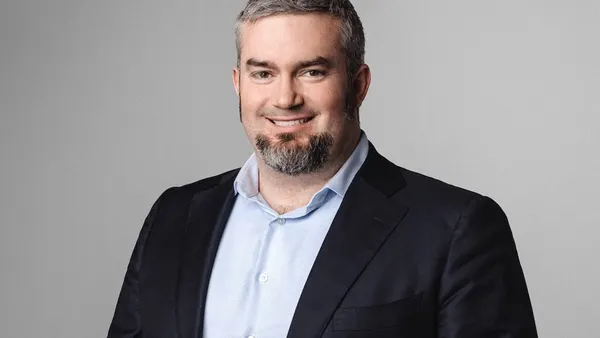
Qubic Labs, host of the annual Boston Blockchain Week, had built future plans around a $1.9 million grant from the Massachusetts Technology Collaborative and a connected $10 million commitment from the city of Quincy, Massachusetts, where the nonprofit is headquartered, said Qubic co-founder Ian Cain.
Cain said the incubator had received the funding previously and was encouraged by the state to apply for it again after ranking highly in – although not winning – a separate competition in November.
But when Mass Tech passed over Qubic for the funding this summer due to its status as a prior recipient, a condition Cain said wasn’t previously communicated to him, he and co-founder John O’Keeffe came up with a different plan: raise funds from within their community, and invite them to “help us envision what comes next,” Cain said.
“The response has been positive,” he told Banking Dive, sharing that Qubic has received cash and in-kind commitments since beginning a fundraising campaign two weeks ago.
But the contributions haven’t been “enough to move the needle,” he said, citing a five-figure dollar amount versus the seven-to-eight-figure dollar amount the incubator lost out on.
Still, “it's been meaningful” that the local fintech community has shared testimonials about and amplified Qubic, “and I think we're on track for what we set out to do with the appeal,” he said. “I don't think we know yet the conclusion of this appeal.”
Cain co-founded Qubic in 2019 because he wanted to see “startup action” in Quincy, his hometown. He and O’Keeffe partnered with a local real estate developer who gave them 14,000-square-feet of office space.
Around the same time, “blockchain found us,” Cain said, when he participated in an education program that was hosted by the state on potential blockchain deployments in cities and towns.
“I saw an opportunity there. I was like, ‘Nobody's built a space for blockchain, and it sounds like this thing's going to be big, and I think there's some things we can do with it. So let's march forward,’” he said.
Qubic has since provided startups, primarily blockchain and digital-asset companies, with a physical space to work out of as well as networking and funding opportunities. It’s supported about 70 companies, helped them raise about $40 million and allowed for the creation of hundreds of jobs, Cain said.
In collaboration with the city of Quincy one of Qubic’s portfolio companies, Blockwise Advisors, led the first municipal bond offering on blockchain in the country in 2024.
“It was a huge deal. That puts the city of Quincy on par with Hong Kong and Lugano, Switzerland, and that's history-making and something that we continue to explore with issuers around the country.”
Boston has a deep history in the tech sector, he noted, as the historic capital of the minicomputer and semiconductor industries. It’s now home to global financial institutions Fidelity and State Street, and with an innovation pipeline through Harvard University and the Massachusetts Institute of Technology, it has high potential to grow as a fintech hub, Cain said.
Building on that goal, Qubic will host Boston Blockchain Week from Sept. 8 to 10, hosting executives from Circle, Coinbase and Offchain Labs, who will be speaking, as well as Taylor Lindman, chief counsel of the Securities and Exchange Commission’s cryptocurrency task force.
Beyond the Boston area fintech community, Qubic has been pursuing partnerships with financial institutions to become external innovations partners, where Qubic would run bespoke accelerator cohorts designed around specific needs and goals.
With capital up in the air, the focus will be “trying to understand at what scale Qubic continues. But we will continue either way,” he said.