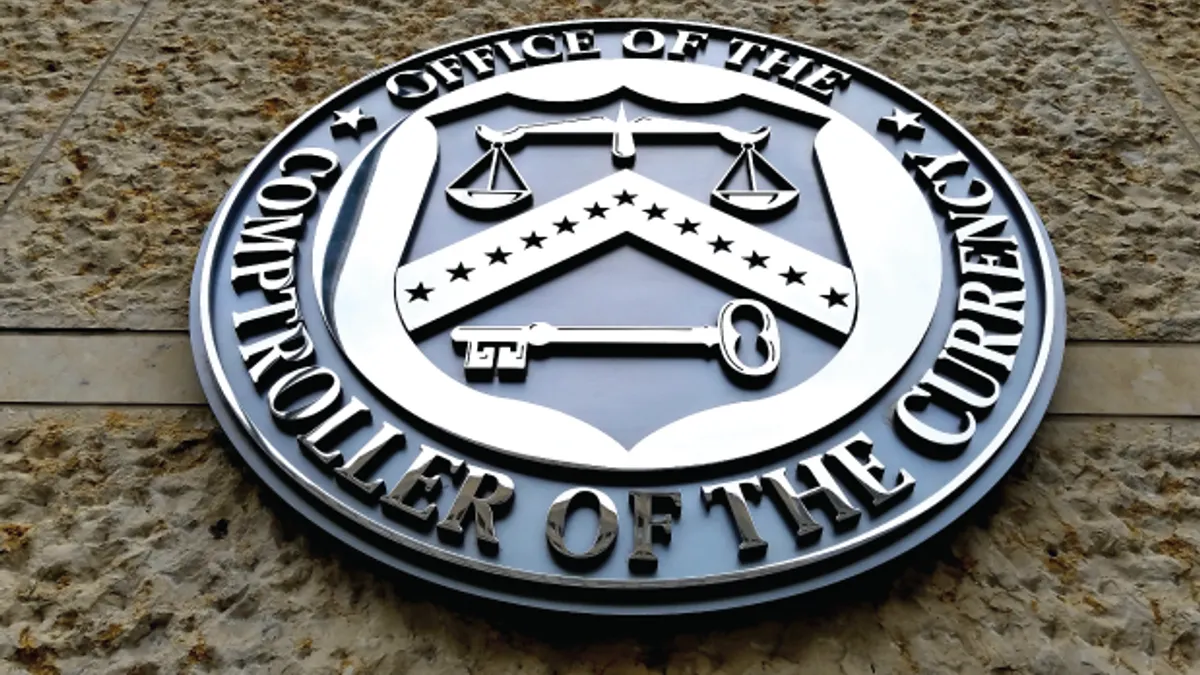
Dakota, a registered money services business that launched a stablecoin offering in January, has applied for a national trust banking charter with the Office of the Comptroller of the Currency, the company said last week.
“For you, that means fewer layers between your product and the financial services underneath it,” Dakota CEO Ryan Bozarth said in a blog post. “Fewer intermediaries mean more control, more reliability, and a cleaner experience for the people you serve.”
The charter “would position Dakota as a federally regulated provider of digital asset custody, stablecoin issuance, and related services, and a partner of choice for corporate and institutional clients building on us,” Bozarth wrote.
It would not, however, let Dakota take deposits.
National trust bank charters have seen a spike in interest under OCC chief Jonathan Gould.
Within the past month, Japanese conglomerate Sony received the OCC’s conditional approval for a trust bank charter, and stablecoin issuer Circle gained full approval after seven months under conditional status.
Not every application gets approved, though. The OCC last month rejected a trust charter application from Wise, saying the U.K.-based fintech raised “significant supervisory and compliance concerns,” notably with regard to actions taken by state regulators over the firm’s anti-money laundering practices. Additionally, organizers didn’t demonstrate “sufficient familiarity” with federal banking laws, the OCC asserted.
Wise plans to submit a new application under a Genius Act framework. That legislation, governing the regulation of digital assets, is set to take effect by January.
Still, some trust charter applications have generated backlash from banking trade groups such as the Bank Policy Institute and Independent Community Bankers of America, as well as the nonprofit National Community Reinvestment Coalition.
Granting trust charters to stablecoin issuers would blur the statutory boundaries of what constitutes a bank, the NCRC said last November.
For one, a trust would not be forced to comply with the Community Reinvestment Act, as banks are, the NCRC said.
For another, a trust wouldn’t be forced to hold deposit insurance, the ICBA said, creating the risk of consumer “confusion” and “harm” if the trust becomes insolvent.
If approved for the charter, Dakota would still rely on banking partners for some services. Lead Bank, for example, provides deposit insurance for the company. If it receives conditional approval, Dakota would have 18 months to build out its operations, get the OCC’s final nod and launch the regulated business.
“There are so many hurdles that make building financial products hard: distributed licensing, compliance that runs as a periodic scramble instead of as code, payment rails never built for programmable or agent-native money,” Bozarth wrote in his blog post. “Instead of working around that, we rebuilt from the foundation and became the layer underneath.
“The application is in. The work continues,” he wrote.