Dive Brief:
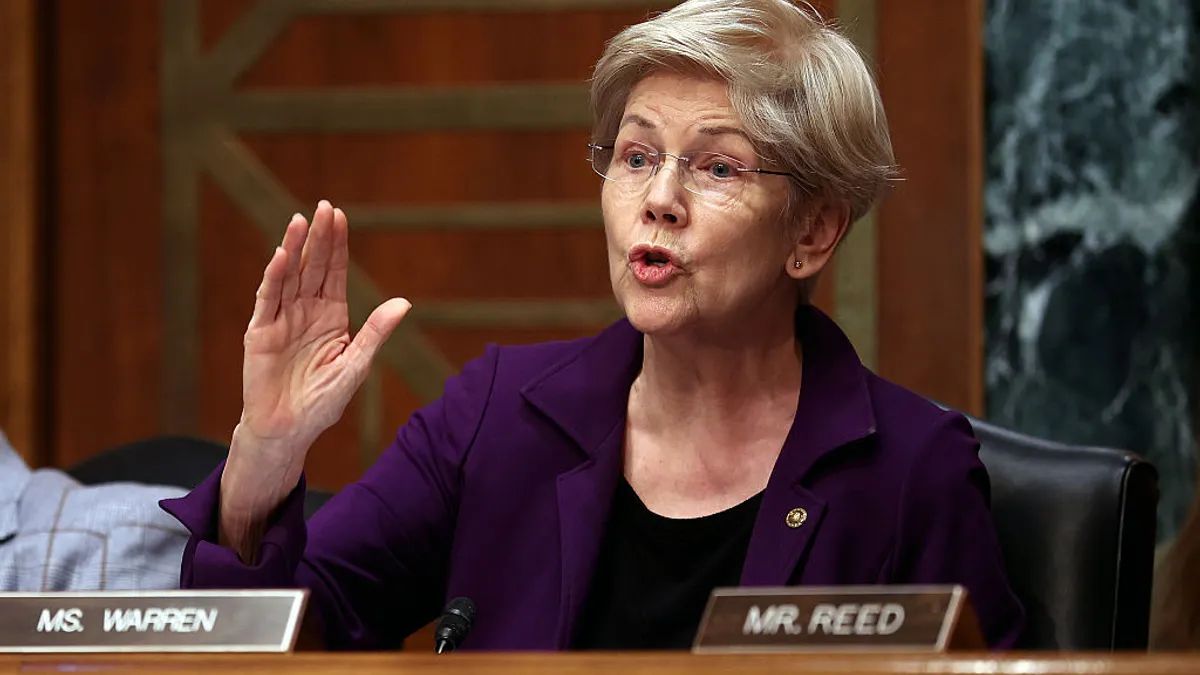
- Sen. Elizabeth Warren, D-MA, and four other Democratic senators are urging the heads of the Federal Deposit Insurance Corp. and Office of the Comptroller of the Currency to withdraw a proposed rule that would shrink the scope of the term “unsafe or unsound” practices.
- The proposal “would limit the agencies’ ability to initiate enforcement actions against banks that take excessive risks or otherwise operate in a dangerous manner,” the Thursday letter said. Warren, the ranking member of the Senate Banking Committee, and Sens. Richard Blumenthal of Connecticut, Jack Reed of Rhode Island, Chris Van Hollen of Maryland, and Sheldon Whitehouse of Rhode Island sent the letter to FDIC Chair Travis Hill and Comptroller Jonathan Gould.
- The proposed rule, issued in October, would “disarm examiners” and “silence supervisors, who are able to identify and communicate risks to banks early — before they fester and become much bigger problems,” the lawmakers warned.
Dive Insight:
The FDIC and OCC said the proposed change would provide greater consistency for banks and “appropriately” focus supervisory and bank resources on the most critical financial risks to lenders and the broader system.
“Lack of clarity” regarding the scope of the term among examiners “could lead to inconsistent application of the terms in communicating supervisory findings,” the agencies said in the notice of proposed rulemaking.
The proposed rule would essentially raise the bar for regulatory enforcement actions issued in connection with safety and soundness, said Patrick Haggerty, partner at financial services advisory and investing firm Klaros Group.
Under the changed definition, “an unsafe or unsound practice would include a practice, act, or failure to act that, if continued, is likely to materially harm the financial condition of an institution” or the Deposit Insurance Fund.
The agencies emphasized the use of the word “likely — as opposed to, for example, merely possible” and underscored “material,” noting “risks of minor harm to an institution’s financial condition, even if imminent, would not rise to the level of an unsafe or unsound practice.”
Warren and fellow Democrats took issue with the proposed changes, which would “severely narrow” the definition and limit banking agencies’ ability to employ supervisory and enforcement tools in response, such as capping bank assets, revoking federal deposit insurance or issuing monetary penalties.
For decades, “unsafe or unsound” has been interpreted to mean any action or lack of action “contrary to generally accepted standards of prudent operation, the possible consequences of which, if continued, would be abnormal risk of loss or damage,” the letter said.
That definition enables banking agencies to step in early to address dangerous conduct before it spirals into a bigger problem threatening the bank’s viability or harming customers, the senators wrote.
The lawmakers faulted regulators’ use of “likely” and “material,” which they didn’t define or provide clear expectations for assessment.
The “likely” emphasis “would seem to prohibit examiners from addressing risky behaviors that could very plausibly cause damage,” and mean they end up ignoring tail risks that could cause “catastrophic harm,” the letter said.
Or worse, the standard won’t be administered at all. “There is often no way to precisely quantify the likelihood that an imprudent act or practice will directly lead to some quantifiable harm,” the letter contends.
The Democrats warned the emphasis on “material” could have “especially troubling implications in the case of large bank supervision. Given the sheer size of a Wall Street bank, waiting for the likelihood of a ‘material’ harm to develop could be catastrophic and put the entire economy at risk.”
The Conference of State Bank Supervisors, which also weighed in on the proposed definition change in a Dec. 29 comment letter, said the final rule should “promote management accountability” if laws or regulations are violated that pose material harm to a bank’s financial condition, operations or customers. And rule finalization should be done in coordination with the Federal Reserve, otherwise lenders supervised by the central bank could face different standards and expectations, the CSBS said.
Last September, Gould said the agencies sought to “hardwire” the definition of what constitutes an unsafe or unsound practice in regulation, to put the risk-based supervision approach both agencies are taking “on firmer ground.”
The proposal “should make us much more focused on material financial risks,” rather than “burying bankers under a deluge of” other issues that serve as “a distraction from focusing on things that really matter,” Gould said at the time.