Dive Brief:
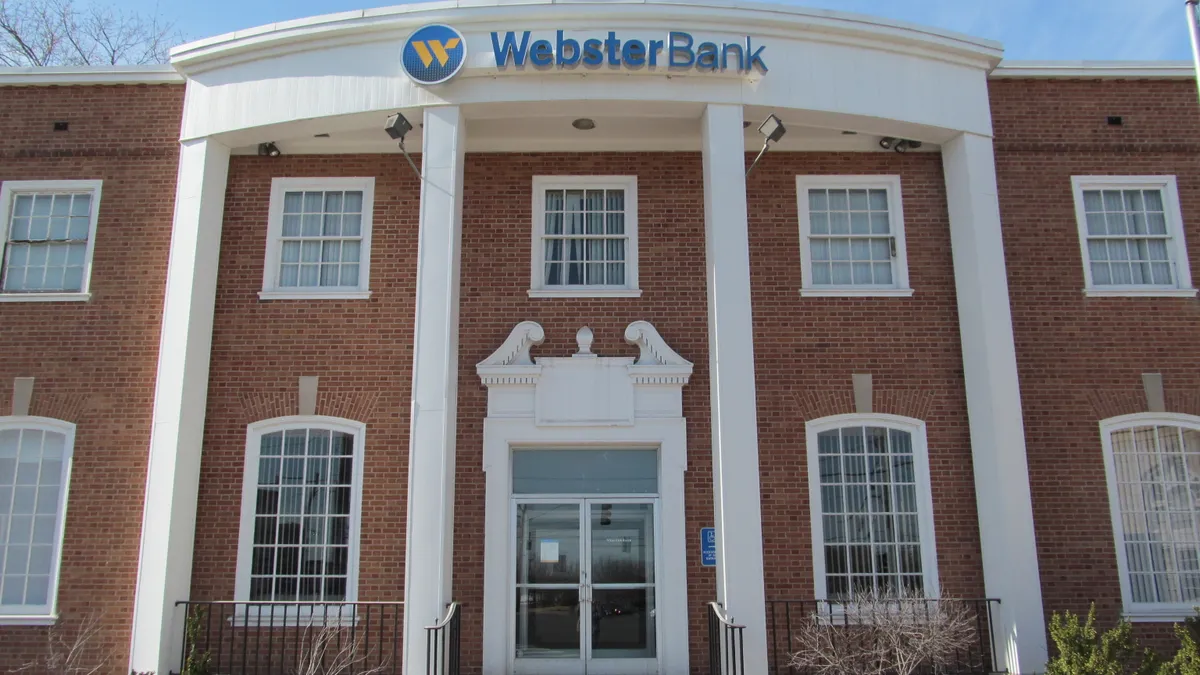
- Banco Santander has agreed to acquire Stamford, Connecticut-based Webster Financial Corporation for $12.3 billion in cash and stock, the companies said Tuesday.
- Under the deal’s terms, $84 billion-asset Webster would become a wholly-owned subsidiary of Santander. Christiana Riley will remain Santander’s country head in the U.S. and the CEO of Santander Holdings USA, while Webster CEO John Ciulla will become the CEO of Santander Bank, N.A., into which all of Webster’s businesses will be integrated, the companies said Tuesday.
- The deal is expected to close in the second half of the year and awaits regulatory approvals in the U.S. and European Union.
Dive Insight:
The transaction’s price tag tops that of last year’s biggest bank deal, Fifth Third’s $10.9 billion acquisition of Comerica.
The Webster acquisition would make Santander a top-10 retail and commercial bank in the U.S. by assets, with about $327 billion in assets, and a top-five deposit franchise in the Northeast, with about $172 billion in deposits, according to a securities filing.
The deal’s value represents a 16% premium to Webster’s 10-day volume-weighted average share price, and is about twice Webster’s fourth-quarter tangible book value. Webster investors will receive $48.75 in cash and 2.0548 Santander American depository shares for each Webster common share they own. The total consideration of $75.59 per Webster share is based on the Spanish bank’s closing stock price Monday. The consideration mix is 65% cash and 35% newly issued Santander shares.
“As a larger organization, we will unlock greater scale, broader capabilities and new opportunities for growth — while remaining deeply focused on the people who define our success,” Ciulla said in the release. “I look forward to joining the Santander team and enhancing our ability to support our clients. As a Connecticut-based bank with deep roots in the region, we also look forward to continuing our commitment to the communities we serve.”
It was “paramount” to Webster’s board to partner with a company “that understands the importance and power of legacy as we do and the value we place on our clients,” Ciulla said.
“We found that shared commitment in Santander and are confident this transaction will create an even stronger partner to help our clients achieve their financial goals,” he said.
Banco Santander Executive Chair Ana Botín called the move “strategically significant for our U.S. business,” offering the Spanish lender greater scale and profitability in the U.S.
The biggest U.S. bank deal in two years – since Capital One’s move on Discover in 2024 – is intended to address Santander’s “sub-scale” in the U.S., Jefferies analyst Miruna Chirea wrote. Still, Santander executives referred to the deal as “bolt-on” for the broader company: The acquisition is equivalent to about 4% of Santander’s total assets.
“Webster is one of the most efficient and profitable banks among its peers and bringing together two highly complementary franchises will expand the products, technology and capabilities we can deliver, with clear revenue opportunities from a stronger, more capable combined franchise,” Botín said.
For Santander, the transaction is projected to bring 7% to 8% earnings accretion and about a 15% return on invested capital, Botín said. The merger is expected to generate combined cost synergies of about $800 million, Santander said in the securities filing.
Luis Massiani, Webster’s president and chief operating officer, will become COO of both Santander Holdings USA and Santander Bank, and lead the integration, reporting to both Riley and Ciulla. “This will ensure continuity of leadership and strong alignment with clients, colleagues, communities and regulators,” the companies said in the release.
Ciulla and Massiani will continue working out of Webster’s Stamford headquarters, which will become “a core corporate office” for Santander, alongside the Spanish lender’s existing offices in Boston, New York, Miami and Dallas.
Ciulla, Massiani and two additional current directors of Webster will join the boards of both Santander’s holding company and the U.S. bank. Tim Ryan will continue to chair the boards of both.
‘Final step change’
Riley was appointed CEO of Santander’s U.S. bank a year ago, during a global restructuring.
On Tuesday, she called the Webster acquisition “a significant step forward in strengthening our commercial banking presence and filling in our retail branch footprint and scale, particularly in Connecticut where we are committed to maintaining a broad branch presence.”
Webster offers consumer and commercial banking and healthcare financial services, including a health savings account that brings low-cost deposits.
Santander’s digital consumer unit, Openbank, launched in the U.S. in October 2024. It has about $5 billion in deposits and about 200,000 customers, Botín said during Santander’s Tuesday earnings call.
Santander has about 379 U.S. branches, while Webster has about 196, according to Federal Reserve data. The two companies have roughly 40% branch overlap within two miles, and 57% within five miles, according to S&P Global Market Intelligence.
Botín has repeatedly said a U.S. presence is a must if a bank wants to be a global player. The purchase is projected to deliver 18% return on tangible equity by the end of 2028 for Santander.
Buying Webster will “bring benefits from economies of scale and a better competitive positioning,” Botín said.
“Being one of the most profitable banks in our core geographies is a key target for Santander, and the Webster acquisition gets us there,” she said. “Webster provides this final step change that we needed in the U.S.”
Santander recently completed the sale of a 49% stake in its Polish unit; proceeds from that were reinvested to improve deposit franchises in the U.K. and U.S., Botín said.
Last July, Santander said it would acquire TSB from Spanish bank Sabadell for £2.65 billion. It may prove “tricky” for Santander to simultaneously integrate both TSB and Webster, while also overseeing a transformation program for the rest of the company, Chirea noted.
M&A surge
M&A activity soared last year, with 181 bank deal announcements, the highest figure since 2021. Faster and more certain regulatory approvals, increasing need for scale and pent-up pressure from low activity earlier in the decade have analysts projecting this year could see perhaps more transactions.
More activity among midsize banks is expected, particularly among those with between $20 billion and $100 billion in assets, Wells Fargo analyst Mike Mayo wrote.
The number of bank deals “should reach the highest in a decade,” Mayo wrote in a Wednesday note.
While Webster had been labeled a potential takeover target, analysts covering U.S. banks seemed surprised by Santander’s move.
“No one had Santander high on the list of potential buyers,” Truist analyst Brian Finneran noted Wednesday.
“We are somewhat surprised to see Santander step in here, given that its last meaningful U.S. bank acquisition was Sovereign Bank in 2009,” Jefferies analyst David Chiaverini wrote Tuesday.
Indeed, M&T Bank had been flagged as the more likely acquirer of Webster, he said, since “it appeared to check the boxes” for deals the Buffalo, New York-based bank would be interested in.
Although a few other banks might be interested in Webster's Northeast footprint, it seems unlikely they would offer similar cash consideration or roles for Webster management as Santander is, Truist analyst David Smith wrote Tuesday. “Hence, we wouldn't put a high chance of a competing bid.”
The closure expectation for the second half of the year represents an “incrementally longer timeframe” than other recent bank deals, Chiaverini said.
“We view this as making sense given foreign bank acquirers tend to face additional scrutiny in obtaining regulatory approval which lengthens the regulatory review process on a relative basis,” he wrote. “This move may signal renewed interest from foreign institutions looking to build scale in the U.S. under a more favorable regulatory backdrop for bank M&A.”
Despite the openness to bank M&A, “it is a fair question if U.S. regulators will love a European bank buying an American one under the current administration,” Truist’s Smith wrote. “But at ~0.3% of U.S. bank assets, it could be small enough to not matter, and of course Santander already has a U.S. bank 2x as large as Webster.”