A new artificial intelligence-powered “team member” in Citi’s wealth unit is poised to draw in new customers and bolster the bank’s knowledge base about its clients, said Joe Bonanno, head of wealth intelligence at Citi.
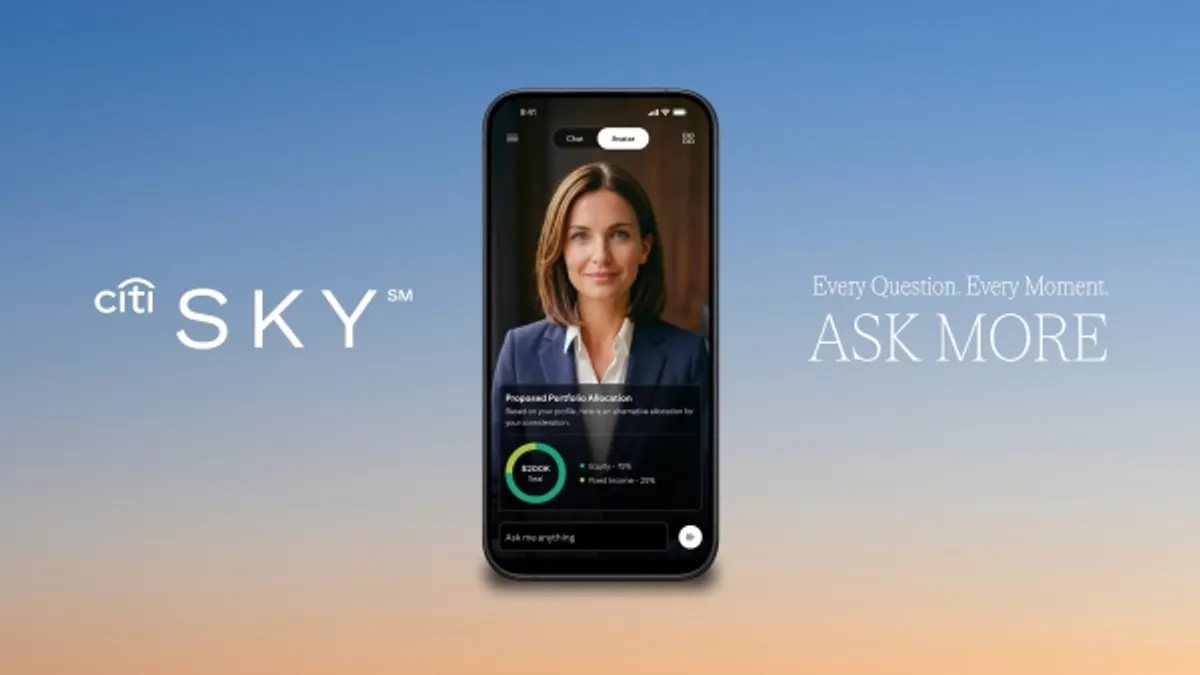
Citi Sky, an “always-on” AI tool that can engage with clients like an adviser, was unveiled last week at a Google conference. The feature was developed with Google’s Cloud and DeepMind technology. That followed an announcement earlier in April highlighting new AI-powered tools the bank has built for wealth advisers, designed to help them provide “a more proactive, data-driven and personalized client experience.”
Sky is in an initial phase and will be rolled out to U.S. Citigold clients this summer, before being enabled for other wealth divisions, Bonanno said. The bank declined to say when subsequent phases would be launched.
After Citi announced the development at the conference, working moms approached executives to express interest in the agentic AI tool, for its ability to provide bank advice after business hours, Bonanno said. “They were like, ‘Wow, you mean I can actually talk to somebody at 9, 10, at night?’” he said.
“We didn't really think about that opportunity,” Bonanno said in a recent interview. “This is opening up new segments.”
New York-based Citi has been keen to drive stronger growth in its wealth segment, and Andy Sieg, the lender’s head of wealth, has emphasized a greater focus on “frontline productivity.” In the first quarter, the bank’s wealth revenue grew 11%, to $3.1 billion.
Last year, Sieg also said ongoing efforts to modernize Citi’s technology put it in a position to “leapfrog” competitors.
The bank’s wealth unit has about $1 trillion in assets under management, although $5 trillion of client funds are held elsewhere, Bonanno said. To draw some of that amount to Citi, “we would probably have to hire thousands of financial advisers,” he said.
But Sky’s ability to converse with clients and take care of certain tasks “allows us to go faster, but also dip into that wallet share,” he said.
Financial advisers tend to have hundreds of clients they typically call quarterly or maybe monthly, but clients may want guidance more often than that. Sky can field basic questions to free up some adviser time, Bonanno said. Plus, some clients hesitate to ask certain questions of advisers, so the tool offers another way to engage.
Sky’s information-gathering abilities are crucial for the bank, he noted. If clients check in more often using the tool, that’s feeding information into the bank’s knowledge base more frequently, which he said can lead to better customer service.
“It’s also making our advisers smarter, because it’s building up this corpus of knowledge on people’s goals and objectives and interests, or things that they might not say directly to the adviser,” Bonanno said.
Sky, as well as CitiScribe, an AI note-taking tool for advisers rolled out for advisers in North America in the first quarter, generate data that the bank can mine to pitch clients other products and services. That “anticipatory intelligence” can help an adviser be more effective by talking to clients about things they need in the current moment, he said.
“For us, this is really about how do we get more market share from our existing clients, but then how do we organically grow? It's all about cross-sell, up-sell and retention of clients,” Bonanno said.
Discussions are underway to use Sky more broadly across the bank, he said, “especially with the credit card business.” Bonanno expects broader use within the bank in 2027.
“This is a wealth-first kind of product, and then we want to surround it with these other products within Citi,” he said. “We look at a client as a client, and we don't want to have different experiences or different chatbots.”
‘Let’s get everybody involved’
Big banks have been eager to implement AI with the aim of becoming more efficient and boosting revenue. Bonanno said Citi sees its use of the agentic technology as “disruptive” and a differentiator for the bank.
Citi began working on the tool about six months ago, Bonanno said. Sieg was “intimately involved,” Bonanno said, as were delegates from various departments and businesses within the bank.
To avoid bottlenecks during the process, “this was one that we knew from the beginning, let's get everybody involved,” including legal, risk and compliance, Bonanno said.
Noting the extensive amount of time spent testing the tool, Bonanno said financial advisers engaged with Sky to ensure responses align with what advisers themselves would say, as well as with clients’ risk tolerances and investment objectives.
In milliseconds, the response to a client’s question – provided by a Google large language model – is passed through a series of controls, standards and policies; fed through a Citi enterprise engine to ensure the absence of bias; and matched to meet that individual client’s goals and needs, Bonanno said.
Testing is ongoing and Bonanno’s team continues to make enhancements. In its initial phase, Sky can look up clients’ holdings and positions in investment portfolios, inform them of certificates of deposit coming due and offer thought leadership based on the bank’s research, Bonanno said.
The bank’s unique relationship with Google DeepMind, which helps build AI systems, enabled Citi to develop the tool more quickly, he said.
Citi opted to go with a human avatar after extensive research revealed “it was overwhelmingly positive to go with something that you can see and engage with,” he said. Clients do, however, have the option to turn off the avatar and simply text chat.
Sky can also “see,” he said, so if a client reacts to a portfolio development, Sky can interpret that and say something that puts a client at ease, for example, Bonanno said.
Sky operates in English and Spanish, but over time, the bank will be able to offer the tool in 100 languages, he said.