The Justice Department on Friday accused two fired members of the National Credit Union Administration board of “scouring legislative history, statutes no longer in effect, and the zeitgeist of the 1970s” to persuade a district court to reinstate them.
In urging the D.C. Circuit Court of Appeals to reverse that reinstatement, the DOJ reached much further back than the 1970s, quoting James Madison, Alexander Hamilton – and a Supreme Court case from 1903.
“‘In the absence of [a] constitutional or statutory provision’ explicitly to the contrary, the longstanding constitutional rule is that ‘the President can, by virtue of his general power of appointment, remove an officer, even though appointed by and with the advice and consent of the Senate,’” the DOJ argued Friday, quoting the turn-of-the-20th-century case Shurtleff v. U.S. “When ‘no statute restricts removal,’ ‘there can be no doubt’ that the President as the appointing authority may remove NCUA Board Members ‘at will.’”
President Donald Trump in April 2025 fired Todd Harper and Tanya Otsuka, two Democrats serving on the NCUA board. But Harper and Otsuka sued Trump, arguing their ouster left the board with just one member, which didn’t qualify as a quorum.
A district judge reinstated them in July of that year. But since then, the eyes of the legal community have been trained on the Supreme Court’s rulings on Trump’s attempts to fire Federal Trade Commission members (allowed) and a Federal Reserve governor (denied).
In a July motion to the appeals court, Harper and Otsuka argued the NCUA was modeled after the Fed, affording it the same independence as the central bank and shielding board members from at-will firings by the president.
The DOJ on Friday blasted that notion.
“While plaintiffs try to analogize themselves to the Federal Reserve Board of Governors, that analogy fails on its own terms because Congress explicitly provided for statutory restrictions for the Federal Reserve … but did not do so for the NCUA,” the DOJ wrote. “In all events, the NCUA is not the Federal Reserve.”
The DOJ asserts that Harper and Otsuka “argue that Congress should be understood to have implied removal restrictions for the Board without bothering to have enacted any.”
“Plaintiffs’ argument gets things exactly backwards,” the DOJ wrote.
The DOJ may not agree with the Supreme Court’s decision exempting Fed Gov. Lisa Cook from Trump’s attempted at-will firing, but it held up the case Friday as an exception to the rule.
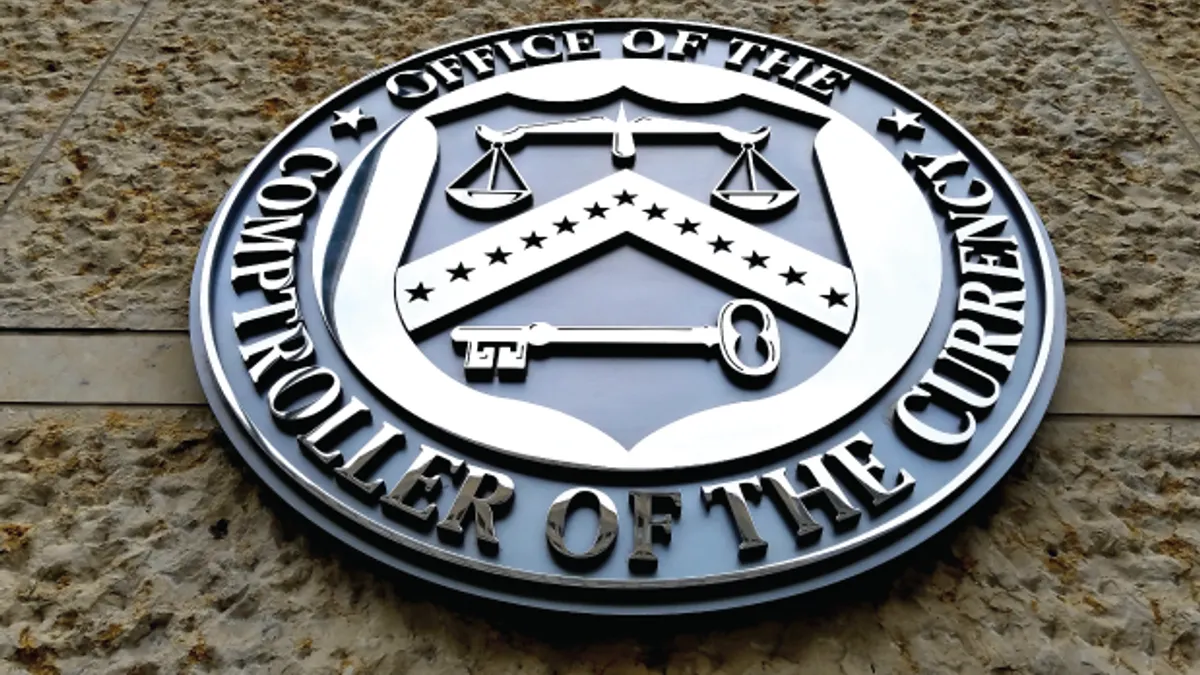
The “singular tradition” of shielding Fed board members “does not extend to all federal financial regulators,” the DOJ wrote Friday. “The Secretary of the Treasury does not enjoy political insulation from the President even though the Secretary’s decisions regarding Treasury securities can affect interest rates or the implementation of monetary policy. Nor does it extend to the Office of the Comptroller of the Currency.”
The DOJ cited Madison, who referred to the comptroller of the currency when he wrote, “There may be strong reasons why an officer of this kind should not hold his office at the pleasure of the Executive branch.”
“The Constitution demands,” the DOJ wrote, again citing Madison, “that these executive officers must ‘be dependent upon the President because [they] can be removed by him.’”
The district court erred by reinstating Harper and Otsuka, the DOJ argued.
The Cook ruling established that “courts of equity would ‘not interfere by injunction,’” the DOJ wrote. “Instead, a court’s equitable powers were limited to orders allowing an officer to proceed “de facto, * * * pending a litigation at law to determine their title.
“Put another way, a court of equity could issue injunctive relief to allow a plaintiff to ‘remain in office during the pendency of litigation,’ but the court of equity ‘could not finally determine whether a plaintiff was validly removed,’” the DOJ wrote.