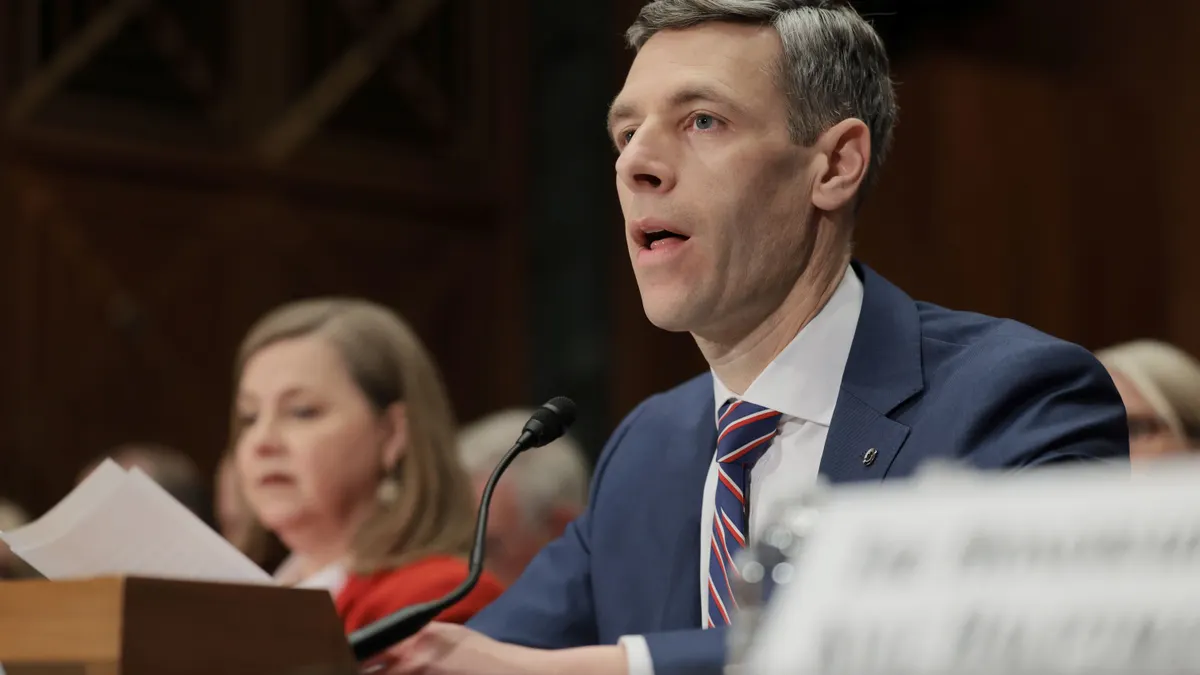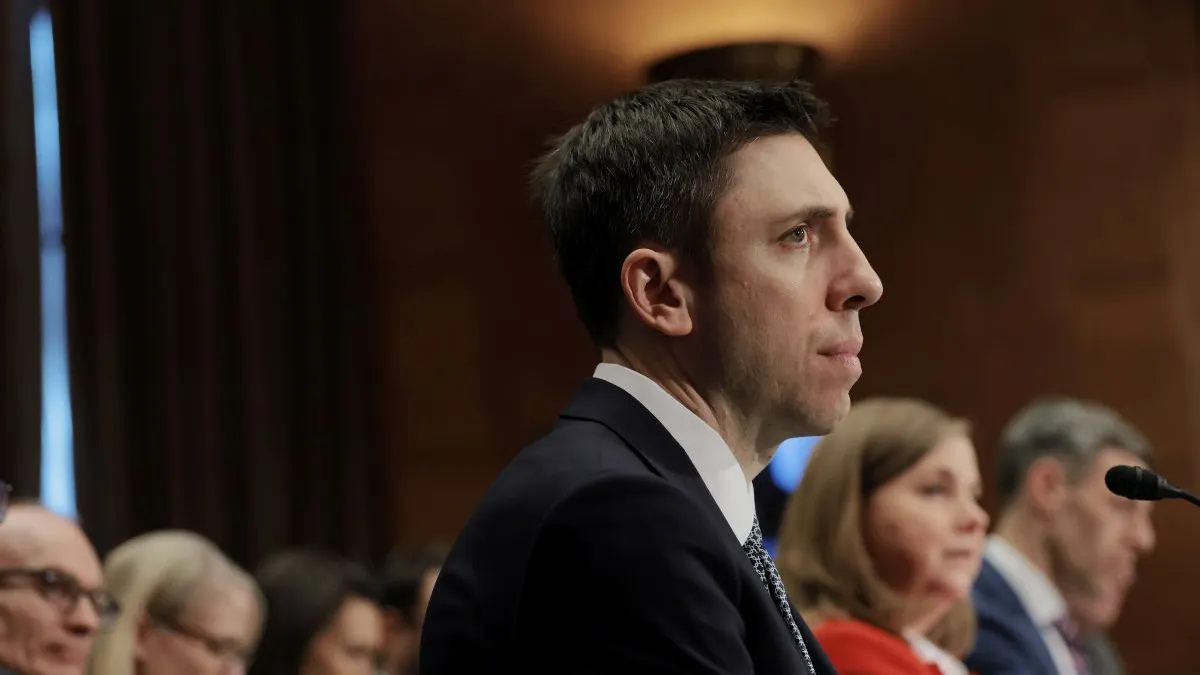
Federal Deposit Insurance Corp. Chair Travis Hill pushed Tuesday for a revamp of the planning that banks must do in case of failure.
“I am skeptical of the value of requiring institutions to prepare lengthy narrative plans discussing proposed resolution strategies and hypothetical failure scenarios,” Hill told the U.S. Chamber of Commerce. “Instead, our focus should be on maximizing an optimal resolution outcome while being prepared in the event that option proves unavailable.”
In his speech, Hill outlined five changes he said the FDIC is considering.
1. A ‘resolution readiness adjustment’
The FDIC plans to allow larger banks to take a downward adjustment to their quarterly deposit insurance assessment if they can prove they’ll let the agency quickly access data in the event of a failure. Banks can do that by either populating a virtual data room or by letting the FDIC temporarily access the lender’s third-party service providers or internal systems, allowing the regulator to build IT infrastructure.
Either scenario “is likely to lower the cost of a bank’s failure, and therefore should result in a lower deposit insurance assessment,” Hill said Tuesday.
2. Changes to the assessments framework
The FDIC plans to raise – from $10 billion – the threshold for banks subject to the large bank scorecard to better reflect “the scale, complexity and risk profile” of institutions covered under that framework, Hill said.
The agency also aims to reduce assessments by two basis points for banks subject to the small bank scorecard, Hill said. The reduction will be smaller for large bank scorecard institutions, but those banks could narrow the gap by opting in to the resolution readiness adjustment described above.
The FDIC expects to continue to build up its reserve ratio to meet its long-held target of 2%, Hill said. That ratio now sits at 1.43%.
Bank failures “are not evenly distributed over time,” Hill said.
“Losses may be very modest for extended periods, and then explode during crises,” he said. “This creates a challenging balancing act in determining the appropriate size of the Deposit Insurance Fund.”
The agency strives to build up the DIF so it won’t have to raise assessments during a crisis. At the same time, assessments “effectively take funds away from lending and investing in the real economy” – rather, diverting them toward “financing the federal government,” Hill said.
3. The ‘least cost’ test
The FDIC has been talking with lawmakers on the prospect of a de minimis exception to the requirement that the agency choose the bank failure resolution that is least costly to the DIF, unless systemic risk is determined to be too great.
To make his case, Hill cited the failures of First Republic, Signature and Silicon Valley Bank, for which, he said, the difference between winning bids that included only insured deposits and the lowest-cost options that included all deposits “were $754,000, $1.2 million, and $3.6 million.”
“By contrast, the current estimate for covering uninsured deposits at Silicon Valley Bank is $16.6 billion,” he said. “To put that in perspective, the cost of choosing transactions that covered uninsured deposits at all of those three small banks would have cost less than one-twentieth of 1% of the cost of covering uninsured deposits at SVB, and less than one 200th of 1% of the DIF’s net worth.”
A de minimis exception, Hill said, “would help mitigate the perception of a two-tier deposit insurance regime, where uninsured depositors take losses at small banks but not large banks, by allowing the FDIC to choose an all-deposit bid when the difference in cost to the DIF is essentially a rounding error in the overall cost of bank resolutions.”
“Imposing losses in such cases can have a material impact on a local community, and on community banking as a business model, while saving tiny amounts for the DIF,” he said.
4. Boosting private capital’s role in failed bank bids
Hill on Tuesday outlined ways the FDIC is making it easier for nonbanks to participate in the bidding process, in the name of increased competition and a lower cost to the Deposit Insurance Fund.
The FDIC rescinded the 2009 policy statement that set several restrictions on private investors. The regulator has also reached out to the Office of the Comptroller of the Currency and Federal Reserve to allow an emergency exception so a “shelf charter” – to purchase a failed bank outright – can be created quickly after a failure.
Additionally, the FDIC has been conducting a pilot to qualify a group of nonbank investors to bid on asset pools from certain failed banks at the time of failure and be eligible for seller financing, Hill said. The agency expects to open the pre-qualification process for that this year, he added.
5. Resolution contracting
The FDIC wants to tweak its contracts for financial advisers that help with the marketing and sale of failed institutions.
The agency “has a roster of several firms approved to provide services,” Hill said Tuesday. But “many of the most highly regarded firms have either not been invited to participate due to internal FDIC policies or chose not to participate” because the process is “too difficult, rigid, lengthy or opaque.”
The FDIC plans to issue a new solicitation to a broader set of firms in the coming weeks, Hill said.