Marianne Lake doesn’t expect agentic commerce to take off soon.
The CEO of JPMorgan Chase’s consumer and community banking business on Tuesday noted artificial intelligence platforms and summaries have been quickly adopted for the search and discovery process in online purchasing because they’ve removed friction.
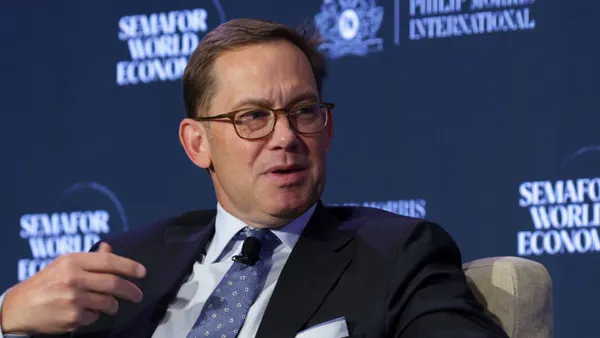
However, “what we're not seeing is that that's moving into the transaction part of this,” Lake said during an appearance at a Morgan Stanley investor conference, referring to AI agents making purchases on consumers’ behalf.
She expects that to continue, potentially long term. “Because when people are moving money, things change,” she said. “Trust and security matter even more.”
“I don't think people are going to delegate their purchasing to agents just yet,” she said.
Customer protections need to be preserved, as do consumer payment preferences for methods such as cards or digital wallets, and the bank is working to ensure those remain with agentic-enabled commerce, she said.
That includes establishing that “humans in the loop for things that matter are still present, that there's transparency on what is being done by agents, and that there's a liability framework that works, if an agent makes a mistake,” she said. AI platforms recognize investments made in the consumer payment ecosystem “are important and complex.”
Lake contrasted that scenario with travel arrangements, where it’s “still very complicated to do the discovery and figure out how to bring together the flights and the hotels and the itinerary, and do the itinerary, and when something changes, how do you manage it, and how do you deal with disputes?”
With JPMorgan’s platform, data and partnerships, it sees room to use agentic AI to help customers execute those tasks more easily, beginning with the bank, she said.
The New York City-based lender aims to have a consumer-facing travel agent in pilot before the end of the year, she said.
“You've got to look for the problems to solve, and where there is no problem, I'm not saying you can't improve experiences, but it's not going to be the thing that scales rapidly,” Lake said.
As AI transforms the industry, it’s reducing barriers to entry, which may lead to more competitive threats, she said. But it’s also an equalizer helping the biggest U.S. bank move at the speed of fintechs or new entrants, and modernize and develop things more quickly, she added.
“As long as we continue to make sure that we're taking advantage of all of the opportunities that AI brings, to make our teams more productive, to improve the customer experience, to leverage our data advantage, to modernize our infrastructure, then I actually think that this may level the playing field in our favor on speed,” Lake said.
Meanwhile, many of the bank’s differentiators, such as its brand, are “AI-resistant,” she said. Trust, security and customer protections will matter even more in an AI-enabled world, she said.
The bank’s consumer business continues to push for a 15% share in U.S. consumer deposits by expanding into new markets, building and refreshing branches, and investing in marketing and products. It’s an effort Lake said “won’t be linear, and the last hundred basis points will definitionally be harder.”
JPMorgan is also chasing growth with younger and small-business customers in both banking and cards, and in its Chase Private Client segment.
“We can find plenty of places where we are not No. 1 or No. 2, and in some cases, not No. 3,” Lake said.
The competitive landscape of the last decade has “people looking to disintermediate us from our relationships faster than we can fix the problems that exist,” Lake said. “So far so good, for us.”
Competitors “look for chinks in our armor,” including “customer segments that we're not supporting as well as we should, or the product, or the experiences that aren't working the way they should,” Lake said.
JPMorgan scours its trove of customer data to fend off competitive threats, she said.
“It is our job to interrogate that data to find out what our customers are telling us through their behaviors that we aren’t doing well for them, and to fix those things,” Lake said.