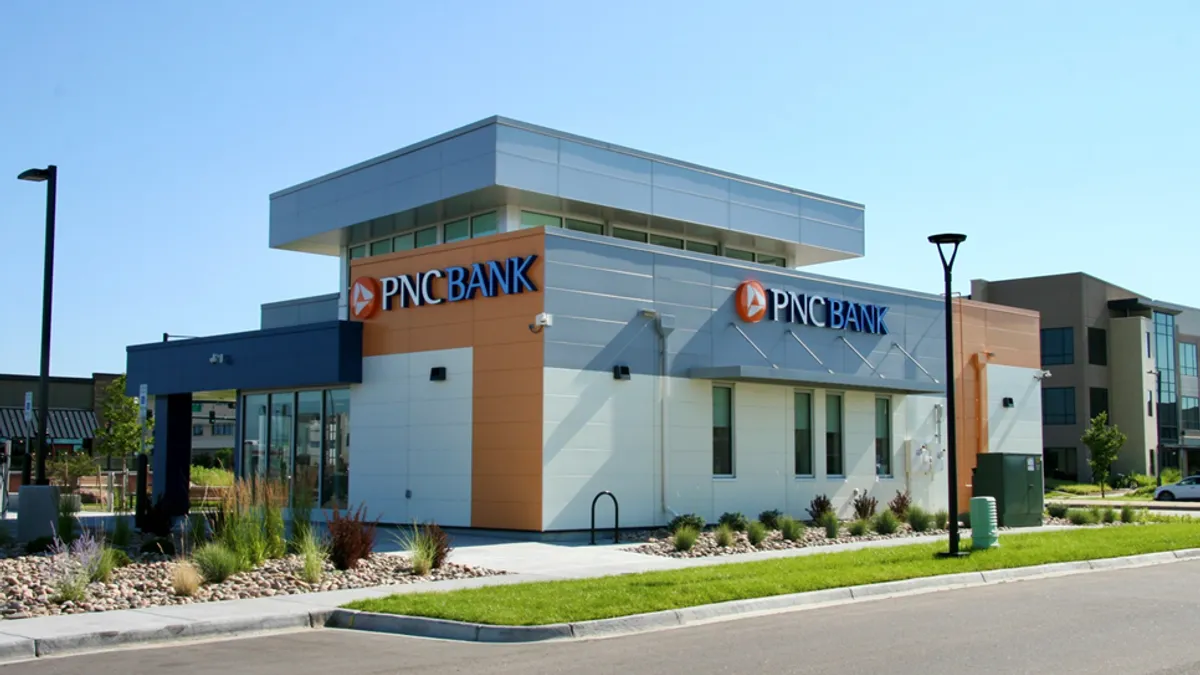
The Federal Reserve approved PNC’s application to acquire Colorado-based FirstBank, the central bank said Thursday.
The green light for the $4.1 billion deal – which would triple PNC’s presence in Colorado and expand it in Arizona, too – came 94 days after the bank announced the transaction.
The timeline from deal announcement to regulator sign-off has quickened significantly under the second Trump administration, as expected.
Republican lawmakers, even before President Donald Trump’s reelection, had called for regulators to abide by a “shot clock” of sorts to prevent deals from entering a “purgatory” of evaluation and indecision.
During the Biden administration, at least one deal with a value close to that of the PNC-FirstBank tie-up – Columbia Banking System’s $5.2 billion merger with Umpqua Bank, announced in October 2021 – took more than 16 months to close.
By this spring, several billion-dollar bank deals had found approval by the nine-month mark or less; some of those were proposed with Biden-era regulators in place and approved under Trump-era ones. Mississippi-based Renasant’s $1.2 billion acquisition of The First Bancshares, proposed in July 2024, took eight months to approve. UMB’s $2 billion acquisition of Heartland Financial took nine. Atlantic Union Bank’s $1.6 billion acquisition of Sandy Spring wrapped in just over five months.
The PNC approval fits well within the early-2026 timeline the bank projected for the deal to close. The development also comes just two days after PNC CEO Bill Demchak pushed back against the deal’s detractors, who may have questioned the $4.1 billion price tag given the accompanying 3.8% tangible book value dilution and 3.3 year earnback period.
“You have bank deals getting done saying, hey, I have no tangible book value dilution, but, oh, I’m stopping share repurchases for the next 20 years, and I just bought this crappy-ass franchise that isn’t going to make me any money,” Demchak said Tuesday at the Goldman Sachs U.S. Financial Services Conference. “You want to buy a good franchise where you get a good return on what you bought.”
Indeed, Demchak has repeatedly defended the deal for its quality and not just its geographic significance in PNC’s push to go coast to coast.
“If you asked me a year ago if a small bank existed that looked like this one … I probably would have said, no, they’re all kind of broken and put together from old [Federal Deposit Insurance Corp.] deals,” he said in September. “Yet, here this is.”
The FirstBank deal is set to push PNC, the nation’s ninth-largest bank, to $590 billion in assets, the Fed said in its approval order Thursday. It is slated to close 14 existing branches and consolidate four, over their proximity to FirstBank locations. FirstBank, for its part, counts roughly $26.6 billion in assets, the central bank said.
PNC received 14 comments of support during the deal’s public comment period, versus two against – both alleging the Pittsburgh-based super-regional approved fewer home loans to Black borrowers compared with white borrowers nationwide, based on Home Mortgage Disclosure Act data. PNC, however, received an “outstanding” rating in Community Reinvestment Act evaluations.
The PNC approval presumably bodes well, too, for other multibillion-dollar bank deals among 2025’s Mount Rushmore. PNC-FirstBank is the smallest of four tie-ups valued at $4 billion or more that were announced between July and October. The others are Fifth Third’s pending acquisition of Comerica for $10.9 billion, Synovus and Pinnacle’s $8.6 billion merger of equals, and Huntington’s proposed purchase of Cadence Bank for $7.4 billion. The Fed approved the Synovus-Pinnacle deal last month.
In a conference appearance Wednesday, Fifth Third CEO Tim Spence confirmed as much, saying, “The experience we’re having is consistent with what we have been hearing from others who were ahead of us in line, in terms of these transactions moving through in a sort of 90 day-ish type time frame.”
The green light also comes at a time of year when, at least recently, regulators appear to push through an increased amount of pending paperwork. In December last year, the Fed approved SouthState’s $2 billion acquisition of Texas-based Independent Bank Group. On the same day, the central bank signed off on Scotiabank’s deal to take a 14.9% stake in KeyBank. And in January, the Fed signed off on UMB Financial’s $2 billion acquisition of Denver-based Heartland Financial.
Acquisition is just one prong to PNC’s growth strategy, though, and to that end, the bank last month said it would expand the number of new branches it plans to build – to 300 by 2030, instead of a previous goal of 200 by 2029.
Demchak has been outspoken about the need for scale to compete with the nation’s biggest banks, JPMorgan Chase and Bank of America. And he’s determined to double PNC’s size. But Demchak has also said the bank isn’t looking to pay “a silly price” for a “busted” franchise.