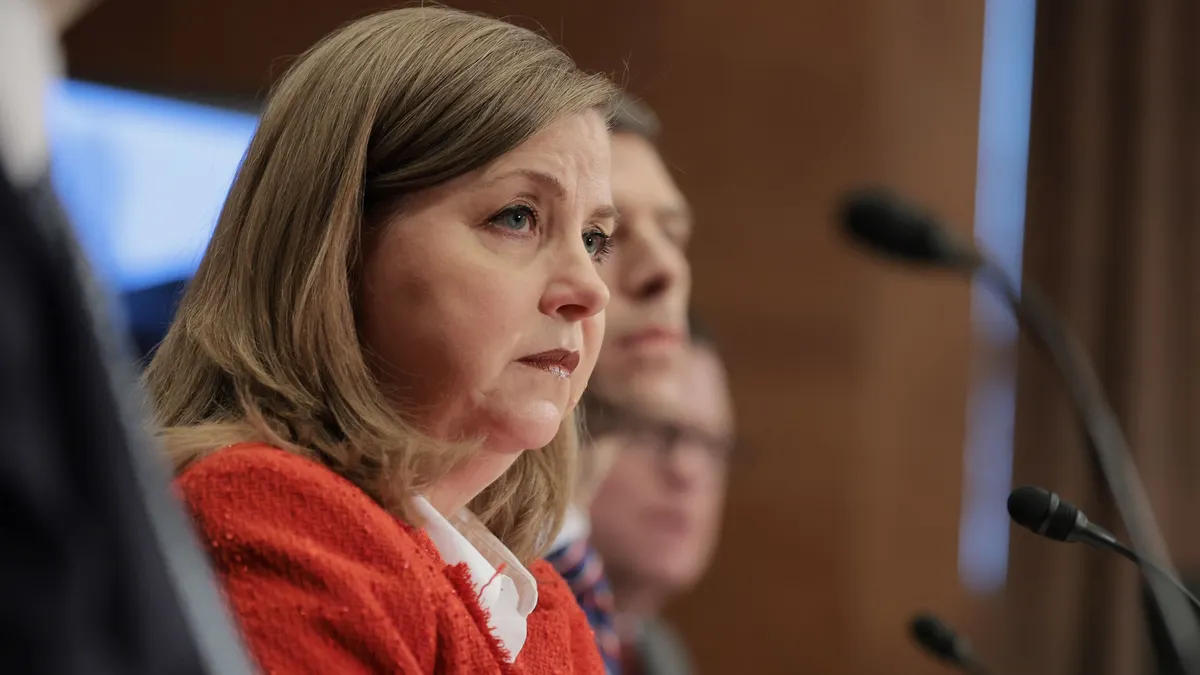
The Federal Reserve has launched a new data-collection effort intended to provide more transparency on banks’ lending to the private credit sector, the central bank’s vice chair for supervision, Michelle Bowman, said Thursday.
Bowman, who was among several regulators to testify Thursday to the House Financial Services Committee, noted the data collection as some lawmakers expressed concern over a lack of information on banks’ exposure to the private credit market.
Rep. Ritchie Torres, D-NY, asked Bowman whether an April letter the Fed sent to U.S. banks inquiring about their financial exposure to private credit was “an admission that the Federal Reserve has insufficient visibility” into the full extent of the issue.
And Rep. Juan Vargas, D-CA, expressed concerns about the interconnectedness between private credit and the rest of the financial system, and the “gap in data” that surrounds it.
Bowman said “a number of opacities” exist between bank involvement and where funding ends up in the nonbank space.
“This is an important issue that we’ve been looking very deeply into and trying to work with our regulated financial institutions to get a better sense of what the bank investment is into the private credit space,” she said. “Since it’s quite opaque, it’s difficult to know.”
The Fed introduced the data-collection effort last month “to understand exactly where those investments are going outside of the banking system,” Bowman said.
That should afford more transparency and specificity on how bank funding is being used in the private credit space, she said, adding it hopefully will “provide us with a much better view on where the vulnerabilities might lie.”
“We have seen a rise in the investment from banks into NBFIs in particular, but it’s been very difficult for us to have a clear understanding of where those funds have been flowing,” she said.
Moody’s has estimated U.S. banks’ private credit exposure is about $300 billion, as part of more than $1.2 trillion in loans extended to non-depository financial institutions broadly. The private credit market is about $2 trillion globally, the Financial Stability Board said last month.
When Vargas pressed Bowman on whether private credit poses a problem, given the mushrooming size of that market, she said it’s still a “very small proportion of the lending categories within the banking system.”
“But it is something that we need to know more about because it’s very opaque, which is exactly why we’re asking for more information from our regulated institutions,” she added.
Bowman referenced “bankruptcies and challenges last fall with several private credit funds,” due to poor collateral management, fraud or lack of clear disclosures.
Bankruptcies of subprime auto lender Tricolor and auto parts maker First Brands burned some banks, including JPMorgan Chase, Fifth Third and Jefferies. The situation prompted JPMorgan CEO Jamie Dimon’s October remark that “when you see one cockroach, there are probably more.”
When Torres asked how to frame the private credit problem, Bowman pointed to underwriting quality.
“If you’re looking at a particular industry that may be more vulnerable to shocks, or erosion of its previous positioning, then you should take that into account as you’re trying to understand how you should structure a loan,” she said.
Private credit firms have become both clients and competitors for banks, which have “ceded significant lending turf to alternative asset managers on the back of more stringent regulations following the 2007-08 financial crisis,” Moody’s said.
On Thursday, Bowman referred to that consequence and said regulators are trying to reverse that trend.
“What we’re trying to do with some of the capital rules, especially with Basel III, was to bring some of that activity back into the banking system so that we have a much better view and an ability to supervise that activity,” she told lawmakers.
Although it’s unclear whether the data the Fed will gather will become publicly available, “this echoes concerns we have raised,” including rising private credit defaults and rapid growth, said JPMorgan Securities analyst Vivek Juneja.
“Opaqueness in private credit remains a big challenge,” he wrote in a Friday note.
Wells Fargo has the highest exposure to private credit among big banks, followed by Citi and Bank of America, he wrote. Among regionals, KeyCorp has that designation.
“There is some gradual increase in private credit defaults and in companies at risk of default on their private credit loans, but data is scarce, opaque, and hard to reconcile,” Juneja wrote.