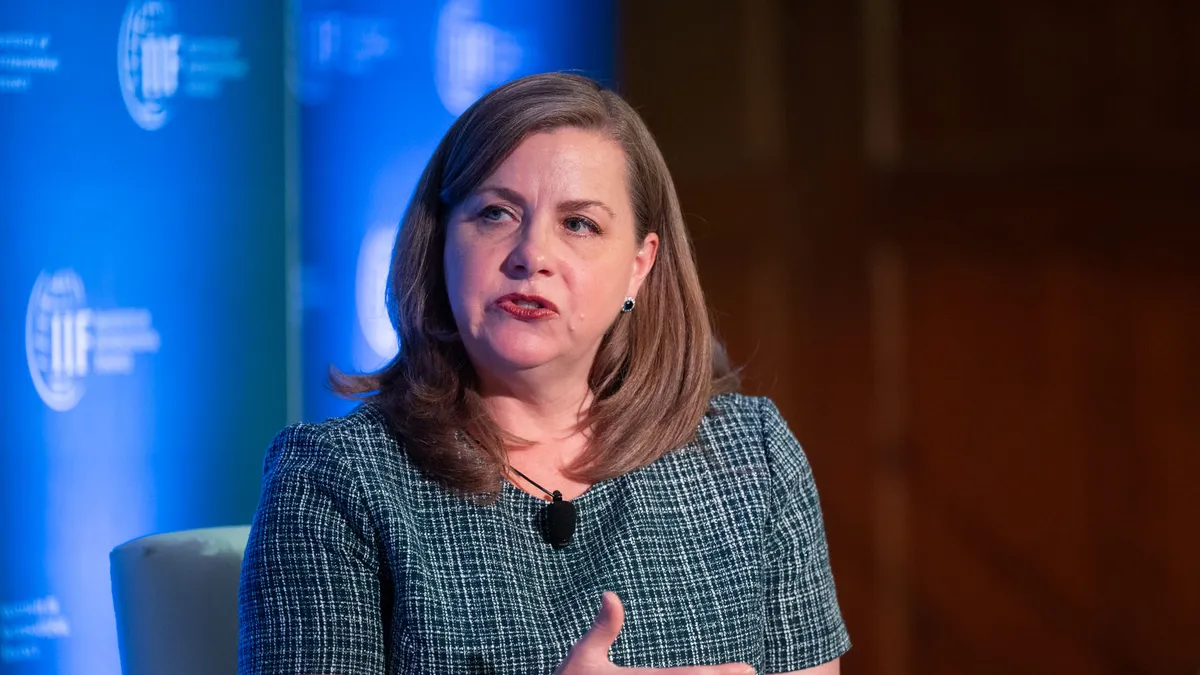
Banks’ capital requirements will decrease “by a small amount” under proposals set to be published “in the coming week” by the Federal Reserve, the central bank’s vice chair for supervision, Michelle Bowman, said Thursday.
The proposals, to be issued jointly with the Office of the Comptroller of the Currency and the Federal Deposit Insurance Corp., will represent an initial draft of Republican-led changes meant to align U.S. banks’ capital requirements with the Basel III standard. Republicans in 2023 and 2024 dashed successive proposals, floated by Bowman’s Democratic predecessor, that would have boosted the biggest U.S. banks’ capital requirements by 19% and 9%, respectively.
Basel-aligned tweaks this time will increase requirements slightly for the largest banks. But that will be offset by a “modest decrease” in the surcharge that global systemically important banks pay, Bowman said Thursday at the Cato Institute.
Smaller banks “will see slightly larger reductions in capital requirements,” she said.
Taken together, the proposals are meant to allow banks to engage in lower-risk activities – pointedly, they would reduce incentives for mortgage origination and servicing and commercial lending to migrate to nonbanks, Bowman said.
The revised framework doesn’t add new capital penalties for mortgages or consumer lending and seeks public feedback on the appropriate role of private mortgage insurance, she said.
The proposals also remove the requirement to deduct mortgage servicing assets from regulatory capital. Rather, they assign a 250% risk weight to those assets, Bowman said.
Operational risk standards would be tailored to large banks. Revenues and costs for heavily fee-based activities – credit cards, for example – would be accounted for on a net basis, in a change from the Basel standard, Bowman said. Proposed requirements for wealth management and custody services have been recalibrated to reflect those activities’ typically lower risk, she said.
The Basel III proposal, for its part, eliminates “duplicative capital calculations for the largest banks,” Bowman said.
The proposal, she said, establishes a single risk-based capital ratio to replace the two-calculation system that exists – one that uses a standardized approach and another that factors in internal models.
A revised approach to market risk includes a standardized calculation meant to reduce the burden for banks with simple trading activities. Market risk methodology, meanwhile, better captures losses under stressed conditions and reflects the risk of less liquid positions, Bowman said.
Among other changes, large banks would have to include elements of accumulated other comprehensive income in their common equity tier 1 capital. The change, though, would have a five-year phase-in to stave off “material immediate increase in capital requirements,” Bowman said.
Next week’s revisions would update the coefficients that drive the calculation of individual banks’ G-SIB surcharge. The Fed pledged in 2015 to review those coefficients regularly, but it hasn’t – causing the calculations to increasingly diverge from international methodology, Bowman said.
The G-SIB surcharge calculation will also contain revisions tied to short-term funding risk. It will also require G-SIBs to calculate certain systemic risk indicators using an average of their daily or monthly values, rather than year-end figures.
Further, the surcharge will be more granular, incorporating calculations in increments of 10 basis points rather than 50 basis points, Bowman said.
“These changes … eliminate overlapping requirements, right-size calibrations to match actual risk, and comprehensively address long-standing gaps in our prudential framework,” Bowman said in her speech Thursday. “The result is more efficient regulation and banks that are better positioned to support economic growth, while preserving safety and soundness.”
Reaction was mixed, as observers might expect – with enthusiasm, or lack thereof, coming from predictable sources.
Three banking trade groups issued a joint statement Thursday, crediting the Fed’s “thoughtful, bottom-up approach.”
“We have consistently called for a capital framework that reflects the actual risks in the banking system, rather than over-calibrated requirements that impede economic growth and unnecessarily drive up costs,” the Bank Policy Institute, American Bankers Association and Financial Services Forum said in a statement Thursday.
The groups praised what they saw as a “welcome focus on risk-sensitivity and a comprehensive view, taking into account the cumulative effects of all capital requirements.”
“As with previous proposals, the details will matter,” they said. “We look forward to reviewing the proposal in full, as well as the economic analysis underpinning it, and appreciate regulators’ continued efforts to work to ensure a fair outcome.”
At least one Democratic lawmaker, Sen. Elizabeth Warren of Massachusetts, accused Trump-era regulators of “handing the big banks exactly what they want – a weak rule that fails to address the severe flaws in the capital framework that were never fixed after the 2008 financial crisis, leaving our entire economy at risk.”
“Today’s proposal is yet another example of [President Donald] Trump selling out American workers, families and small businesses to enrich Wall Street,” Warren said. “Trump owns the next crash."