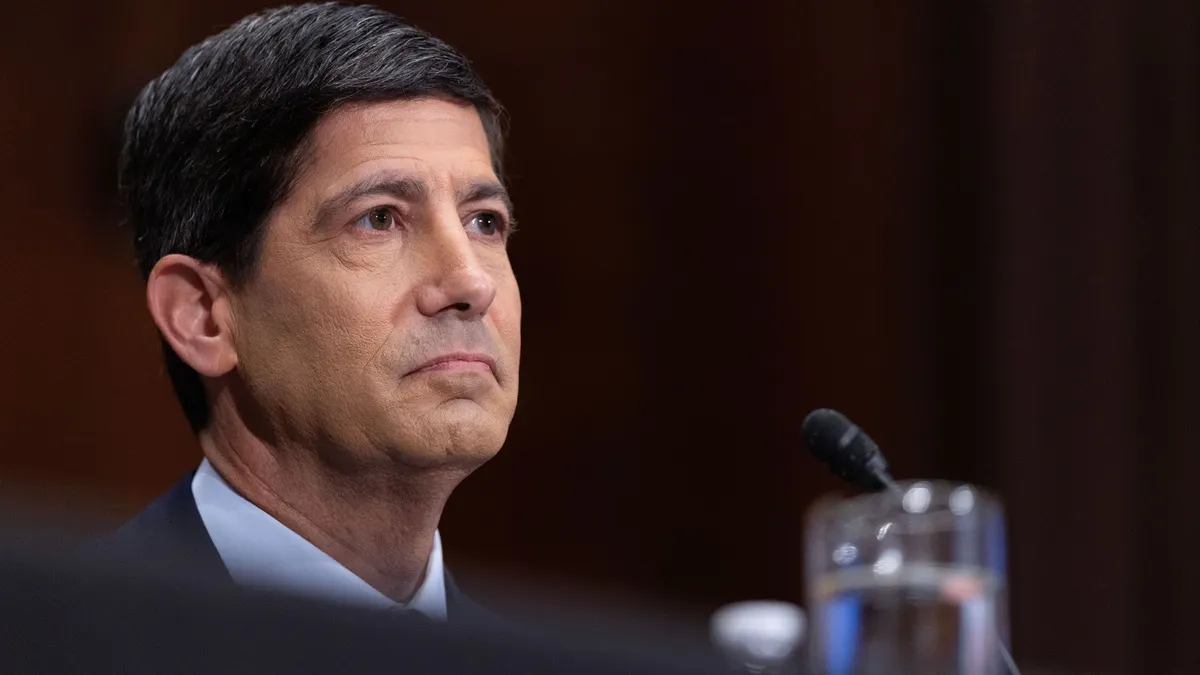
In his first month as Federal Reserve chair, Kevin Warsh indicated the central bank would talk less – particularly about what it predicts for future economic conditions – and concentrate more on bringing inflation down.
At the 100-day mark of Warsh’s tenure – coinciding with the Kansas City Fed’s annual Jackson Hole summit in Wyoming – those throughlines remain true.
“You can call it an outline. You can call it a trail map. Just don't call it forward guidance,” Warsh said Friday of his own remarks.
Warsh has made it a point to mute “forward guidance” from the start of his term. In June, at his first Federal Open Market Committee meeting as chair, Warsh oversaw the removal of wording in a previous policy statement that may have suggested the Fed anticipated trimming borrowing costs in the future.
He echoed that stance Friday.
“Transparency in communications about future policy decisions is not a virtue unto itself,” he said. “Communications must be in service to the Fed's paramount responsibility: getting monetary policy right.”
A “quieter Fed,” Warsh said, “is better able to meet its objectives. And we can be held accountable for delivering on our remit: the only true test of our credibility.”
Warsh said the Fed began pushing forward guidance during the 2007-08 financial crisis but that the practice had “overstayed its welcome.”
“Market participants will always try to anticipate what we will do next. But we should not indulge a regime in which market participants are looking primarily to the Fed for their next trade,” Warsh said. “If markets rely materially on the Fed's guidance and the Fed relies on market prices, we are all more likely to be blinded to new developments, more likely to be caught unprepared for a turn of events, and more likely to commit errors in policymaking.”
Cutting forward guidance would help “get the relationship right between financial markets and the central bank,” Warsh said.
“The Fed needs clear market signals, as unfiltered as possible, from market internals,” he said. “Market participants … should be tracking real information across the economy. They should draw their own conclusions; form their own expectations of output, employment and inflation; and stay sharply attuned to risks.”
For its part, the Fed “will endeavor to construct more reliable models and more robust rules to guide policy decisions,” Warsh said.
“We'll do this knowing that accuracy in economic forecasting is still just an aspiration,” he added. “With so much changing so fast in geopolitics, global supply chains, and technology, it's wise to be modest about what we can and cannot know.”
On what the Fed can and can’t yet know, Warsh spoke some on the advent of artificial intelligence and its impact on the economic infrastructure.
“It's not obvious where the returns on capital will land or on what timescale,” Warsh said. “Likewise, we don't yet know the equilibrium price of the tokens.”
But, he added, the Fed “will be thinking through these matters with the help of a task force on productivity and jobs.”
“Their recommendations will come later and have no bearing on decisions we make in the current policy conjuncture,” Warsh said. “But I believe that for future policy challenges, this intellectual investment today will leave us far better prepared.”
Warsh noted, too, the amount of time that inflation has hovered above the Fed’s stated 2% target.
“The responsibility for 65 months of sustained, elevated inflation sits squarely with the central bank,” he said. “We must be confident that underlying inflation is moving to our objective, clearly and at sufficient speed. Otherwise, we have work to do.”