The biggest banks spend billions of dollars on technology annually, FNB Corp. CEO Vincent Delie Jr. said, “but do they spend it wisely?”
Given the rapid pace of change around artificial intelligence and its potential to democratize capabilities – such as using AI-powered coding assistants for programming – “I think the future’s going to lead to smaller banks coming out with some very innovative tools that the larger banks miss,” the CEO of the $50 billion-asset lender predicted.
“Large banks have bureaucracy, they have embedded spend,” and “they keep muddling along,” Delie said during a recent interview. “It’s harder for these mega-banks to get everybody on the same page, and to create something that is better for the customer.”

Pittsburgh-based FNB, the holding company for First National Bank, operates in seven states and Washington, D.C. The bank has spent the past decade seeing through a digital strategy focused on data management and making online banking feel more like online shopping; the lender declined to share the amount it’s invested in the digital strategy.
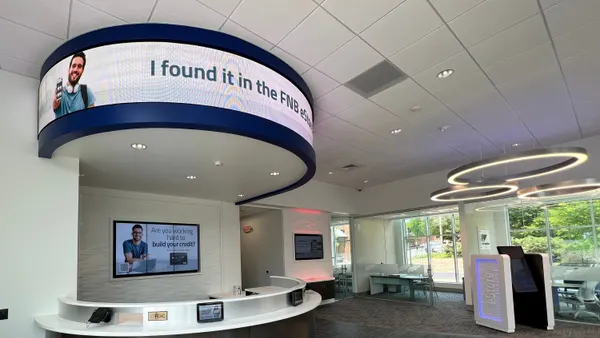
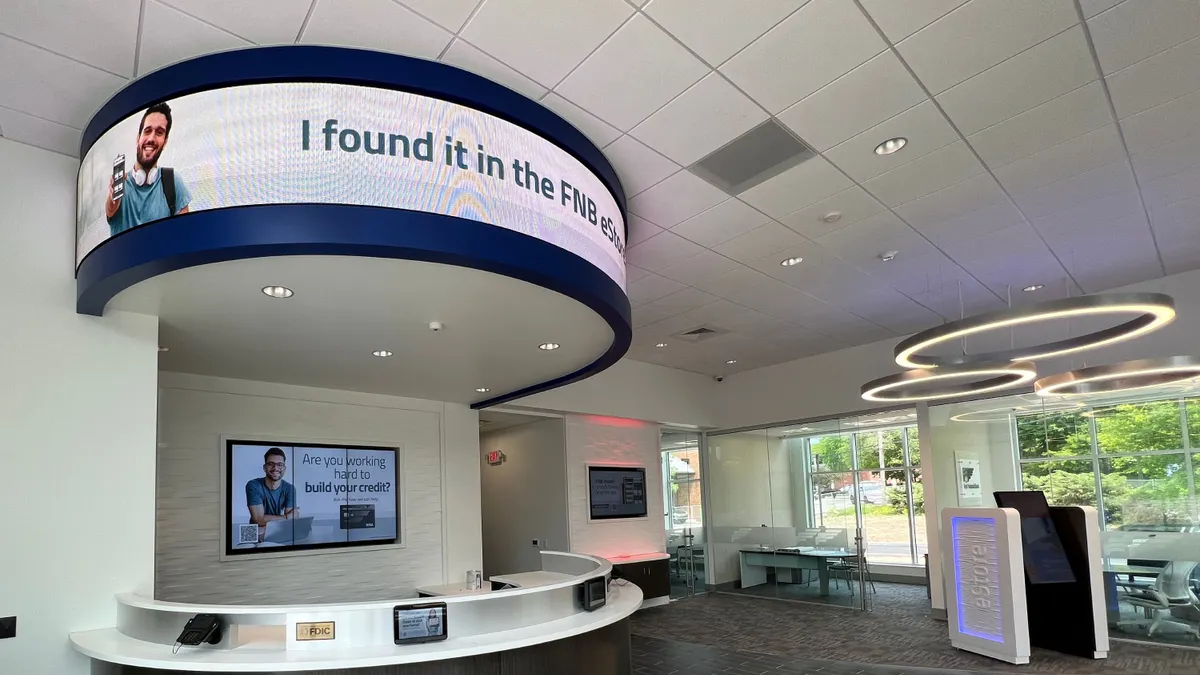
The bank’s eStore platform aims to offer an e-commerce-like experience for customers shopping for banking products and services, and FNB enables a customer to fill out one common application to access about 50 checking, savings or loan products. That paired with the bank’s branch footprint creates an omnichannel environment for customers, Delie said.
“Other banks didn’t engage customers the way a retailer engages customers,” Delie said of the gap he saw. Bank websites were a “spaghetti bowl of information. You really couldn't find things.”
And to access multiple products or services at other banks, “it’s a hodge-podge of disparate applications and origination systems that really force customers to do a lot of work,” Delie said.
FNB has tried to make those processes more intuitive and shrink the time it takes to apply for products or services, he said. “That’s one of the things that banks have kind of missed over the years; other industries were moving much faster,” he said.
For FNB, the next step is tapping AI to drive recommendations, aimed at benefiting the client and bolstering revenue for the company, he said. The bank is preparing to roll out late this year or early next an insights tool for customers, which offers a complete view of their relationship with the bank, analyzes eStore transactions and suggests products or ways to improve cash flow.
The bank also declined to specify the amount it spends on technology annually. For 2025, FNB reported revenue jumped 10.5%, to $1.8 billion, while non-interest expense came in at $1 billion for the year, influenced partly by higher technology and third-party costs and technology-related investments.
FNB prioritized keeping critical data fields on premises – to be easily digested by tools the bank built, Delie said. That gave the bank a head start on AI and data science initiatives, he said.
“We’ve spent a lot of time on data governance, building the data hub, building out these systems that enable us to move data around within the company, and standing up digital workstreams to assist clients,” he said.
FNB is also making enhancements to eStore, a cost-effective way for the bank to increase penetration or enter new territory, Delie said. And the bank is working to roll out combined eStore interactive teller machines, “so that you can purchase products and services with the assist from a human being, and do transactions: make loan payments, etc.”
The interactive teller machines, which FNB has at 150 locations, allow customers to talk with an operator at an ATM-type kiosk, Delie said.
“There are a lot of banks our size that haven't invested in these technologies,” he said. “We're not out there creating a new cryptocurrency … we're focused on engaging the customer and managing how effectively and efficiently we can operate the systems that we have and do a better job.”
FNB is also bolstering its physical footprint. Last September, the bank said it’s expanding in the Southeast, opening 30 branches over the next five years. That’s set to bring the bank’s branch count to 380. “We’re really doing it to augment our delivery channel,” Delie said.
Branch builds are focused on Charleston and Greenville, South Carolina; Charlotte, North Carolina; and Richmond, Virginia. Those markets are experiencing big growth, Delie said – while also becoming crowded as bank competitors like JPMorgan Chase, PNC, Fifth Third and Huntington open locations throughout the Southeast.
Legacy markets such as Pittsburgh and Cleveland, on the other hand, “aren’t growing at all,” Delie said. The de novo strategy appeals because those branches are performing better, from a production standpoint, than the rest of the footprint, he said.
FNB entered the Carolinas in 2017, when it merged with Raleigh, North Carolina-based Yadkin Financial Corp. FNB has made other acquisitions since then, including Greenville, North Carolina-based UB Bancorp and Baltimore-based Howard Bank.
Despite the bank’s history of acquisitions, Delie said more than half of the bank’s asset growth during his time as CEO has been organic.
“People don't realize FNB’s an organic growth story, just as much as it was a roll-up of small banks,” he said.
Asked about further M&A, Delie indicated it’s not high on the bank’s priority list right now.
“We’re looking at the most efficient way we can deploy capital, period,” he said. “My focus is on making sure that we can continue to grow organically.”
Pitching services to consumers and small and medium-size businesses within the bank’s footprint should sustain that for the foreseeable future, he said.