Dive Brief:
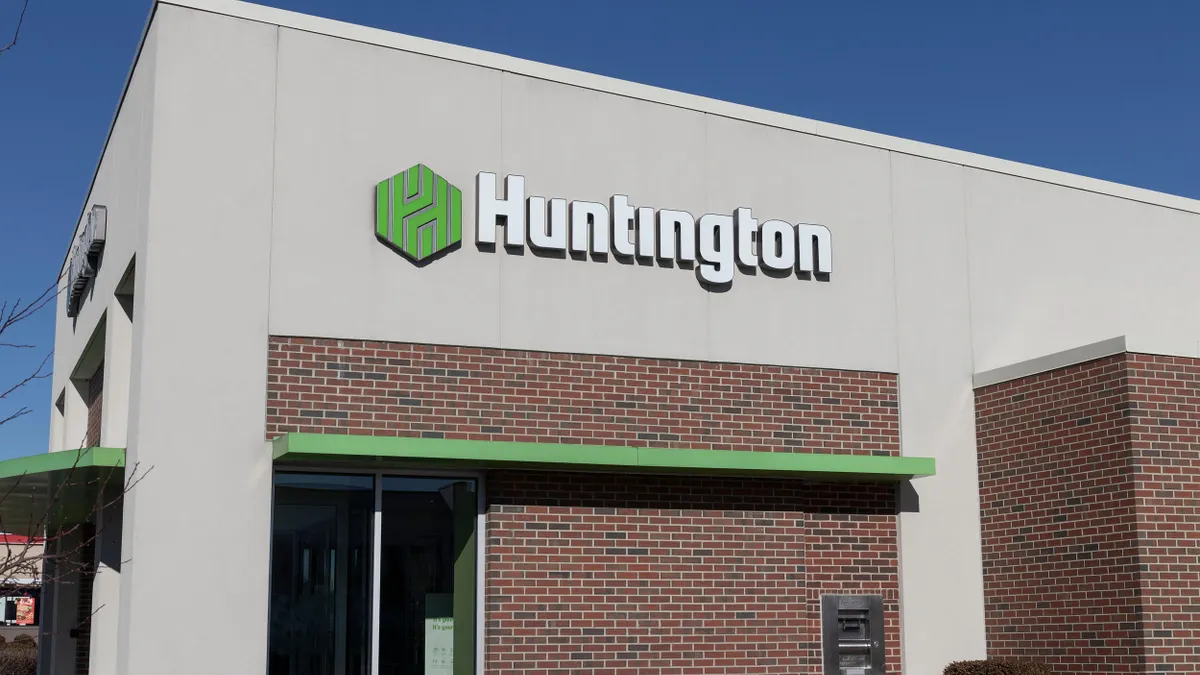
- Regional bank Huntington isn’t interested in acquisitions that would take it beyond the geographic footprint it’s set to acquire in buying Houston-based Cadence, CEO Steve Steinour indicated last week.
- The CEO of the Columbus, Ohio-based lender, speaking Dec. 10 at the Goldman Sachs U.S. Financial Services Conference, also said the bank’s appetite for further acquisitions is predicated on its ability to grow organically.
- “If we do any further [mergers and acquisitions], it will be with partners,” Steinour said of the bank’s appetite over the next year or two. “It’s highly unlikely we’re going to show up at an auction. We’re not interested in [mergers of equals]. We’re not looking to go beyond the geography that Cadence gives us.”
Dive Insight:
The comments come at the close of a year that saw the $210 billion-asset lender make two acquisitions in Texas: Dallas-based Veritex, for $1.9 billion, which was announced in July and closed in October; and Cadence, for $7.4 billion, which was announced in October and is projected to close in the first quarter of 2026.
Huntington had already been pursuing expansion in Texas, and the regional bank saw the Veritex deal accelerating its efforts with commercial clients in the Dallas/Forth Worth and Houston markets.
Cadence, meanwhile, has a 390-branch network and 1 million customers across Texas, Louisiana, Arkansas, Mississippi, Alabama, Florida, Georgia, Tennessee and Missouri. Acquiring that bank is set to give Huntington $276 billion in assets and grow its footprint to 21 states.
The Veritex conversion is scheduled to take place in January, while the tentative closing date for the Cadence deal is Feb. 1, with a June conversion plan, Huntington executives said Dec. 10. As the regulatory climate for bank M&A has shifted under the Trump administration, lenders have grown more confident in approvals and are seeing faster deal timelines.
Management teams have been identified, Steinour said, and the Veritex and Cadence CEOs “and largely their teams, are going to be with us going forward.”
Steinour told Reuters last week that Huntington planned to pare Cadence’s headcount, but didn’t share a number. He indicated at the Goldman conference that the bank’s employees had been notified of their status.
“The reason we did the notification to all the colleagues now was we wanted them to know their status before Christmas and the holiday season, versus after, so they had assurances, where that’s appropriate, and 80% – roughly 80% – got those assurances,” Steinour said.
Cadence has about 5,800 employees, so the figure Steinour shared would indicate about 1,160 Cadence employees are being let go. A Huntington spokesperson declined to comment Friday.
Steinour noted bank executives view M&A as a “springboard” for – not an alternative to – Huntington’s organic growth ambitions, which have included expanding in North and South Carolina. Further acquisitions won’t happen unless Huntington delivers the growth it’s targeting, the CEO emphasized.
“We must grow organically, in order to earn the right to potentially partner,” Steinour said. “If we can’t grow organically as we expect to, we won’t partner. We’ll just put a full stop on it. The core has to perform well.”
That applies over the coming years, not just 2026, he added. In the third quarter, Huntington’s average total loans and leases were up 9% year over year, and average total deposits, 5%, according to an earnings supplement.
The regional bank’s expansion strategy in the Midwest is what it’s looking to employ in Texas, a state that offers plenty of room for growth, Steinour said.
“We’re not going to be trying to go national, or West Coast, or Northeast, or other stuff,” he added. “It’s just, get better and do more where we are in this expanded footprint.”
While some like super-regional PNC pursue coast-to-coast expansion, Northeast regional M&T, for one, is uninterested in becoming a national bank, CEO René Jones indicated last month.
“As you get further and further away from home and [add] more geographies, I think the management challenge goes up,” Jones said at an investor conference.
Retaining customers post-acquisition starts with engaging the acquired bank’s employees, Steinour said. Initial messaging from Veritex and Cadence CEOs was “incredibly positive.” “It’s up to us now, to continue to build that trust, the transparency.”
When asked about the risk of integration efforts distracting the bank from its organic growth strategy, Steinour said, “there better not be, because I’m holding our team accountable.”
“We’re quite clear with our executive team that we have to deliver the organic growth,” he said.