In tempering expense growth for the year, Huntington Bank is maintaining planned investments in marketing and branch builds but trimming some hiring and technology spending, its CFO said.
The Columbus, Ohio-based lender is tightening its 2026 expense growth estimate to the lower half of the 32.5% to 33.5% range, Huntington CFO Zach Wasserman said, in light of softer revenue expectations. The bank expects higher fee revenue but lower net interest income, equating to slightly lower revenue expectations for the year.
“Against this backdrop, we're accelerating targeted efficiency initiatives and rephasing select investments,” Wasserman said during the bank’s first-quarter earnings call Thursday.
That means the regional bank is looking to pull back about $50 million of an annual expense base of about $7 billion, he said.
Not including the acquisitions of Texas-based banks Veritex and Cadence, Huntington’s core expenses are set to grow about 10% this year, “and I took out 7/10ths of one percent out of that,” Wasserman said during a Thursday interview. “It’s just tuning.”

The bank’s first-quarter revenue jumped about 34%, to $2.6 billion, according to earnings materials. Non-interest expenses soared 54%, to $1.8 billion, although the bank noted $263 million was attributed to acquisition-related costs.
As Huntington seeks to speed up efficiency programs, the lender is seeing encouraging momentum tapping agentic artificial intelligence, Wasserman said. About 50 uses of the technology to improve processes are in place, with another 63 in the pipeline and more than a dozen new uses coming each month, he said.
The $285 billion-asset bank also reviews its investment plans to identify those that can wait, he said. “If push comes to shove,” Wasserman said he can delay some “a little bit and not really have a meaningful impact on the business.”
The bank’s 2026 budget had included about $850 million in investments: roughly $500 million was earmarked for technology, $150 million for hiring, $60 million to $70 million for new branches, and the remaining $130 million for marketing, Wasserman said.
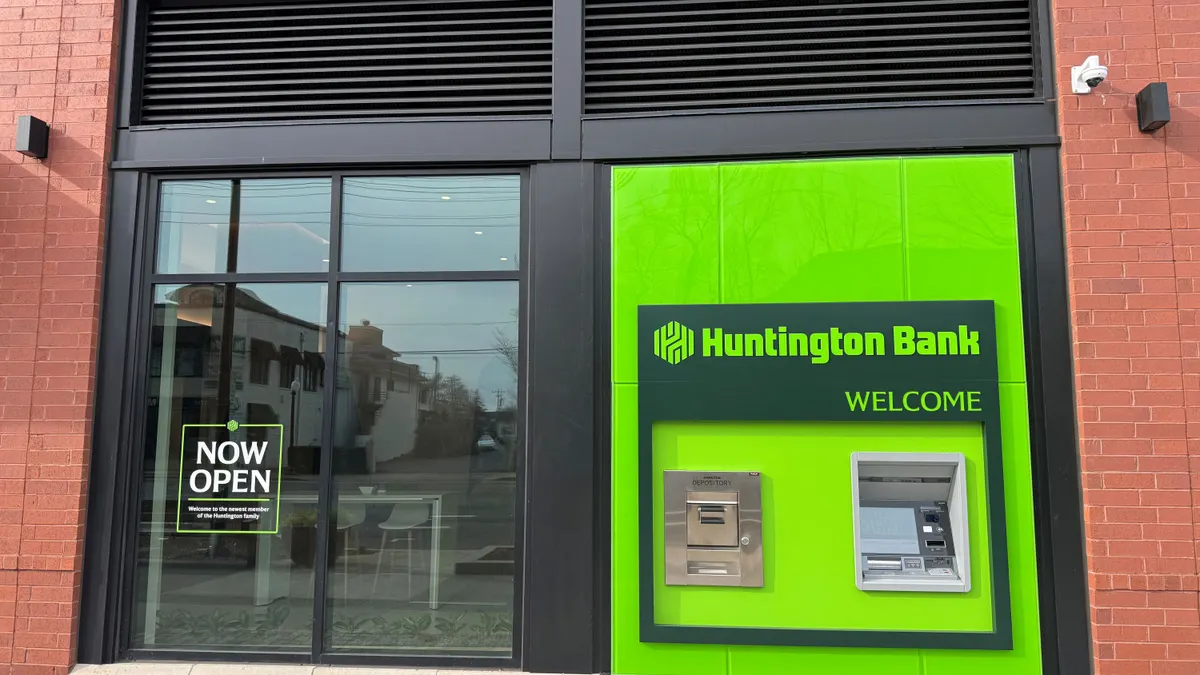
“We didn’t slow down the branch builds one iota,” he said. Huntington has opened seven locations so far this year; between 17 and 20 openings are targeted for 2026.
The bank also “didn’t touch marketing,” he said, but did “take a little bit off the bottom of technology.” Wasserman declined to provide specific examples, saying expense trimming was “pretty broad based,” and shaving $10 million to $15 million from $500 million earmarked for technology wouldn’t be “particularly noticeable.”
The exercise ensures investments “are really rigorously justified,” he said. Huntington executives don’t see the decision substantively altering growth expectations this year or next.
Piper Sandler analyst Scott Siefers said he appreciates the tighter focus on spending, noting the bank’s formerly low-single-digit annual expense growth has swelled in recent years.
“It always led to some concern on our part that [Huntington’s] peer-beating growth was in some ways just a function of its willingness to spend considerably more than others to generate it,” Siefers wrote in a Thursday note.
Wasserman said he did also “ratchet back” some of the bank’s acceleration in hiring.
Still, Huntington aims to hire “hundreds” of people this year, including bankers and support staff, although Wasserman declined to provide a more specific figure. The bank had about 24,600 employees as of the first quarter.
In Texas, the lender recently hired bankers from Wells Fargo and PNC. Those additions are pursuing commercial business in the middle market and corporate segments, which they’ve done at larger banks, Wasserman said.
Veritex has a strong presence in Dallas, and Cadence in Houston, but there’s needed work to build out Huntington’s coverage in the rest of Texas, including Austin and San Antonio, he said.
And in other growth markets in Cadence’s footprint, such as Orlando and Tampa, Florida; Atlanta; and Nashville, Tennessee, “there's a lot of additional hiring going on,” Wasserman said.
Deposit competition in all of Huntington’s markets is high, as other banks have their sights set on growth in Texas and the Southeast, and the Midwest remains competitive. To boost deposits, adding customers is essential, as is “price elasticity and pricing understanding at a very granular level, so you know how to grow volume at the most efficient way,” Wasserman said.
In the first quarter, the bank’s core deposits, excluding Cadence, grew 2.3%, or $3.8 billion, quarter over quarter, fueled by primary relationships in consumer and commercial, executives said. But the bank reduced its 2026 net interest income and net interest margin expectations.
Siefers noted the bank’s deposit pricing leverage “doesn’t seem as though it will be as powerful as hoped, which is a factor in a lower [net interest margin] expectation trajectory.”
Huntington is also leaning on growth through digital customer acquisition. That’s something Cadence hadn’t done much of, since smaller banks tend to acquire customers primarily through branches or bankers, Wasserman said.
In the first quarter, about 62% of Huntington’s client acquisitions occurred digitally, Wasserman said. The bank has “turned on” that capability throughout the South and Texas, and after two months, Texas is the lender’s fourth-largest digital deposit acquisition market, he said.
“That’s a big source of revenue synergies,” Wasserman said. “It’s basically just our playbook that we’re now deploying across these markets.”