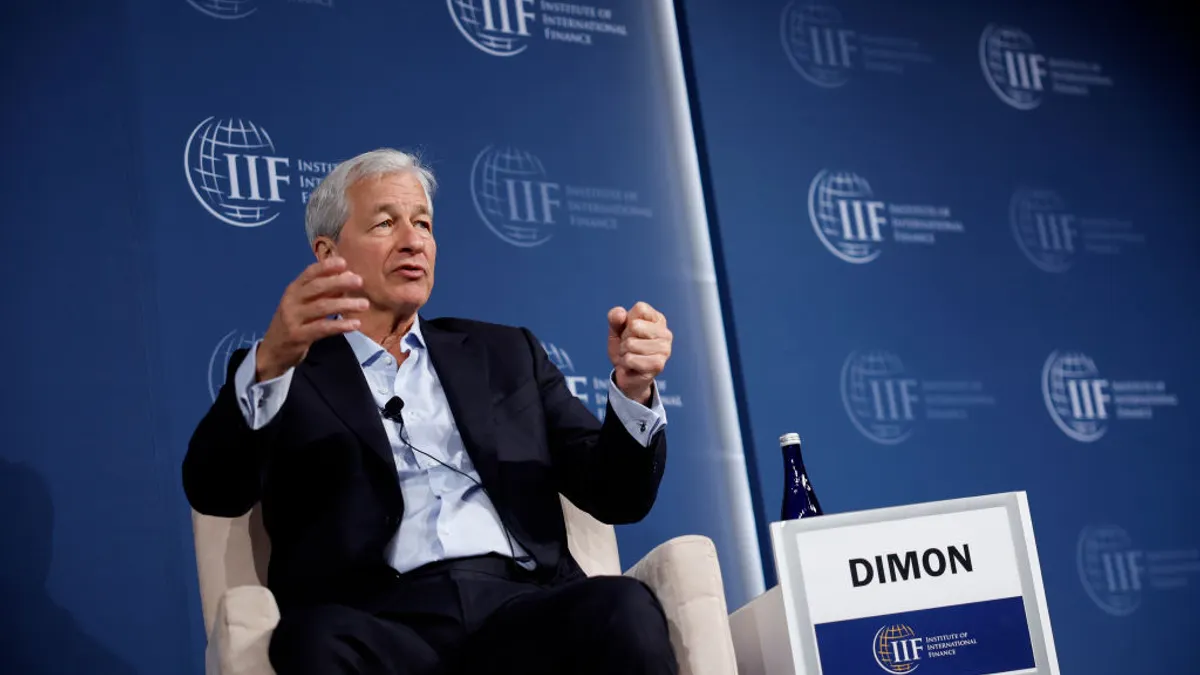
JPMorgan Chase CEO Jamie Dimon cautioned customers Tuesday that if they’re giving artificial intelligence agents access to their bank accounts, they’re owning that decision.
The comments from the CEO of the biggest U.S. bank come just weeks after Meta’s AI assistant Muse debuted, reigniting conversation around AI-cash sorting concerns for lenders.
“You’ve got to make sure customers aren't hurt by it, and so that is of concern,” Dimon said during the bank’s third-quarter earnings call. “You don't want rogue agents, and there could be thousands of them.”
“If people are using them, they should understand the risk,” the CEO said. “There's a liability transfer. They should understand the liability transfer. If data is being misused, they should understand it’s being misused.”
“We have to make sure we protect our customer in the right kind of way. So we’re building tools to do that, too,” Dimon said. “In the meantime, we're not going to allow just any outside agent to come in inside the company because it's too risky for the clients and for JPMorgan.”
Consulting firm McKinsey warned in April that retail banks may face disintermediation of their relationships with customers if AI agents acting on consumers’ behalf move money in pursuit of better rates.
For its part, JPMorgan’s AI-powered Smart Cash tool – which moves customer money between accounts at the New York City-based bank to maximize yield and manage cash flow – is in pilot, CFO Jeremy Barnum said Tuesday.
“The strategic question is not whether AI pulls deposits out of checking, but who owns the agent, the wallet and ultimately the customer relationship,” Bank of America Securities analyst Ebrahim Poonawala said in a Sept. 23 note.
Regulators should also consider how agentic AI’s potential impact on deposits could affect liquidity risk management, Dimon said.
“It’s a new world,” and “with all these bots and agents and stuff like that, could someone get hurt and cause a problem? Maybe. If I was a regulator, I’d try to be prepared for that,” Dimon said.
Bank executives also faced AI expense-related questions Tuesday, as the industry begins to feel pressure to show return on AI investment while costs have soared. Last year, Dimon said the bank’s annual AI-generated savings of $2 billion roughly equal what it spends yearly on the technology.
Asked for updated figures Tuesday, Barnum put the bank’s annual AI spending somewhere closer to $700 million, not $2 billion, but also said that figure is “a little stale at this point.”
“If you sort of price out the amount of time we're all spending thinking about it, you could probably get a higher number, too,” the CFO said. “It’s, at this point, not really something that you can ring-fence. It's pretty well diffused inside the whole institution, and it's obviously a very, very high priority.”
As for the benefits, Barnum said he’s trying to move away from quantifying that, in part because the previous estimate would have included more traditional AI and machine learning uses.
Generative and agentic AI’s impact on productivity, expenses and revenue “is the more relevant focus right now, and I'm just very reluctant to spend a lot of energy quantifying it because it winds up wasting a lot of people's time inside the institution, when we actually need to get them to focus on doing things,” Barnum said.
AI benefits aren’t yet observable in JPMorgan’s quarterly earnings, the CFO said.
“As important and dramatic and exciting as this theme is, it takes a long time to really do things that are visible in an institution of our size,” he said.
The bank’s quarterly expenses jumped 12% year over year, to $27.3 billion, driven by higher compensation and employee growth; higher brokerage expense and distribution fees; and higher marketing and technology expenses, according to an earnings release.
JPMorgan expects fourth-quarter expenses to be about $27.5 billion, Barnum said.
Anecdotally, Barnum said he’s starting to see benefits within the technology organization supporting the finance department, as experiments yield promising improvements when it comes to productivity.
“How long it’s going to take for that to show up, we’ll see, and obviously some of those benefits are going to be offset with token costs, which is a whole other conversation,” he said.
To manage costs, the bank is focused on “minimizing lock-in and maximizing optionality,” Barnum said. Model agnosticism and the ability to run both proprietary models and open-source models are “designed to get the best of what's available at the best price.”
Dimon noted the advent of tools that handle model routing, sending queries to the quickest and cheapest model, to keep token costs under control.
“You don't need the most expensive things for every query you have, and very often people just use the one they're comfortable with,” he said.