Big-bank executives this week largely brushed off concerns that agentic AI-driven cash optimization could post a threat to their consumer deposit businesses.
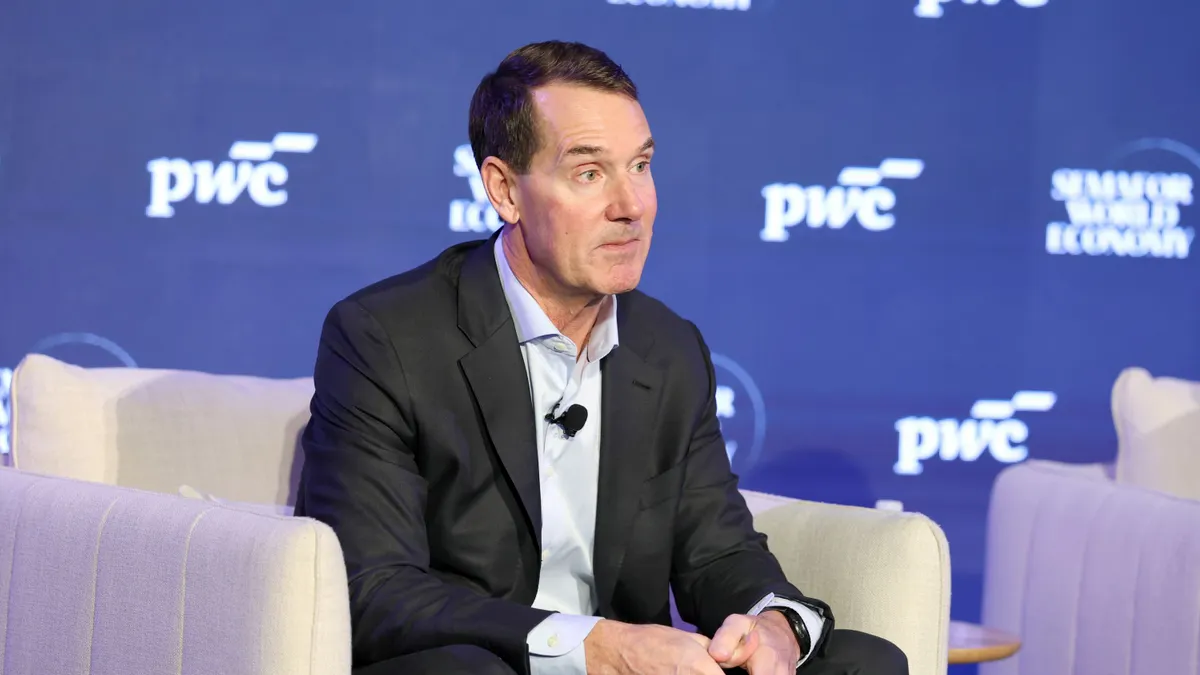
PNC CEO Bill Demchak, at a Morgan Stanley investor conference Tuesday, seemed almost exasperated when asked about the possibility that consumers may employ artificial intelligence to move their money around in search of higher yields.
As consumers become more comfortable with generative AI, consulting firm McKinsey in April warned that retail banks may face disintermediation of their relationships with customers if AI agents acting on consumers’ behalf move money in pursuit of better rates.
Morgan Stanley analyst Manan Gosalia asked executives this week about the risk that scenario poses to banks’ deposit costs and deposit growth over the long term.
“I don’t understand where all that’s coming from,” Demchak said Tuesday. “We’ve been on a journey in banking for years for cash optimization. The ability to move money quickly with little burden will be more driven by open banking and [application programming interface] connectivity than it will be on AI.”
The CEO of the Pittsburgh-based super-regional argued AI isn’t needed to move money from account to account to secure the best rate, “if it’s super easy and I care.”
For the average customer with around $10,000 in a PNC checking account, “people aren't trying to invest that extra $1,000 to earn another 20 basis points,” Demchak contended.
Funds above that are typically housed in investment accounts, not transactional accounts, “and that market's become more and more efficient over time,” he said.
Given open banking capabilities and the level of competition, those that win will be “a low-cost producer with really good products and services that somebody doesn't want to trade away from you for 50 basis points on $2,000,” Demchak said.
U.S. Bank CEO Gunjan Kedia said Wednesday the “narrative is overblown,” and the “noise is far outpacing any observed behavior in the franchise,” as it relates to the impact of AI-fueled cash optimization on the bank’s core deposit base.
She suggested the bank isn’t taking its retail deposit customers for granted.
“The narrative that people are just sleepy and sit on deposits without earning is not the world we experience,” Kedia noted, adding that the bank spends a lot of time trying to strengthen its value proposition.
Asked about the company’s efforts to attract deposits, U.S. Bank CFO John Stern said the Minneapolis-based lender is taking a “surgical” approach to deposit pricing on an individual or metro area level.
Citizens President Brendan Coughlin said Wednesday he’s closely monitoring the topic, but isn’t worried as he doesn’t expect “this mass exodus to these AI optimizers.”
It’s not really an issue with corporate deposits, he and other bank executives pointed out, because those are generally already optimized, with CFOs and treasurers managing money to maximize a firm’s financials and the flow of funds.
In Citizens’ low-cost retail portfolio, the Providence, Rhode Island-based regional bank’s average customer has about $3,500 in their day-to-day checking account, Coughlin said. “I don’t think that’s going to get optimized by yield-seekers,” he said.
As for interest-bearing deposits, direct banks have consistently paid the same or more than regional banks, and the percentage of U.S. deposits going to direct banks “has been relatively muted,” holding steady at about 12% to 13%, according to Coughlin.
At San Francisco-based Wells Fargo, the “vast majority” of consumer deposit accounts are under $250,000, and the average balance is much smaller, CFO Mike Santomassimo said Tuesday.
“Clients have a lot of opportunity, if they wanted to optimize cash more, but I think you're going to find very quickly that you get to some pretty stable balances there,” Santomassimo said.
Truist CFO Mike Maguire called the AI cash optimization concern more of a “conceptual risk” than an actual one, at least today. In retail, “I’m not sure that the demand, necessarily, is there,” he said Tuesday.
The median balance across Charlotte, North Carolina-based Truist’s consumer deposit portfolio is about $1,500, and those are operational banking accounts, not necessarily “rate-seeking, reward-seeking type stuff,” Maguire said.
Marianne Lake, CEO of JPMorgan’s consumer and community banking unit, said Tuesday that AI’s ability to help customers optimize their financial position also speaks to the benefit “of consolidating their financial situation with a single service provider, where that could be even simpler and even easier.”
JPMorgan Chase, the biggest U.S. bank, has been beta-testing its Smart Cash product, an AI-powered tool designed to automatically move a customer’s money between their checking account and higher-earning brokerage products to maximize yield and manage cash flow.
Bank of America Co-President Jim DeMare took a different tack than many of his peers: When asked about the potential threat to the industry, he said “you can't dismiss anything.”
“Like any new innovation that's talked about, we spend serious time having discussions and analyzing it,” he said Tuesday.