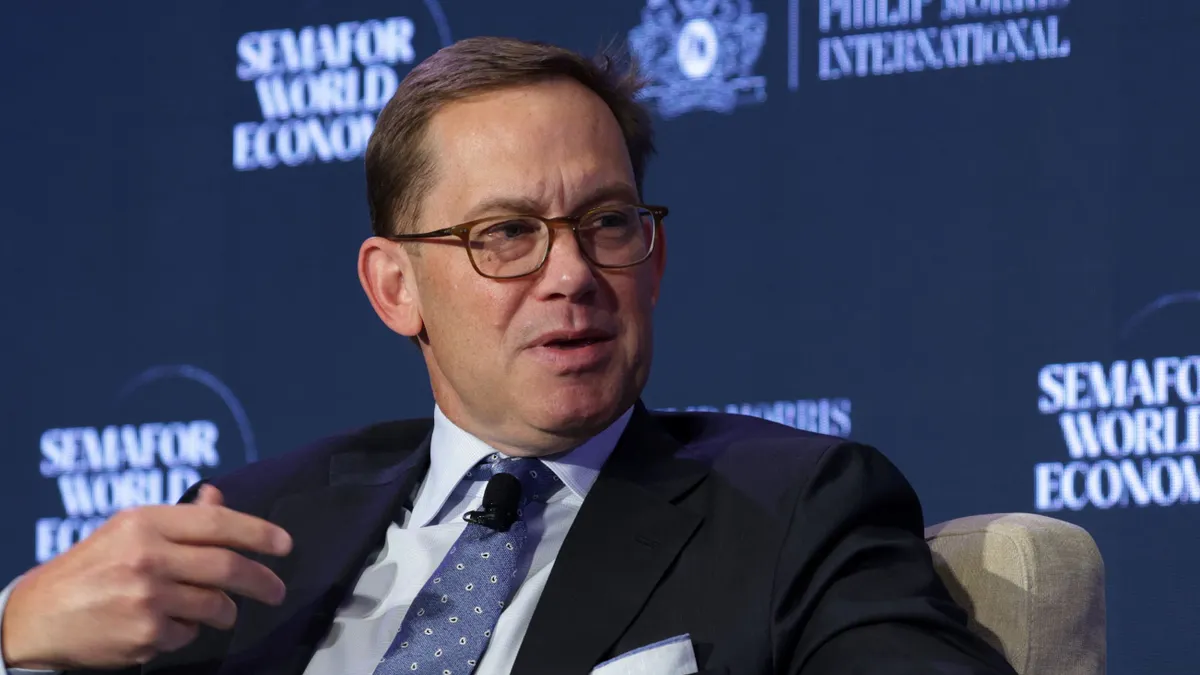
An investment banking veteran hired to lead a recently added division at JPMorgan Chase aims to grow his team serving small companies to about 100 bankers by 2030.
Michael Flynn, head of small-cap investment banking at JPMorgan, said he plans to expand his team of 12 bankers to about 16 by the end of the year, as the lender chases the investment banking opportunity with smaller companies.
Flynn joined the bank in June from Boston-based boutique investment firm G2 Capital Advisors; he’s also spent time at Capital One and Bank of America. Most of his career has been spent in the small- and mid-cap segment, working with founders and family-owned companies.
That size range is “a different flavor of investment banking,” Flynn said in a recent interview.

“It's very intimate in terms of the closeness with the client. You really are impacting a client's life,” he said. For small and midsize businesses, “their personal lives and their business lives are all one.”
JPMorgan’s small-cap investment bank, serving companies valued at $100 million to $500 million, is primarily focused on providing M&A advice, and largely sell-side advice, he said.
Around half of small-business owners are over age 55 and considering succession planning, so a massive transition is expected over the next decade, Flynn said. The liquidity event that comes from selling a company tends to be a “transformational” moment for these business owners, he said.
“That makes a huge opportunity for JPMorgan,” he said, which is why the bank is keen to offer commercial, investment banking and private banking services in a cohesive way.
Historically, commercial banking and investment banking were separate business units that didn’t communicate, Flynn said. But Doug Petno, JPMorgan’s co-president and CEO of the commercial and investment bank, combined those banks in 2024, as part of a “deliberate effort” to ensure the bank’s advisory and investment banking services are being offered to its nearly 40,000 commercial clients, Flynn said.
The New York City-based bank had already found success with a mid-cap investment banking team established more than a decade ago that is focused on middle-market companies with valuations between $500 million and $2 billion. That unit now generates about $1 billion in revenue annually, a JPMorgan spokesperson said.
“The idea was, let’s double down, let’s bring that vision holistically,” Flynn said.
The bank saw a sizable opportunity where smaller commercial clients were looking for advisory services, but JPMorgan didn’t have a team dedicated to that space, Flynn said.
“They would have to look elsewhere” for advisory services, he said, which made “no sense.”
He noted the longer-term difficulty created for the bank when it wasn’t establishing those advisory relationships with smaller companies earlier on. As those businesses went on to become bigger, JPMorgan sought to represent and advise them, but firms had already fostered trusted relationships with different advisers, leaving the bank on the back foot, Flynn said.
“We want to be their first call and their only call,” Flynn said. “They go somewhere else, it’s hard to get them back.”
JPMorgan declined to share a revenue projection or target for the new division.
The biggest U.S. bank focuses on sector expertise that’s delivered locally through hubs in New York, Chicago, Los Angeles, Dallas and Houston, Flynn said.
JPMorgan is initially focused on building out three sector groups – diversified industries, business services, and consumer and retail – since those cover the majority of the bank’s commercial clients, he said. Later, the lender intends to fill out coverage of healthcare and technology, media and telecommunications.
“Clients award advisory business to advisers and bankers who know their business best,” he said. “What drives clients crazy is a generalist model, where people show up and they’re having to educate the bank or the banker on their business.”
Keeping talented bankers engaged in small-cap coverage so they don’t view it as a stepping stone to involvement in larger deals “is an issue at other banks,” Flynn contended, “but not here.”
“It all depends on messaging from senior leadership, in terms of the importance of the initiative and the importance of what we're doing,” he said.