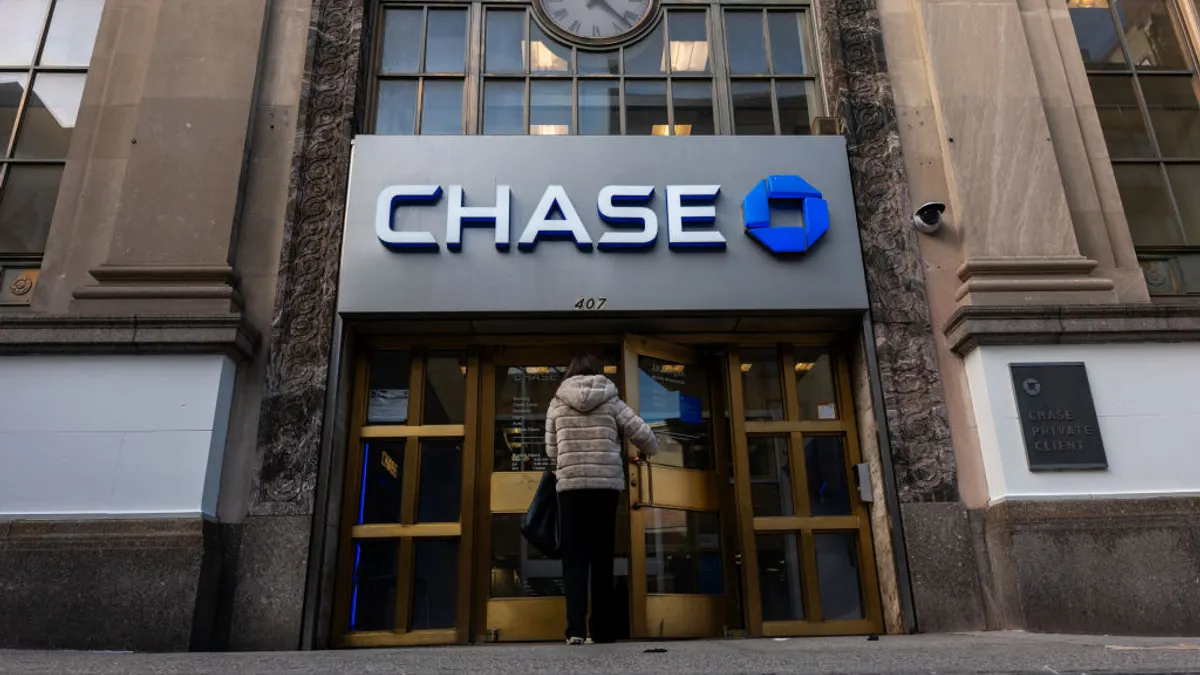
Talking people out of giving their money away to scammers is a regular part of the job for JPMorgan Chase’s front-line bank employees, and the victims aren’t always who some would expect.
“It’s everybody,” said Darius Kingsley, Chase’s head of consumer fraud and scam prevention.
“We always talk about older people, and when they do fall victim to a scam, they lose a lot of money,” Kingsley said. “But it's equal, if not actually a higher number, as a percentage, of younger people these days.”
Dissuading customers from funding scammers is an everyday occurance at the bank’s branches, and given the prevalence, the bank is leaning into education as a tool to fight back.
JPMorgan Chase, at 3 p.m. Eastern time Wednesday, will livestream a fraud-focused panel to roughly 700 branches, during which the bank’s information security chief, Pat Opet; Washington Post columnist Michelle Singletary; and Brett Leatherman, the assistant director of the FBI’s cyber division, will discuss how AI-enabled impersonation and money movement scams can be spotted, as well as how individuals can strengthen their cyber defenses and protect personal and financial information when using AI tools.
Kingsley will moderate the panel, livestreamed from JPMorgan Chase’s mid-Atlantic regional headquarters in Washington, D.C.
“The problem is the scammers and the scams are getting more and more sophisticated,” Kingsley said in an interview ahead of the event.
Open-source AI models make sham texts and emails much more convincing than the Nigerian prince scams of yesteryear, he said.
“What AI allows you to do is really personalize your messages,” he said. “It’s really, really tough to counter.”
Older Americans are more often targets of romance scams or “pig-butchering” investment scams, while younger Americans tend to fall victim to apartment or employment scams.
In one common scheme, fraudsters will offer a fake product review gig with the caveat that the reviewer – the unknowing victim – buy a $600 Chromebook with a check provided by them.
“They send you a check, except it's not $600,” Kingsley said. “It's $2,600, and they immediately send you an email saying, ‘Oh my God, we made a mistake. We misprinted your check. Please, the moment you get it, deposit that check and wire us back $2,000, and then keep the $600 [to] go buy your laptop.’”
But when the victim deposits the check, he said, it bounces; meanwhile, the victim has already wired the $2,000.
“Now there's no job, and you're out the $2,000, and maybe your credit score got dinged, which, when you're young and you're about to go try to rent an apartment, is not a great thing,” Kingsley said.
Imposter scams cost reported victims $3.5 billion in 2025, the Federal Trade Commission said in June. That’s three times more than in 2020.
Gallup put the number much higher: $68 billion in 2025. Most scam victims lost less than $500, but 5% lost over $10,001, the polling firm reported.
Fraud, Kingsley noted, doesn’t start at the bank. It starts upstream, with a spoof phone call or a fake social media ad. What’s really needed, he said, is for “all the industries to come together to work together to help stop this.”
Lawmakers are trying. Politicians on both sides of the aisle sponsored legislation in February meant to crack down on fraudulent and deceptive advertisements on social media and online platforms. The bill remains pending in committee.
In June, a coalition of government agencies known as the Elder Justice Coordinating Council launched The Never Ever campaign, meant to raise awareness around imposter scams. Partners in the effort include the American Bankers Association, USTelecom, Google and Microsoft.
JPMorgan, like other banks, fights scams using the same AI models scammers do.
Banks are using AI models to map customer payment behavior patterns, and to get “smarter and faster about saying, ‘We really don't want you to send that out,’ or ‘Are you sure?’” Kingsley said.
The “vast majority of all payments are good, and people actually want to make them. So you're looking all the time for a needle in a haystack,” he said. “AI will help us do that.”
The threat, he said, is countered by an equal-opposite effort on the bank’s end. Part of the battle is fought with AI, and part with community events.
“Honestly, there's nothing else like just trying to really get out there and educate people,” Kingsley said.