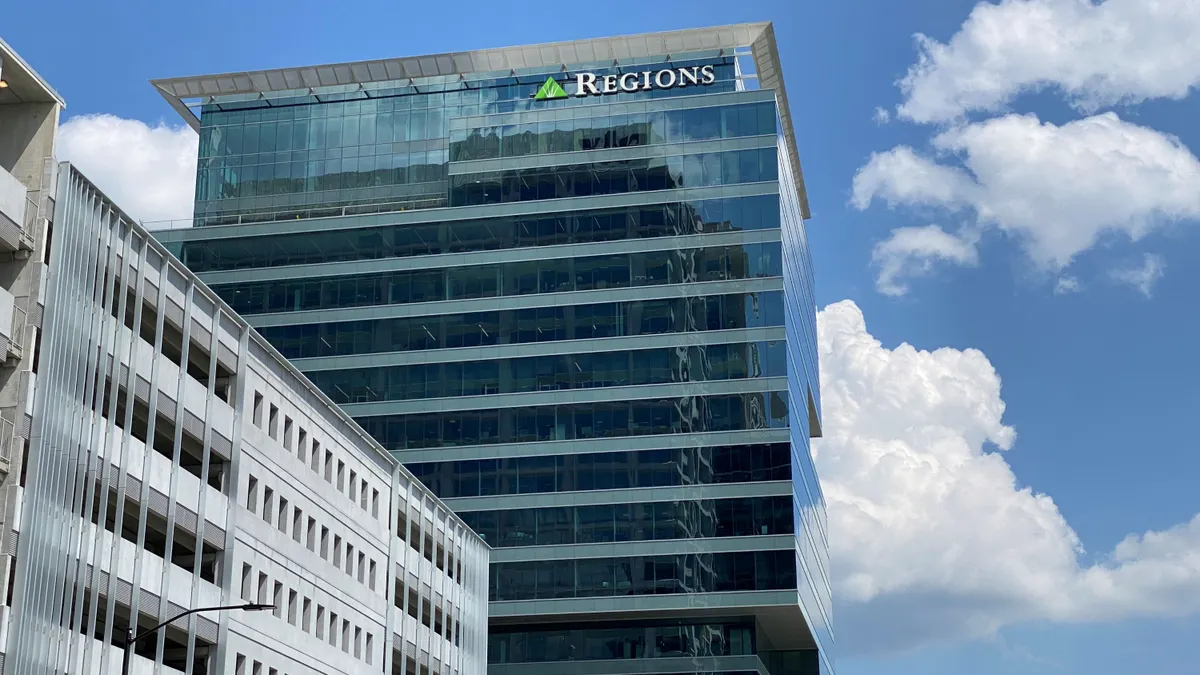
After launching a new mobile app in July, Regions is planning to roll out additional app features early next year, including a function that offers customers data-based insights.
One experience-focused feature that’s risen to the top of the to-do list, based on customer feedback since the new app was launched is dark mode, said Kristen Rankin, the Birmingham, Alabama-based regional bank’s head of digital.
“That was really the first thing that we heard when we launched the new app. Our customers were like, ‘This is great, but give us dark mode,’” she said, referring to the digital display setting that features light text on a dark background. “If there was anything we were surprised by, that was one.”
The $160 billion-asset bank then bumped that up on the list, and is working to deliver that feature early next year, she said.

“We want to connect business strategy with customer needs, so we're always making sure whatever we're doing is … solving a need, whether that's a problem the customer is having, or maybe an unknown need,” Rankin said in a recent interview.
The new app, built in-house, features a more modern design, the ability to use biometric login, more functionality on the home screen, shortcuts to popular tasks, and the ability to nickname accounts.
The insights function – leveraging data and analytics to deliver specific, personalized feedback – will provide tailored notifications based on customer activity related to unusual bill amounts, duplicate charges, subscription changes or cash-flow trends, she said.
The feature, which Regions is planning to roll out early next year, will also offer enhanced visibility into customers’ spending and saving habits and patterns, including frequently used merchants.
“We have done a lot of testing to know that those insights are valuable to our customers, and we want to meet them where they are,” Rankin said.
About 2.7 million customers are active on Regions’ mobile app, Rankin said. The bank reported a 3% year-over-year increase in digital transactions in the third quarter, according to a spokesperson.
Also coming next year, based on client feedback: added features around convenience, including the ability to report a lost or stolen card, reset a pin and change an address in the app.
With the redesigned app, Regions switched to native app development, which refers to building an app specifically for Apple iOS or Google Android.
That offers experience benefits for customers partial to those operating systems, and better app performance, including quicker page loading or transition, Rankin said. The bank can also introduce new capabilities more quickly, she noted, adding that customer satisfaction and engagement tend to be higher with native applications.
In preparing to launch the new app, the regional bank spent “a ton of time” with customers – soliciting feedback, doing usability testing, and conducting multiple rounds of focus groups, Rankin said. The bank would share a few options, take in feedback on what users liked best, and then iterate on that. That cycle was repeated “15 times over a 10-month period,” she said.
Since July, customer engagement with both peer-to-peer payment service, Zelle, as well as the bank’s virtual financial assistant, Reggie, have climbed, Rankin said.
Regions hasn’t disclosed investments specific to its mobile app enhancements. The bank invests between 9% and 11% of its total revenue annually on technology, putting overall tech investments between $630 million and $830 million each year, based on revenue figures for the past two years, the spokesperson said.
Like other large lenders, Regions is also working to build out Reggie’s capabilities, particularly after seeing customers take to the virtual assistant.
“We're leaning into that one a little bit more,” Rankin said. “We saw such an increase in adoption of the chat functionality with this new app that we really thought, ‘Oh, this is a functionality or perhaps even a channel of choice for customers that we're seeing more and more.’”
That’s led the bank to prioritize ongoing development of that tool, “and address it with some more resources to build out capabilities there,” she said. The bank declined to provide more details on that effort.
As Regions mulls further enhancements, the bank seeks to keep close tabs on customers’ use of the app and whether they’re getting hung up anywhere.
“How can we make it easier and quicker? How many clicks does a customer have to go through before they reach the functionality that they need?” Rankin said.
Ensuring digital enhancements are grounded in customer need, not driven by industry hype, is key, she said.
“If it's something net-new or the shinier or more exciting feature functionality, [we] make sure that we're doing it not just because maybe we hear about it in the market in general, but it's really meeting a need and it makes sense for our customers,” Rankin said.
Although there’s room for adjustment, such as the desire for dark mode, a digital prioritization process also keeps the bank zeroed in.
“Keeping up with the pace of change means, how do we constantly deliver and be very clear about our priorities and not spend time questioning or changing priorities?” Rankin said.