Dive Brief:
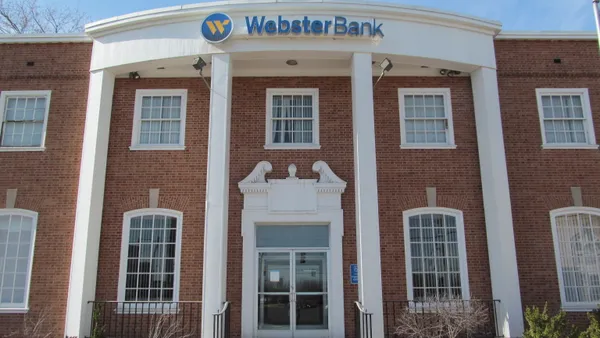
- Banco Santander has agreed to acquire Stamford, Connecticut-based Webster Financial Corporation for $12.3 billion in cash and stock, the companies said Tuesday.
- Under the deal’s terms, $84 billion-asset Webster would become a wholly-owned subsidiary of Santander. Christiana Riley will remain Santander’s country head in the U.S. and the CEO of Santander Holdings USA, while Webster CEO John Ciulla will become the CEO of Santander Bank, N.A., into which all of Webster’s businesses will be integrated, the companies said Tuesday.
- The deal is expected to close in the second half of the year and awaits regulatory approvals in the U.S. and E.U.
Dive Insight:
The transaction’s price tag tops that of last year’s biggest bank deal, Fifth Third’s $10.9 billion acquisition of Comerica.
The Webster acquisition would make Santander a top-10 retail and commercial bank in the U.S. by assets, with about $327 billion in assets, and a top-five deposit franchise in the Northeast, with about $172 billion in deposits, according to a securities filing.
The price represents a 16% premium to Webster’s 10-day volume-weighted average share price. Webster shareholders will receive $48.75 in cash and 2.0548 Santander American depository shares for each Webster common share they own. The total consideration of $75.59 per Webster share is based on the Spanish bank’s closing stock price Monday. The consideration mix is 65% cash and 35% newly issued Santander shares.
“As a larger organization, we will unlock greater scale, broader capabilities and new opportunities for growth — while remaining deeply focused on the people who define our success,” Ciulla said in the release. “I look forward to joining the Santander team and enhancing our ability to support our clients. As a Connecticut-based bank with deep roots in the region, we also look forward to continuing our commitment to the communities we serve.”
It was “paramount” to Webster’s board and Ciulla to partner with a company “that understands the importance and power of legacy as we do and the value we place on our clients,” Ciulla said.
“We found that shared commitment in Santander and are confident this transaction will create an even stronger partner to help our clients achieve their financial goals,” he said.
Banco Santander Executive Chair Ana Botín called the move “strategically significant for our U.S. business,” offering the Spanish lender greater scale and profitability in the U.S. The acquisition is equivalent to about 4% of Santander’s total assets.
“Webster is one of the most efficient and profitable banks among its peers and bringing together two highly complementary franchises will expand the products, technology and capabilities we can deliver, with clear revenue opportunities from a stronger, more capable combined franchise,” Botín said.
For Santander, the transaction is projected to bring 7% to 8% earnings accretion and about a 15% return on invested capital, Botín said. The merger is expected to generate combined cost synergies of about $800 million, Santander said in the securities filing.
Luis Massiani, Webster’s president and chief operating officer, will become COO of both Santander Holdings USA and Santander Bank, and lead the integration, reporting to both Riley and Ciulla. “This will ensure continuity of leadership and strong alignment with clients, colleagues, communities and regulators,” the companies said in the release.
Ciulla and Massiani will continue working out of Webster’s Stamford headquarters, which will become “a core corporate office” for Santander, alongside the Spanish lender’s existing offices in Boston, New York, Miami and Dallas.
Ciulla, Massiani and two additional current directors of Webster will join the boards of directors of both the holding company and the U.S. bank. Tim Ryan will continue to chair the boards of directors of both the holding company and bank.
Riley was appointed CEO of Santander’s U.S. bank one year ago, during a global restructuring.
On Tuesday, she called the Webster acquisition “a significant step forward in strengthening our commercial banking presence and filling in our retail branch footprint and scale, particularly in Connecticut where we are committed to maintaining a broad branch presence.”
Santander currently has about 379 U.S. branches, while Webster has about 196, according to Federal Reserve data.
“It is a fair question if U.S. regulators will love a European bank buying an American one under the current administration, but at ~0.3% of U.S. bank assets, it could be small enough to not matter, and of course Santander already has a U.S. bank 2x as large as Webster,” Truist Securities analyst David Smith wrote in a Tuesday note.
Editor’s note: This story is developing and will be updated.