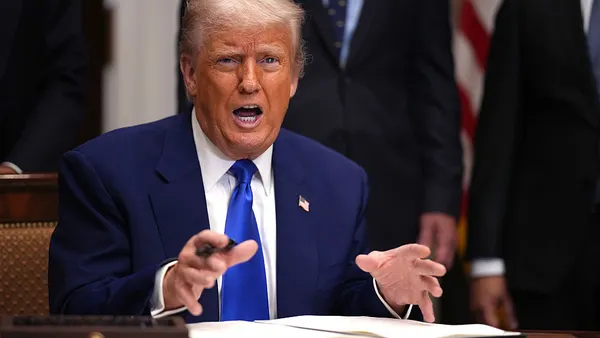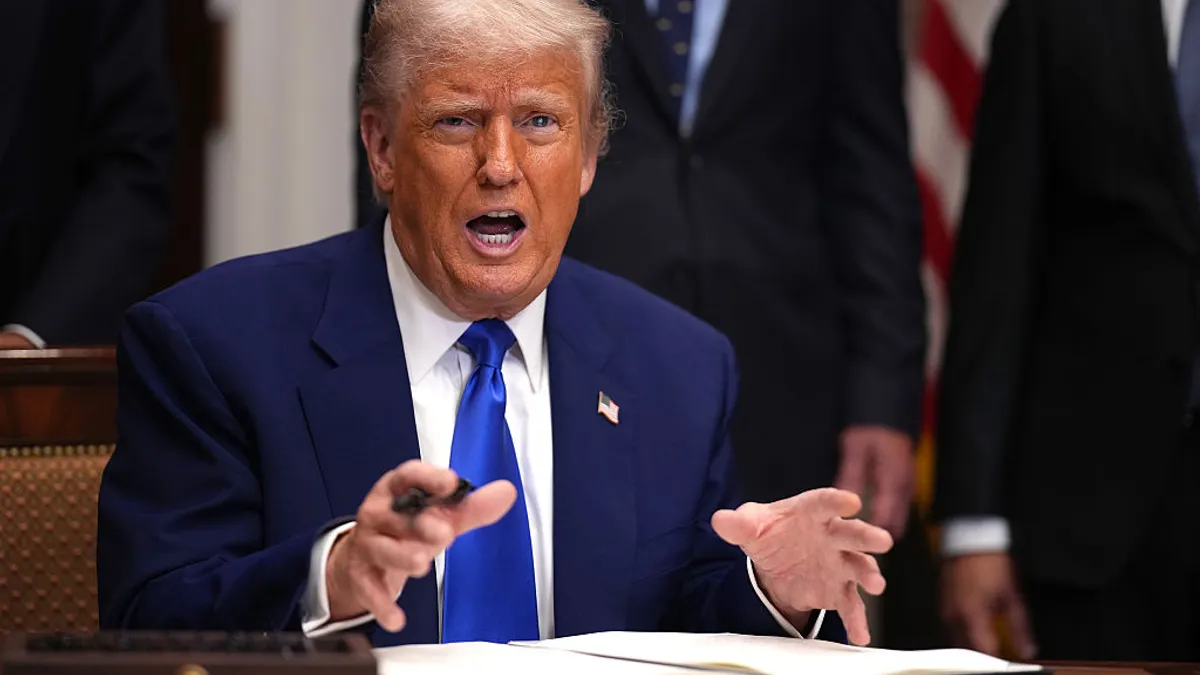
President Donald Trump signed an executive order Friday intended to confront cybercrime and fraud schemes, the day after a House subcommittee hearing detailed a “staggering” fraud problem and how to better address it.
Trump’s order called for a comprehensive review to identify “operational, technical, diplomatic, and regulatory tools” that could be improved to combat transnational criminal organizations that perpetrate cybercrime and fraud.
The edict also requires the submission of an action plan labeling the criminal organizations engaging in scams and cybercrime and solutions to take down their operations. Trump also wants the attorney general to prioritize prosecutions of cyber-enabled fraud and scams and offer a recommendation on establishing a program that would return seized funds to victims; and prodded the secretaries of State and Homeland Security to get involved in addressing the issue, too.
The Consumer Bankers Association applauded Trump’s order, saying it “has long called on policymakers to address the issue through a whole-of-government strategy that works across industries to protect consumers and their hard-earned money.”
Trump’s action “will enhance interagency coordination, pursue the criminal networks behind these attacks, and prioritize prosecution of cyber-enabled fraud,” the trade group said.
Trump’s order was issued the day after a House Financial Services subcommittee hearing featured bank and credit union executives emphasizing the need for better coordination among lenders, law enforcement and government to address the snowballing fraud problem.
Industry executives also voiced support for proposed legislation geared toward combating fraud and scams. The Transaction Risk Analytics and Collaborative Exchange Act, for example, would create a framework allowing banks, payment networks, fintechs and other financial institutions to share fraud-related information in a secure way.
Rep. Andy Barr, R-KY, the chair of the financial institutions subcommittee, said Thursday the scope of the fraud problem is “staggering,” with cybercrime losses jumping 33% in 2024, to $16.6 billion. Fraudsters are becoming more sophisticated, taking advantage of artificial intelligence and social media networks to perpetrate scams, as banks and credit unions devote substantial resources to fight back, he said.
Still, Barr cited “serious structural challenges” to confronting the issue, including an outdated legal framework that inhibits bank information-sharing, checking-account money availability rules written in a different era, and a lack of coordination between federal and local law enforcement.
Barr also said financial regulators “often lack robust understanding” of AI and machine learning, preventing the establishment of “clear guardrails” for lenders.
Gay Dempsey, the CEO of Fayetteville, Tennessee-based Bank of Lincoln County, told the subcommittee her bank has seen a significant rise in check fraud, as well as impostor scams, enabled by social media platforms and bitcoin ATMs.
The $225 million-asset lender is investing considerable time and resources in consumer education and staff training to spot fraud and report suspicious activity, since fraud losses exceed the bank’s loan losses, she said.
Scams in which victims are told to deposit money in bitcoin ATMs are “rampant,” Dempsey said, noting that it’s a challenge to get a customer to accept they’ve been the victim of a romance scam.
“We’ve literally pulled up Facebook and showed them the photo, and they’ve told us, ‘Oh, they told us you were going to do that.’ We’ve shown them FBI reports, we do everything that we can from our end when we identify those to stop it and to inform them,” Dempsey said.
Kate McKune, general counsel at Louisville, Kentucky-based Park Community Credit Union, said her credit union often runs up against “law enforcement’s limitations in terms of resources,” or it seems they can’t help unless losses are large enough.
“Oftentimes, no amount of security investment or intervention can fully compensate for a consumer’s decision to trust a scammer,” McKune said.
Patrick McDade, senior vice president for fraud and technology risk management at Jacksonville, Florida-based EverBank, noted impersonation scams ensnaring consumers and small businesses are “especially dangerous” because they erode customer trust.
The lack of coordination among banks and federal agencies stands in contrast to the fraudsters, who coordinate among themselves and don’t respect boundaries that law enforcement or other agencies do, witnesses said.
“We’ve had experience with banks where we call and they won’t give us any information just because of fear of sharing information, even though it should fall under the current [regulations] now, that they’re able to share with us and they don’t,” Dempsey said.
Banks can’t face the problem alone, and because fraud activity often originates outside the financial sector, a national strategy to combat scams is essential, McDade said.
Witnesses also recommended revising suspicious activity report policies to allow for “a fraud signal report.”
Once a lender is aware of fraud, a report would enable “a concise way to get the metadata associated with that fraud reported to law enforcement, and if all the banks did that in the same fashion, they could immediately cross-reference that essential data and see the patterns and actually reach out and warn other banks that they might have fraudulent accounts,” McDade said. “Or even go upstream to the telecoms and the social media accounts and let them know, we’re seeing fraud on this phone number, or on this account, please take it down.”
As fraud losses mount, the subcommittee’s Democrats also blasted the Trump administration for sidelining the Consumer Financial Protection Bureau and said Congress should restore the agency’s authority to supervise payment apps and digital wallets.