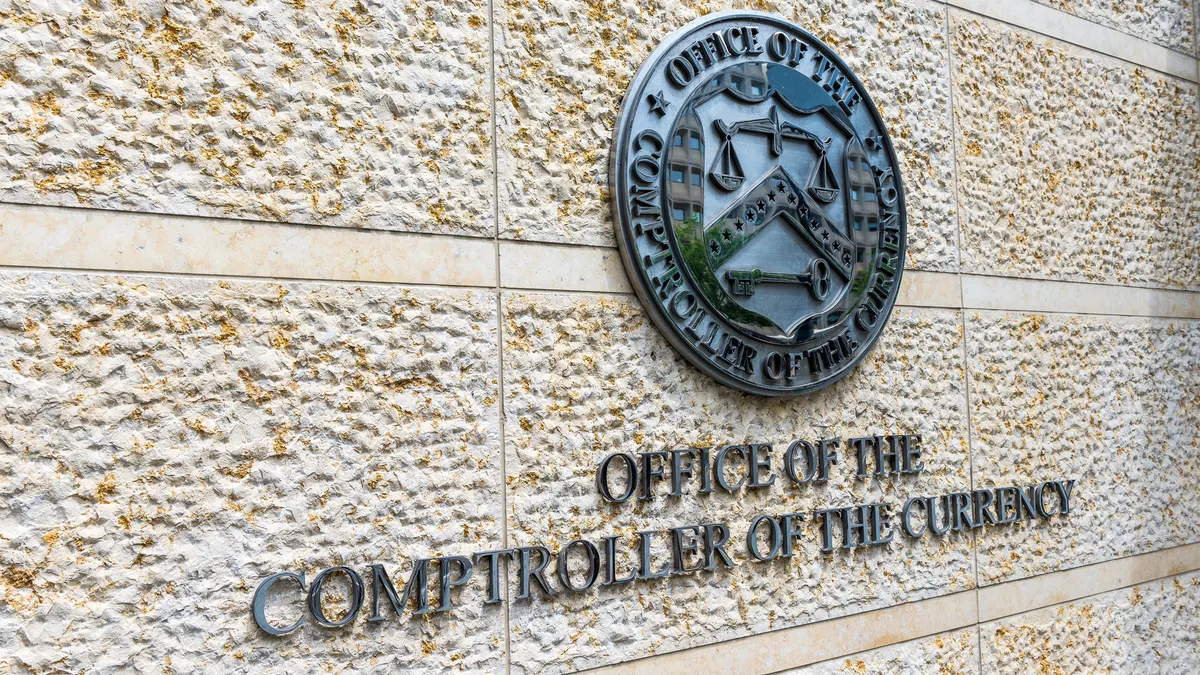
Upstart will submit applications to the Office of the Comptroller of the Currency and Federal Deposit Insurance Corp. to become a national bank, the company said Tuesday in a press release.
“The time is right to launch the first bank built from the ground up on AI,” Paul Gu, Upstart’s chief technology officer and incoming CEO, said in a statement. “Applying for a bank charter is the natural evolution of our business as we’ve grown in size, scale and product offerings.”
Annie Delgado, Upstart’s chief risk officer, called artificial intelligence-based lending the “future of credit.”
“As more and more lenders are looking to adopt AI tools for these critical functions, engagement with regulators is critical,” said Delgado, who would serve as CEO of Upstart Bank, a Delaware-based entity that would serve all 50 states but have no branches.
“If approved, we look forward to working directly with the OCC, FDIC and the Fed to set the standard for modern AI model deployment within the banking system,” Delgado said.
Upstart is also applying to the Federal Reserve to become a bank holding company.
Upstart was an early entrant into the AI-powered credit space. As far back as 2017, the fintech used the Consumer Financial Protection Bureau’s sandbox to experiment on an alternative data model that used factors like borrowers’ job history and education to help determine creditworthiness.
More than 90% of Upstart’s loans are now fully automated, the company said.
Upstart showed in 2019 that its alternative credit data drove loan approval up 27% over two years, with an average 16% drop in the annual percentage rate on those loans.
The company received the CFPB’s first no-action letter, which shielded it from penalties. Upstart’s agreement with the CFPB ended in 2022, when the agency established its Office of Competition and Innovation and wound down the sandbox in favor of “incubation events” such as sprints, hackathons, tabletop exercises and war games.
Upstart received a subpoena in 2023 from the Securities and Exchange Commission over disclosures the fintech made in relation to its use of AI models in lending.
A national charter, in theory, would help Upstart reach more customers and trim operational and regulatory costs by subjecting it to a single federal framework rather than a patchwork of state licenses.
“Eliminating duplication will permit more rapid product innovation and cut costs, which should translate into more approved applicants and lower rates,” Michele Alt, co-founder of financial services advisory and investing firm Klaros Group, told American Banker. Klaros is advising Upstart on its application process.
“A national charter will also allow more loans to be funded with insured deposits, enabling lower rates, thereby attracting more customers,” Alt said.
Tuesday’s announcement would make Upstart the latest fintech to join a groundswell of interest surrounding new charters. At least 18 banking charter applications were filed with the OCC last year, and several more have followed in 2026.
British neobank Revolut last week said it filed an application to become a national bank in the U.S.
Dutch neobank Bunq resubmitted its national bank charter application in January, and fintech Mercury applied in December. Brazilian lender Nubank received the OCC’s conditional approval for a national banking charter in January, four months after applying.
Erebor Bank has gone further, receiving a full green light from the OCC in February, less than four months after getting conditional approval from the agency, and less than two months after receiving the FDIC’s nod for deposit insurance.
Several other fintechs have applied for national trust bank charters, which allow firms to provide digital asset custody services but not deposit taking.
For its part, Upstart reinforced Tuesday that it is not trying to compete with its more than 100 banking partners for local customer deposits and checking accounts.
“Banks, credit unions, and institutional funds will continue to be the capital source for the vast majority of all loans originated on the Upstart platform,” Sanjay Datta, Upstart’s president and chief capital officer, said in a statement Tuesday.
About 95% of the loans Upstart originates are sold to its partners. The fintech said it wants to maintain that ratio after the bank launches.
“We will need deposits to source some amount of capital for the bank, and so we intend to use things like brokered deposits and other retail deposit offerings that would help us to do that without becoming a competitor to our lending partners,” Delgado told American Banker.
Upstart returned to profitability in 2025, reporting revenue of roughly $1 billion for the year. That’s a 64% increase from 2024, according to fourth-quarter earnings disclosed last month.
The fintech reported $18.6 million in profit for 2025’s fourth quarter – compared with a $2.8 million loss during the same three months a year earlier.