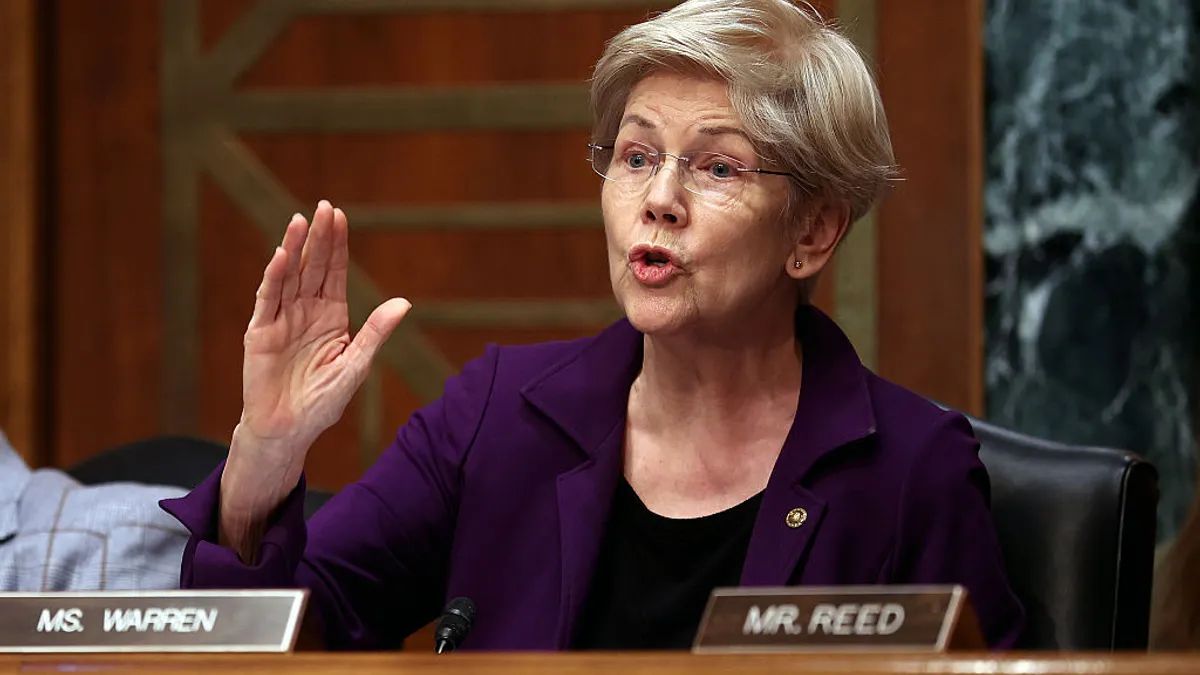
Sen. Elizabeth Warren, D-MA, is asking the Office of the Comptroller of the Currency to revoke United Texas Bank’s national banking charter.
The OCC in May approved United Texas’ bid to convert its charter from state regulation to oversight by a national agency.
The Federal Reserve, at the same time, signaled its nonobjection to the move — as did the Texas Department of Banking.
However, the conversion, completed in June, came while United Texas operated under a 2024 consent order. The Texas regulator, along with the Federal Reserve Bank of Dallas, identified “significant deficiencies” at United Texas “related to foreign correspondent banking and virtual currency customers,” including concerns over risk management and anti-money laundering compliance.
The OCC approved the charter switch on the condition that United Texas consent to a new enforcement action.
But Warren argued that’s not permitted under the Dodd-Frank Act, according to a letter sent Wednesday to OCC chief Jonathan Gould and Fed Vice Chair for Supervision Michelle Bowman.
“Granting United Texas Bank a national bank charter sets a dangerous precedent that gives other banks the green-light to convert their charters to the lowest common denominator regulator rather than fix the serious issues that may put the U.S. financial system at risk,” Warren wrote in the letter.
Section 612 of Dodd-Frank Act states that the OCC "may not approve the conversion of a State bank or State savings association to a national banking association or Federal savings association during any period in which the State bank or State savings association is subject to a cease and desist order (or other formal enforcement order) issued by, or a memorandum of understanding entered into with, a State bank supervisor or the appropriate Federal banking agency with respect to a significant supervisory matter or a final enforcement action by a State Attorney General."
Fed Gov. Michael Barr in May issued a dissent to the central bank’s nonobjection — and began it by quoting that specific passage.
He noted that while statutory exceptions can be made for some banks, “I do not believe the request for this charter conversion has made a compelling argument.”
“The issues raised by the public enforcement action include quite serious problems regarding the bank's anti-money laundering and terrorist financing practices,” Barr wrote.
Warren asked Gould and Bowman on Wednesday to detail, by Aug. 20, the legal and supervisory basis for approving the conversion, including any evidence of progress United Texas showed toward resolving the enforcement action.
In addition to the AML and risk management concerns, the Dallas Fed and Texas state banking regulator in 2024 ordered United Texas to address “significant deficiencies” in corporate governance and oversight by the bank’s board and senior management.
However, when the OCC issued its follow-up consent order against United Texas in June, the corporate governance portion was missing — an absence Warren noted in her letter.
Regulators’ conversion decision “highlights the deficiencies in the OCC's process for reviewing charter applications as it has already improperly granted a slew of national trust charters to seemingly ineligible cryptocurrency companies,” Warren wrote.
"Considering that crypto technologies make legal enforcement against money laundering more difficult, allowing a bank that is already facing [Bank Secrecy Act]/AML compliance issues to grow this business model poses significant risk to the financial system,” Warren wrote.
The letter was first reported by American Banker.