January. May. September.
For years, you could set your watch by it (if you still wear a watch that requires setting).
These are the points during the year when banks push for more robust office attendance: after the New Year holiday, before summer and just after.
In the COVID-19 years, Labor Day became a benchmark for banks to tighten return-to-office policy. As years progressed, pre-Memorial Day policy announcements became de rigueur. In recent years, banks have issued “reminders” or, my favorite, “letters of education” – often just after the new year – as a way to say, “Welcome back. We’ll be seeing more of you.”
Such policy pronouncements have felt less frequent of late. In the past year, for example, TD began requiring employees to work from the office four days a week. Truist and PNC have mandated five. Bank of America became more particular about which days of the week employees could work remotely. And, oddly, Goldman Sachs CEO David Solomon – perhaps the O.G. hard-charger for post-COVID in-office work – said his bank doesn’t have a hard-and-fast five-day rule.
“We don’t have a policy. We work,” he said last October.
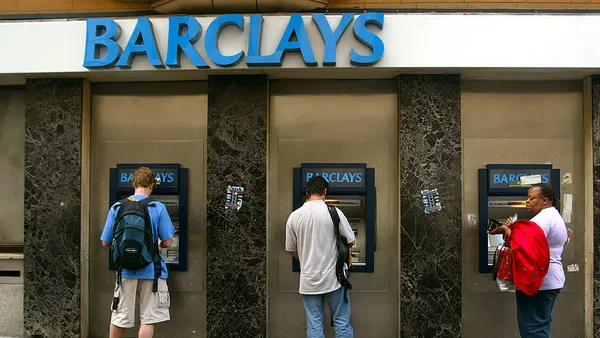
An ocean away, meanwhile, Barclays is seeing resistance against an attempt to bring employees back into the office three days a week starting next month. Four, if you’re a managing director or other senior leader.
Thousands of Barclays staff members have signed an open letter from Unite, the workers union that represents roughly 80% of U.K.-based employees of the bank, according to Rick Coyle, a national officer at the union.
The union is calling for Barclays to reverse its decision to boost the in-office requirement from two days a week to three. Unite demands that employees be exempt from the three-day-a-week mandate if their commutes are more than 40 minutes or 35 miles each way. The union is also asking that affected employees be allowed to work split shifts or be given flexible start or end times if they’re responsible for childcare, or when it’s feasible to avoid “peak” commute times.
Unite also wants Barclays to issue a one-off payment by March 2027 to offset increased costs to affected employees. And the union is seeking a maximum one-day-a-week in-office requirement for “carers” whose responsibilities last more than three months.
“Our members think that Barclays is trying to fix a problem that doesn’t exist,” Coyle said, according to the Financial Times. “Unite will be speaking to Barclays about the strength of feeling in the days ahead.”
Barclays, which announced the pending policy change in July, said it is continuing to engage with Unite but has declined thus far to meet the union’s demands.
“We recognise the benefits of balancing flexibility for colleagues with the importance of working together in our physical locations,” the bank said in a statement seen by Banking Dive. “Our minimum time in office requirements vary by business area, reflecting the nature of the work and the needs of the business. This means that most of our colleagues who are not already working in the office three days [a week] will align with our broader approach across the bank.”
The U.K. government this month unveiled plans to make it more difficult for employers to block flexible working requests. A change in law would force employers to hold a face-to-face meeting with employees requesting to work from home and provide a “justifiable reason” to deny it, according to The Times of London.
In its open letter, Unite said Barclays “is not able to provide an evidence-based rationale for increasing minimum office attendance requirements.”
“Workers across Barclays continue to deliver strong financial results, improved customer outcomes, successful digital transformation, and high operational performance,” the union said. “These achievements have been repeatedly recognised in recent internal communications from senior leaders. In this context, Unite does not believe that significantly increasing mandatory office attendance represents a proportionate or necessary response.”
The changes to Barclays’ in-office requirement would affect roughly half of Barclays' 45,000 U.K. employees, according to Investment News, with operations and technology teams affected most.