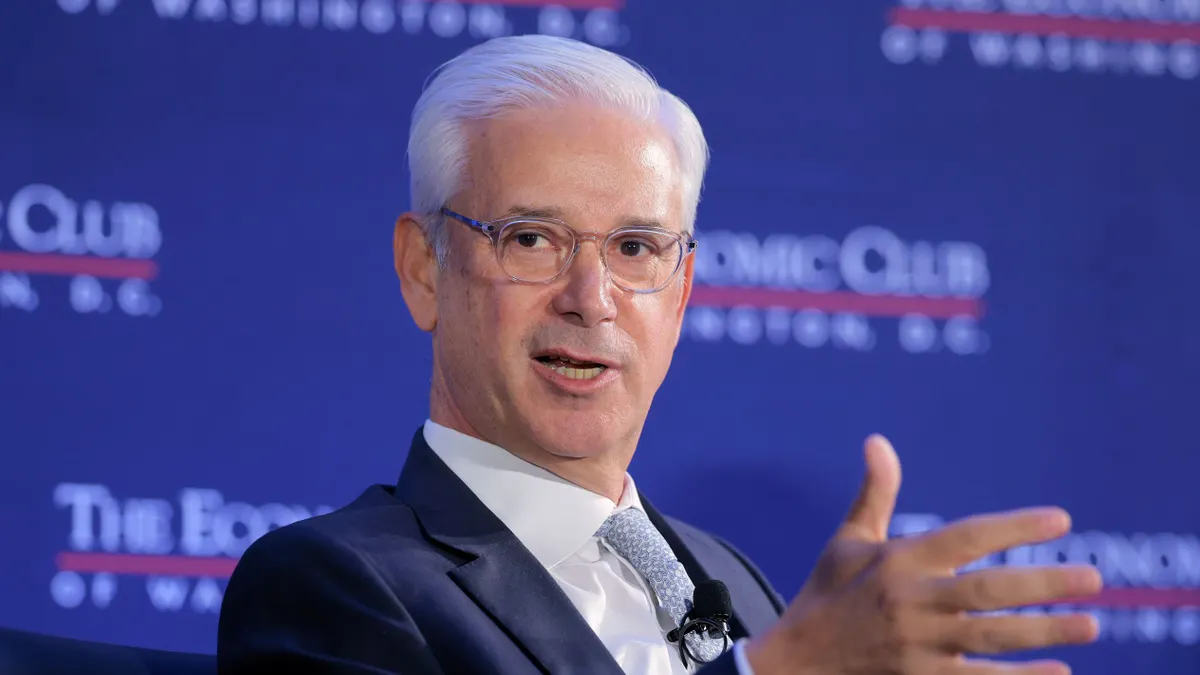
Wells Fargo CEO Charlie Scharf said Wednesday the impact artificial intelligence will have on employment is more nuanced than current debate suggests.
“I find it very surprising when really smart people take one side or the other,” Scharf said during an appearance at a Bernstein investor conference. “They sit there and they say, ‘it's not a threat to employment,’ or they sit there and say, ‘it's a huge threat to employment.’”
“It's so obvious to me, looking at the way we're using AI inside the company, it is both of those things,” the CEO of the San Francisco-based bank said. “The risk is that they're not totally aligned, in terms of the same people and the timing of it.”
In April, Scharf said most of the bank’s employees have been given basic AI tools. Wells executives are assessing how the bank can use the tools to become more efficient and provide better products and services, Scharf said.
They’re also examining the impact of AI on the bank’s customer base, given its lending exposure, and “we're very actively thinking about what that means for the risk that we take, and also where we should be doing more, not just where we should be doing less,” he said.
But “the most complicated” AI-related issue, Scharf said, is how the technology can transform Wells Fargo’s business model, “and is that a plus or a minus in terms of how we react to that?” Scharf said.
AI-powered tools being developed will result in more efficient operations at the $2.2 trillion-asset bank, he said. “We know that, we see that, we’re planning for it every step of the way,” Scharf said.
The CEO named auditing, testing, legal, contracts, patent filings, pitchbooks in investment banking and credit memos as a handful of areas across the company executives see room for AI to improve processes.
“How much of that actually results in pure margin or return expansion is to be seen,” Scharf said, since competitors will be chasing similar AI goals, but it is “a net positive” for the company’s future expense base.
The bank also plans to hire more people who can build models or will be able to use the tools being built to better serve customers. “People don’t go away in this,” he said.
“We’ve got this mismatch, that, as a country, we’re going to have to deal with,” Scharf said. The bank is actively mulling how to get ahead of that through things such as employee retraining.
Large banks have raced to weave AI into their operations and realize the benefits. An estimated one-third of bank jobs or portions of jobs may eventually be better handled by AI, Wells Fargo analyst Mike Mayo has said.
While the bank’s rivals have been driving toward greater efficiency for the last decade or so, Wells Fargo “wasn’t good at expense discipline for a long period of time,” Scharf said. “Then we had all of these issues where we were forced to spend a lot of money – gigantic amounts of money, over $2.5 billion a year – to actually fix a lot of these things,” he said.
Scharf was referring to the bank’s 2016 fake-accounts scandal and the regulatory work Wells was ordered to complete in the wake of it. A $1.95 trillion asset cap imposed on the bank was lifted in June 2025, after seven years.
Concurrently, the bank has sought to “unpack a lot of the processes,” eliminating redundancies across the company, he said.
Since Scharf became CEO in late 2019, the bank has slashed headcount, from about 275,000 people to 205,000, and sold a couple of businesses, he said. The bank’s first-quarter earnings materials put headcount at about 201,000.
Ultimately, Wells has cut about $15 billion in expenses, but added about $9 billion in new investments, including hiring bankers and marketing, Scharf said.
Those efforts have improved the bank’s performance and resulted in better customer service, he asserted, “because we're just eliminating all of the wasteful things that have happened inside the company. We want to do as much through normal attrition as we can, and we would say just on that journey, we're far from done. Not even close.”
As the company considers its spending, there are two conversations: “Every part of the company, area by area, how can we do more with less? And then, what are all the things that we want to do to spend to grow the business?” Scharf said.
Wells Fargo projects this year’s non-interest expenses to total $55.7 billion, which would be about a 1.5% increase over last year’s $54.8 billion. In 2024, the bank’s non-interest expenses totaled $54.6 billion.
“We have targeted, intentionally, restraint on the overall expense base,” Scharf said. “That just forces us to become even more diligent about freeing up resources so we can invest more.”
When asked by Autonomous Research analyst Ken Usdin where executives aim to further cut costs, Scharf pointed to the bank’s multiple call center platforms and multiple testing functions. “Given the scope of the company and the amount of redundancy that existed, there’s still things just like that,” he said.