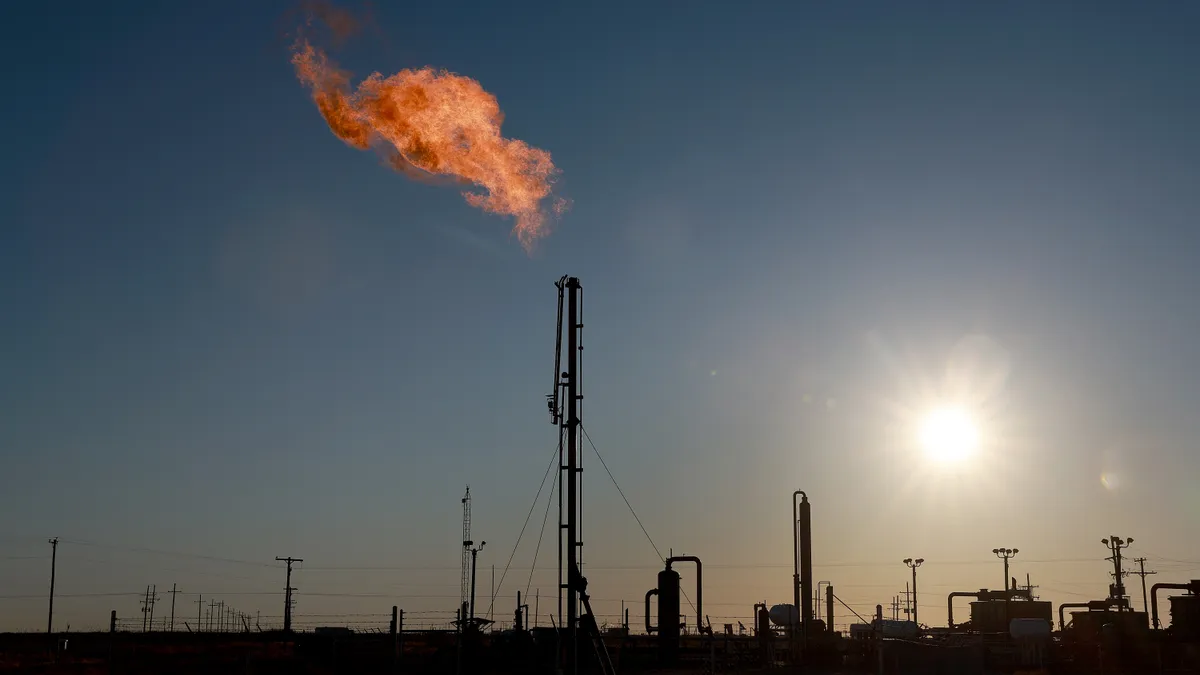

The world’s largest banks increased funding for fossil fuel companies and projects by 8% in 2025, marking the second consecutive annual swell, according to the latest Banking on Climate Chaos report. Additionally, the report documented a 27% increase in funding for fossil fuel expansion among measured banks.
The report, released Monday, found that the largest 65 banks contributed $906 billion in fossil fuel financing in 2025, up from $842.6 billion in 2024.
U.S.-based banks were responsible for nearly one-third (32.2%) of fossil fuel funding last year, and the U.S. showed the largest increase of any of the tracked regions, with $35 billion more in financing than 2024, according to the report, compiled by the Rainforest Action Network, Sierra Club, Reclaim Finance and others.
“The scale of finance still flowing to fossil fuels — especially fossil fuel expansion — shows how deeply major banks remain tied to a climate-wrecking business model,” Lucie Pinson, Reclaim Finance’s founder, said in a Monday press release. “Yet while U.S. and Japanese banks continue to pour billions into coal, oil and gas in pursuit of short-term profits, regardless of the consequences for the living world, some European banks have started adopting measures to restrict financing for new oil and gas upstream expansion.”
JPMorgan Chase was the top fossil fuel financier for the third year in a row, and for the fourth time in the last five years, according to the annual report. The bank upped its funding for fossil fuel companies by 12.5% from 2024, with $58.2 billion committed in 2025.
Bank of America committed the second-highest amount of financing to fossil fuel companies for the second year in a row, with $47.3 billion in funding tallied for 2025. However, two Japan-based banks — Mitsubishi UFJ and Mizuho — knocked Citi out of the top three with substantial increases in commitments to fossil fuel companies.
Mitsubishi UFJ increased its funding by $8.2 billion, or 21%, to $47 billion last year; it was the largest single-year increase by amount. Mizuho gave $46.5 billion to fossil fuel companies in 2025, a 12.8% increase from 2024. Citi rounded out the top five, with $45.3 billion in documented 2025 financing.
The increases in fossil fuel funding and funding for fossil fuel expansion came amid the demise of the United Nations-backed Net-Zero Banking Alliance. After an exodus of North American banks surrounding the inauguration of President Donald Trump, the climate coalition later abandoned the membership model altogether as the departures continued to trickle and spread.
The report’s researchers said the absence of such voluntary commitments — and “anti-climate political pressure,” that’s “particularly acute” in the U.S. — banks have loosened financial restrictions and policies around fossil fuels, or gotten rid of climate targets. The report noted that amid these shifts, Canadian banks such as RBC and Scotiabank have dropped 2030 decarbonization targets. Scotiabank also got rid of a 2050 net-zero target.
The researchers also said fewer of the banks have oil and gas sector policies than in recent years — 34 out of the 65, as of May 2026 — and eight banks have removed or weakened language around their policies for the sector. There was also a slight dip in banks with coal policies — 44 in 2025 from 46 the year before; financing for coal power and mining expansion both increased last year.
“Voluntary pledges have had their chance,” the report’s co-author, Diogo Silva, a campaign lead at BankTrack, said in the release, adding that the financial sector needs “binding rules — not promises.”
“Banks keep telling us they’re committed to climate. Then they abandon their own policies the moment political pressure mounts,” Silva said.
2025 also showed a widening gap between banks decreasing funding for oil, natural gas and coal power generation and the banks and regions increasing. There were 26 banks that decreased fossil fuel financing in 2025, with a concentration among European institutions, according to the report. Meanwhile, the 12 largest financiers of fossil fuels now account for nearly 40% of global bank fossil fuel financing.
“Our research reveals a widening gap between the banks that take the climate crisis seriously and those who act like it doesn’t exist,” report co-author Philipp Noack, a finance campaigner for nonprofit Urgewald, said in the release. “Banks play a critical role in the transition towards a sustainable energy and economic system, and each one of them should step up to the plate.”
Canada-based BMO had the largest decrease in fossil fuel financing, by amount, in 2025, with $3.9 billion less, followed by European banks BNP Paribas ($3.8 billion decrease), BPCE ($3.1 billion decrease), UBS ($2.1 billion decrease) and Barclays ($1.9 billion decrease).