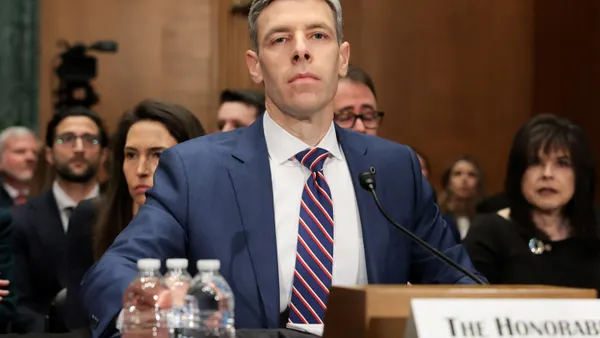
Brian Johnson, President Donald Trump’s nominee to lead the Consumer Financial Protection Bureau, has pledged to recuse himself from any matters involving Capital One for two years if he is confirmed, according to an agreement signed last week.
Johnson has served as a vice president and U.S. card compliance officer at Capital One since November 2024 and was deputy director of the CFPB – or acting in that role – between 2018 and 2020, according to his LinkedIn profile.
Johnson is set to face the Senate Banking Committee on Thursday for a confirmation hearing.
His nomination, though, has received pushback from at least one committee Democrat concerned over potential conflict of interest.
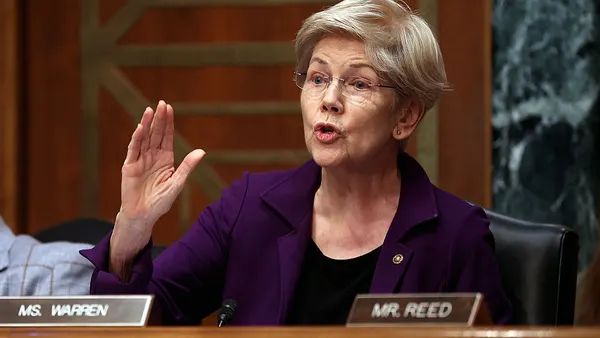
Sen. Elizabeth Warren of Massachusetts, the committee’s ranking member, wrote Capital One CEO Richard Fairbank last month, asking for copies of any correspondence between Johnson and the CFPB – specifically regarding the agency’s decision to drop its lawsuit against the bank just a month after suing.
Warren asked Fairbank to detail any advice Johnson may have given Capital One internally about CFPB enforcement actions.
The CFPB in January 2025 – six days before Trump returned to the White House – sued Capital One, alleging the bank obscured the release of a savings account that would have offered higher interest rates to existing customers.
As part of last week’s ethics agreement, Johnson pledged to forfeit any unvested Capital One restricted stock units and to divest any Capital One stock within 90 days of confirmation.
Johnson also noted that he agreed to repay to Capital One an anniversary bonus from last year and 50% of a sign-on bonus that he received in 2024, based on his presumed resignation date if confirmed, but that the bank “has determined that I will not be required to repay any portion.”
Johnson also agreed to divest his interests in several financial institutions, including JPMorgan Chase, Goldman Sachs, Morgan Stanley, BNY, PNC, Visa, Mastercard, American Express, Charles Schwab and BlackRock.
Further, according to the agreement, Johnson will not repurchase any asset he was required to divest without consulting a CFPB ethics official and the Office of Government Ethics.
Trump nominated Johnson to lead the CFPB in June. The term for the agency’s current acting director, Russ Vought, expires Aug. 1.
Vought testified last week in front of the Senate Banking Committee and House Financial Services Committee, where several lawmakers grilled him over efforts to lay off workers, rescind previous guidance, drop enforcement actions and lawsuits, and delete press releases and speeches from previous administrations.
“You should preserve all of your emails, text messages, and other forms of communication with respect to your CFPB work,” Rep. Maxine Waters, D-CA, the ranking member of the House Financial Services Committee, told Vought last Wednesday. “While your work may be done and a new director may be confirmed, let me be clear, we are not done with you.”