Dive Brief:
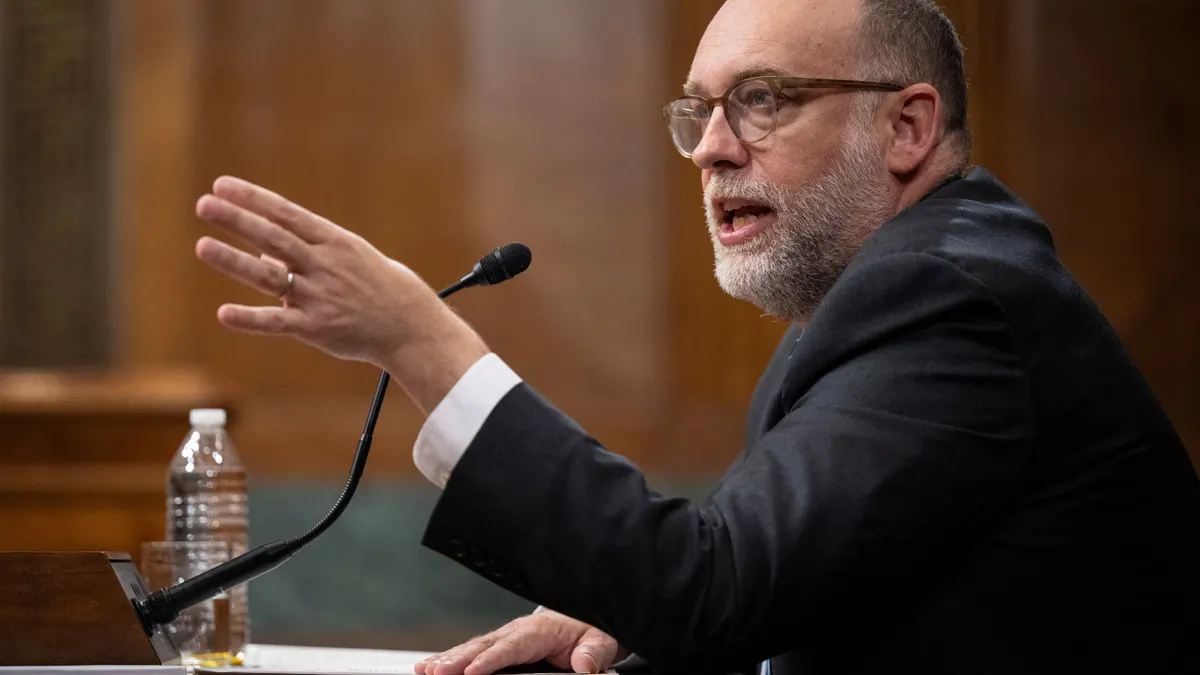
- Russ Vought, acting director of the Consumer Financial Protection Bureau, told the Senate Banking Committee on Thursday the agency “remains structurally defective,” and should not exist in “its current form.”
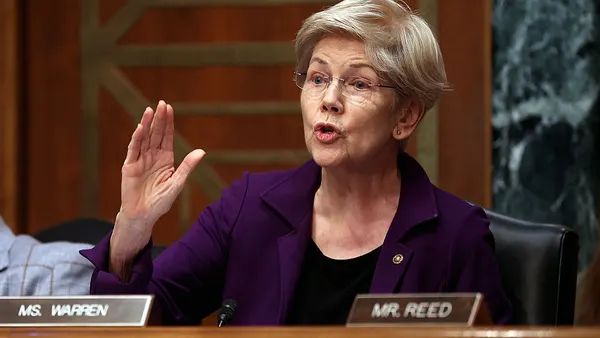
- The hearing saw Vought squaring off with Sen. Elizabeth Warren, D-MA, the architect of the CFPB. Warren skewered the bureau for dropping enforcement actions and investigations, many of which involved companies – including JPMorgan Chase, Bank of America and Capital One – that donated to President Donald Trump, she contended. “Corruption at the CFPB is costing American families,” Warren said. “No matter how many people you have hurt, if you've got the cash, Donald Trump and Mr. Vought have a pardon for you.”
- The committee’s chair, Sen. Tim Scott, R-SC, and other Republicans, meanwhile, praised many of Vought’s moves and drew a sharp distinction between the current CFPB and the one led by former director Rohit Chopra. “Finally, we have a bureau that respects the limits of its authority. A bureau that follows its mandate instead of pursuing an ideological agenda,” Scott said.
Dive Insight:
This week marks Vought’s first appearances before Congress as acting director of the CFPB. He testified before the House Financial Services Committee on Wednesday.
Vought, who’s also the director of the Office of Management and Budget, has led the charge to decimate the CFPB, indicating last October he intended to shutter the bureau in “two to three months.”
The agency, under his watch, has tried to lay off hundreds of workers, rescinded previous guidance, dropped enforcement actions and lawsuits, and deleted press releases, speeches and more that predate Trump’s second term. The CFPB currently has 1,071 employees, he said Thursday.
Vought told the Senate Banking Committee on Thursday that upon taking charge of the CFPB in February 2025, he found an agency that was “weaponized, out of control, and had gone far beyond its statutory mandate.”
“Under previous administrations, this agency actually imposed huge costs on the American people and stifled the innovation and resourcefulness that is necessary for a strong economy,” Vought told senators. “Instead of going down this destructive path, we have steered the bureau toward operating with humility, accountability and fiscal responsibility.”
While officials have tried to “downscale this agency to the maximum extent possible and rein in its abuses,” they’ve continued to operate in accordance with the bureau’s purpose – “to implement and enforce federal consumer financial law consistently,” Vought said.
He said current bureau officials have been clear about their priorities.
“We've taken a lot of steps to cancel enforcements that were done on novel legal theories that we didn't have the statute to do, and we’ve focused on identifiable victims, actual consumer harm that's material and measurable,” he said. “We've also taken the view that if there are state regulators or other agencies taking action, that they can take the lead on that, and we will fill in the gaps.”
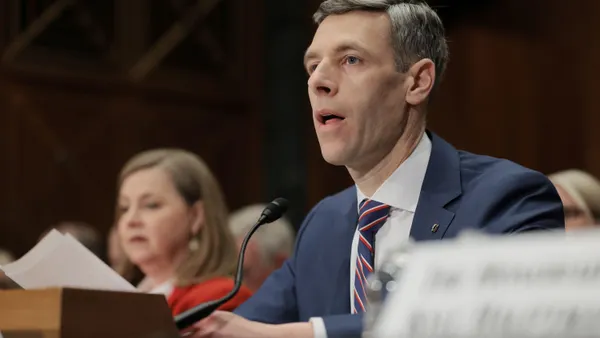
Vought will remain at the helm of the agency through Aug. 1. The White House has nominated Brian Johnson, a Capital One executive and former CFPB deputy director, to lead the agency. A nomination hearing before the Senate Banking Committee has been set for July 23.
A report issued Thursday by committee Democrats estimates Vought’s “attack” on the CFPB has cost American consumers about $26.5 billion.
That includes about $7.5 billion in the first half of 2026, in addition to $19 billion in 2025, stemming from rescissions of credit card late fee and overdraft fee rules. Democrats also noted the CFPB has returned $21 billion to consumers since its 2011 founding.
They blasted Vought over the treatment of federal employees as the now-disbanded Department of Government Efficiency pursued cuts across government agencies and for saying he wanted to put federal workers “in trauma.”
They accused the CFPB of failing to help military service members, pointing to the agency’s 2025 reversal of an order requiring Navy Federal Credit Union to pay $95 million. Vought said Thursday that the credit union paid the $15 million civil penalty, but the CFPB canceled the order to pay $80.6 million in consumer redress.
Sens. Mark Warner, D-VA, and Lisa Blunt Rochester, D-DE, also slammed Vought over the administration’s actions and attitude toward community development financial institutions. Vought said “tons” of those lenders “were incredibly woke” during the Biden administration, “and we have concerns with that.”
Republicans largely lauded Vought’s reforms and his move away from a “sue and settle” mindset.
Scott said “the best way to protect consumers is through competition, choice and clear rules, not through heavy-handed Washington control that leaves consumers with fewer and fewer options.”
Sen. Pete Ricketts, R-NE, asserted that the CFPB isn’t the only cop on the consumer protection beat. “The CFPB is just another added layer of bureaucracy on top of regulatory organizations who are responsible for doing this,” he said.
Vought argued it is more problematic for the CFPB to be exempt from the appropriations process than to have a single, unelected director.
“The main defect was putting it under the [Federal Reserve], in which you have no ability to have any sense of responsibility to come to Congress and justify how you're running the agency,” Vought said Thursday.
As Vought’s time at the CFPB runs out, Rep. Maxine Waters, D-CA, offered him a warning Wednesday during his House testimony.
“You should preserve all of your emails, text messages, and other forms of communication with respect to your CFPB work,” said Waters, the ranking member. “While your work may be done and a new director may be confirmed, let me be clear, we are not done with you.”