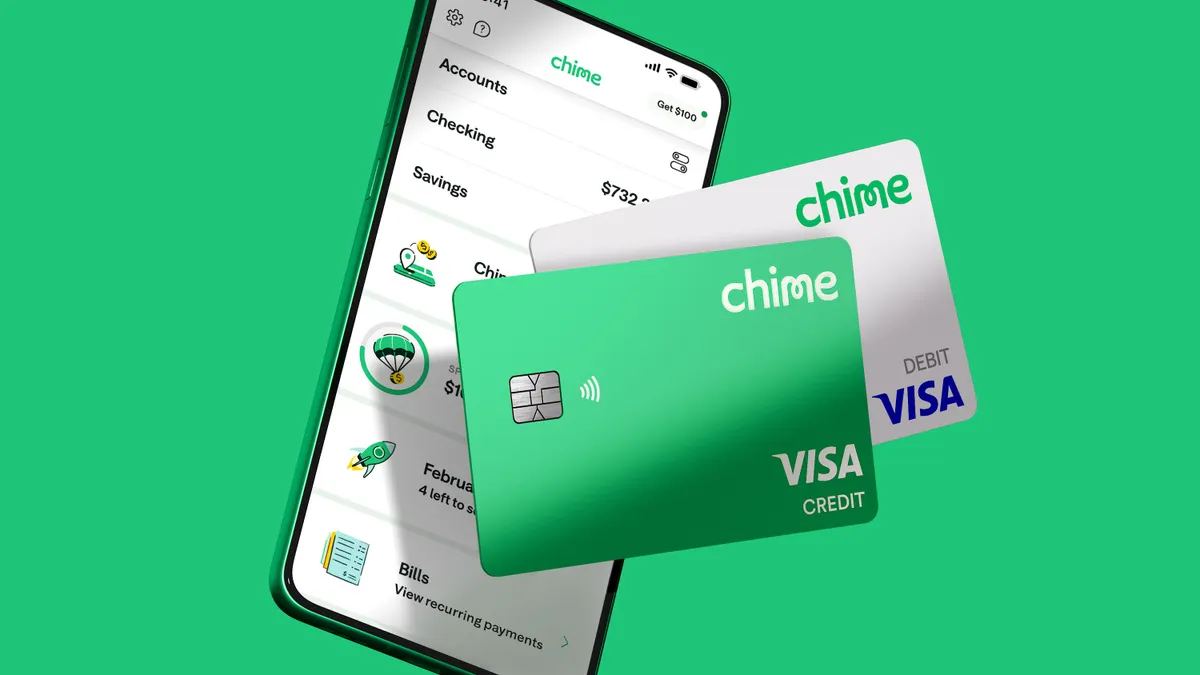
Chime is a fintech, not a bank. But that’s a distinction the company is constantly evaluating, an executive said this week, particularly amid a regulatory climate seeming more amenable to fintechs obtaining bank charters.
“We would never rule it out,” Mark Troughton, the fintech’s chief operating officer, said of pursuing a bank charter. Chime works with Stride Bank and The Bancorp Bank to offer its customers Federal Deposit Insurance Corp.-insured banking services.
Under the Trump administration, banking regulators have signaled a greater appetite for chartering, and that’s inspired companies to pursue industrial loan company charters, cryptocurrency firms to seek trust charters, and fostered an uptick in de novo bank applications. Brazilian fintech Nubank has applied for a charter, and U.K. fintech Revolut is eyeing one, too.
“We applaud what regulators are doing right now in terms of opening up the chartering process and making charters more available to reputable players,” Troughton said in a recent interview.

Pursuing a charter is something the San Francisco-based fintech reevaluates every six months, he said.
“Today, we feel like the advantages of the bank partnership model are greater for us than the costs,” he said. “Now, that may change over time, and we will continue to evaluate that.”
Chime, founded in 2012, went public in June. As of the third quarter, the fintech has about 9.1 million active members – up by about 400,000 from the second quarter, and 21% year over year, according to quarterly earnings materials.
Troughton pointed to the results of a recent J.D. Power survey as a sign of the traction Chime is gaining in the market.
“There's a massive shift happening in banking today, and the leaders in core checking accounts in the next two or three years are going to be very different to what they have been in the last few,” Troughton said.
The consumer insights and analytics company’s polling from August and September revealed 13% of new checking accounts opened in the third quarter were with Chime. That outpaced all other banks, including JPMorgan Chase (9%), Wells Fargo (7%) and Bank of America (7%).
To be sure, Chime has plenty of ground to gain, since those big banks have tens of millions of consumer customers.
“Our longer-term aspiration is to be the leading provider of primary financial relationships in the U.S.,” Troughton said. “We think we can really get there in the next few years.”
Chime’s core market is what it labels “everyday Americans,” the roughly 200 million people making up to $100,000 annually. The company has positioned itself as a financial services provider that stays away from overdraft, monthly service or minimum balance fees, and offers credit building and short-term liquidity services.
Troughton sought to distinguish Chime’s business model and focus from those of bank competitors, saying the needs of customers Chime aims to serve are “quite different” from those of high-net-worth consumers that banks target.
Traditional banks’ reliance on net interest margin makes it challenging to serve customers with low balances in their accounts, while Chime’s payments-driven business model relies on interchange fees, Troughton said.
“On the product and the cost side, and increasingly on the brand side, we feel like we're getting stronger relative to traditional banks, as we get bigger, and we hope to try and accelerate that gap over time,” he said.
To generate enough revenue per user, Chime has sought to focus on building long-term, primary account relationships, Troughton said. Large banks such as PNC and Truist have recently highlighted their aim to increase primacy with customers and foster more engaged, durable relationships.
From Chime’s earliest investor pitches, the company has been focused on primacy and getting customers’ direct deposits, Troughton asserted.
“Venture capitalists were telling us, ‘But you can't just create a primary financial relationship. Surely you have to go in with a wedge product, like a savings or investing or something like that, and then build a relationship over time,’” he said. “It doesn't work that way.”
J.D. Power also pointed to Chime’s high conversion rate for customers considering opening checking (77%) and savings accounts (86%), noting the fintech is not only drawing new customers from traditional banks, but also from the likes of SoFi and Cash App.
“Eighty-five percent of people who come to Chime come from a relationship with a large bank,” Troughton said. “These are everyday Americans who are part of the banking system. We're just offering a better solution. This is not unbanked or low-income people.”
Chime is seeing the fastest account growth among consumers making $75,000 to $100,000 per year, he said. Troughton argued the products Chime offers today hold appeal for consumers above the $100,000 threshold, particularly those in expensive cities such as San Francisco, Los Angeles or New York.
Still, to broaden its reach to serve consumers making up to $200,000 a year, the fintech plans to lean into premium products offering rewards and high annual percentage yields without carrying the costs of more expensive premium credit cards, Troughton said. A premium membership tier is expected to be launched next year.
Chime also plans to expand into investments as well as joint accounts and custodial accounts “to better serve our members and give them more flexibility and serve their families,” he said.
As the company has grown, so have its expenses. In the third quarter, the company’s revenue rose 29% year over year, to $544 million. But operating expenses also jumped about 35%, to $539 million.
The fintech recorded a $55 million loss for the quarter, compared with a $923 million loss in the previous three months, when it went public. Chime recorded a $13 million profit in the first quarter of the year, according to its S-1 filing. Its stock price is down nearly 40% since June.
Marketing is one area where the company’s spending has increased over the past year, although Troughton noted Chime has been able to lower its customer acquisition cost by about 10% year over year. With the value customers bring the company compared to the cost to acquire them, “we're going to continue to lean into marketing,” he said.
Chime’s expense framework “is probably about a third of that of a big bank and about a fifth of that of a community bank,” since the company runs its own tech stack and doesn’t operate branch or ATM networks, Troughton said.