The Federal Deposit Insurance Corp. rescinded a 2009 policy that kept nonbanks such as private equity firms from bidding on failed banks.
The policy included “onerous and highly prescriptive measures,” according to a Thursday memo, including capital standards that don’t apply to other failed bank acquisitions and restrictive limits on transactions.
“The FDIC recognizes that nonbank entities such as private equity firms can play a significant role in the resolution process, given their ability to access and deploy significant pools of capital,” the agency wrote.
Continuing to apply the policy “may have a deterrent effect on private capital investment and inhibit the infusion of a potentially significant flow of capital into failed institutions,” it wrote.
The rationale for the policy shift comes from the regional bank crisis of 2023, when Silicon Valley Bank, Signature Bank and First Republic failed in quick succession. Nonbanks participated in the auctions of these three banks, the FDIC said, but their options for bidding and the participation of other nonbanks were likely limited by the policy.
“Given the increased speed with which a bank failure may occur, in part driven by the advancement of technology and ongoing evolution of the financial system, these impacts could, in turn, result in considerably increased costs of resolution and risk to the Deposit Insurance Fund,” the FDIC wrote.
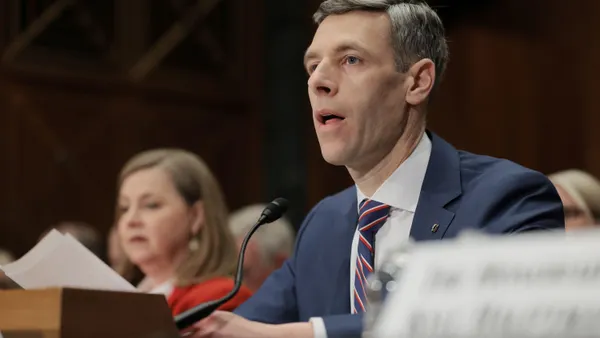
The agency’s chair, Travis Hill, hinted at the change this month at the American Bankers Association Washington Summit.
“Today, there is no path for nonbank entities to buy such a bank outright in a short period of time,” he said, pitching a scenario in which a large bank fails on short notice and the most viable purchasers are nonbanks.
With the presence of other regulatory requirements, removing the current restrictions on nonbanks bidding on failed banks “will not increase risk for the acquired bank or acquiring entity,” Hill said.
Rather, the removal of the barrier for nonbanks “can ultimately reduce the cost of failures to the [Deposit Insurance Fund] and increase the likelihood of a stabilizing resolution outcome,” he said.
Regulators are exploring the possibility of creating an emergency exception that would allow a nonbank to rapidly set up a shelf charter to bid on a failed bank, Hill said. The shelf charter process, which includes approvals from a chartering authority, the FDIC, and sometimes the Federal Reserve, currently takes “months or years,” he said.