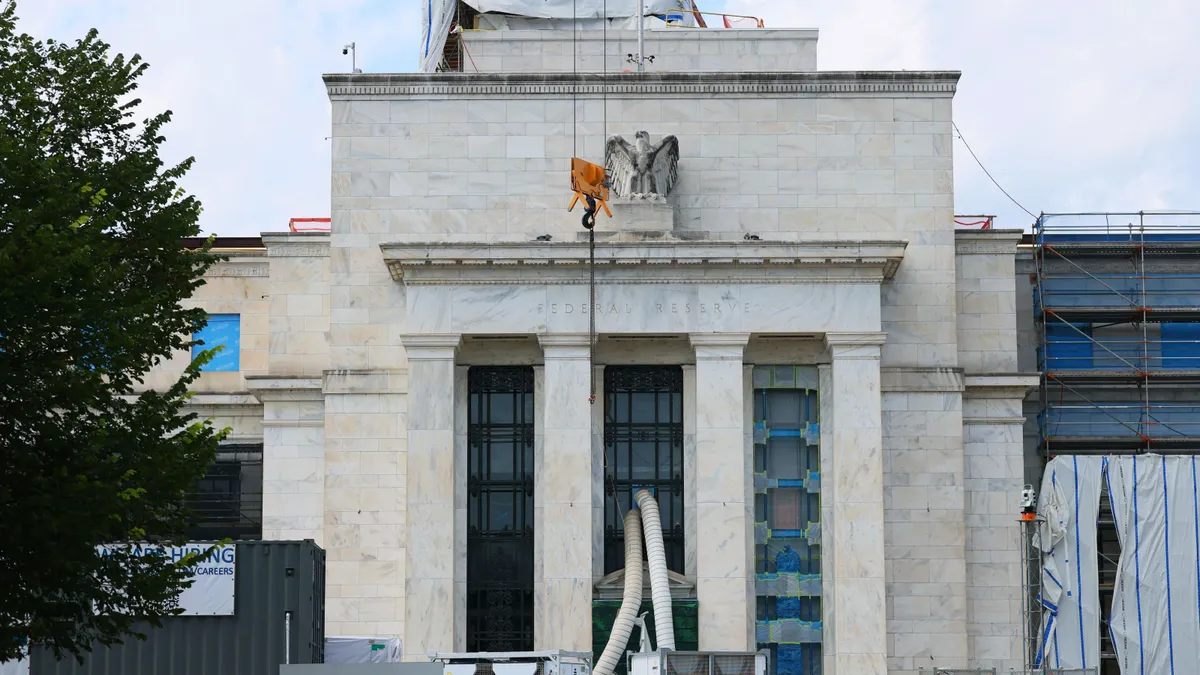
The nation’s largest banks would have to hold 1.4% more in common equity tier 1 capital under a Federal Reserve-led overhaul, unveiled Thursday, that’s meant to better align U.S. financial institutions with Basel III standards.
But when combined with a companion measure that would tweak the surcharge given to global systemically important banks – and previously announced changes to stress tests – those banks would be required to hold 4.8% less than they do now.
Category III and IV banks – those with between $100 billion and $700 billion in assets – would see a 5.2% dip in CET1 requirements. And smaller banks would be required to hold 7.8% less capital under the proposals, previewed last week by Michelle Bowman, the Fed’s vice chair for supervision.
In tandem, the proposals “meaningfully improve the bank capital framework by addressing duplicative overlaps, matching requirements to actual risk, and comprehensively addressing long-standing gaps in our framework,” Bowman said in a statement Thursday.
“The result will be more efficient regulation and banks that are better positioned to support economic growth, while preserving safety and soundness and financial stability,” she said.
The proposals come years after Bowman’s predecessor, Michael Barr, sought twice to push Basel-related reforms that would have increased capital requirements by 19%, and later 9%, for the biggest banks.
Barr stood as the sole dissenter Thursday on the seven-member Fed board that approved the revamped reforms.
“I fear that, if this much weaker version of Basel III is adopted in the U.S., it could trigger a ‘race to the bottom’ on standards, harming the global financial system,” Barr said Thursday in his dissent.
By Barr’s count, the proposals contained more than “20 material downward deviations from the Basel III standard,” he said.
“Each individual deviation from Basel III is perhaps able to be rationalized on its own, but in the aggregate, they result in a significantly weaker capital framework,” Barr said. “Banking is built on trust. I worry greatly that these actions are rapidly eroding that trust.”
Barr is not the only regulator with concerns over the proposals.
“I continue to have some skepticism that regulators can accurately measure operational risk through a complex, standardized formula, and am interested in comments on the merits of exploring a simpler approach,” Federal Deposit Insurance Corp. Chair Travis Hill said in a statement Thursday.
The FDIC and the Office of the Comptroller of the Currency joined the Fed in issuing the proposals Thursday.
Hill, however, noted the difficulty in getting the formula right.
“Calibrating capital requirements always involves balancing a number of competing objectives,” he said.
Fed Chair Jerome Powell equated the proposals to recommended maintenance.
“It has been almost two decades since the [2007-08] crisis and, over the years, we have come to understand that certain elements of the post-crisis regulatory regime may warrant recalibration,” Powell said Thursday. “It is a healthy practice to reexamine rules over time to ensure they are still effectively and efficiently mitigating the risks they were designed to address.”
The proposals are subject to a 90-day public consultation before they can be finalized.
That leaves wiggle room, one former Fed policy attorney said.
“The estimated declines in capital levels are just an opening bid,” said Jeremy Kress, the Fed alum who now teaches business law at the University of Michigan. “After banks submit their comments and optimize their balance sheets under a final rule, we could be looking at a much larger capital reduction.”
As they stand, however, the proposals received a vote of confidence from several banking trade groups, which called the overhaul an “important step forward” in a joint statement Thursday.
“We welcome regulators’ efforts to enable banks of all sizes to make more loans to American businesses and households, fueling economic growth while maintaining resilience in the banking system,” the Bank Policy Institute, American Bankers Association, Consumer Bankers Association, Financial Services Forum and National Bankers Association wrote. “We will carefully review the proposal and expect to provide feedback after assessing the impact on our members and the millions of customers they serve.”
At least one lawmaker, Sen. Elizabeth Warren, D-MA, appeared less than convinced.
“After a multi-year lobbying assault to gut modest safeguards on Wall Street risk-taking, big banks can now declare Mission Accomplished. Today’s proposal grants their every wish,” she wrote in a statement Thursday. “It gives them a green light to fund their risky trading and other activities with reckless amounts of debt, further slashing loss-absorbing capital cushions by tens of billions of dollars. It’ll mean bigger payouts for megabank shareholders and executives, less lending to small businesses and families, and a banking system even more prone to devastating crashes and taxpayer bailouts.”
Scott O’Malia, CEO of the International Swaps and Derivatives Association, appeared loath to jump the gun with praise.
“First impressions are that this is a significant improvement on the previous proposal," said O’Malia, whose organization pushed for changes to Barr's earlier proposals. "But the devil is in the details.”