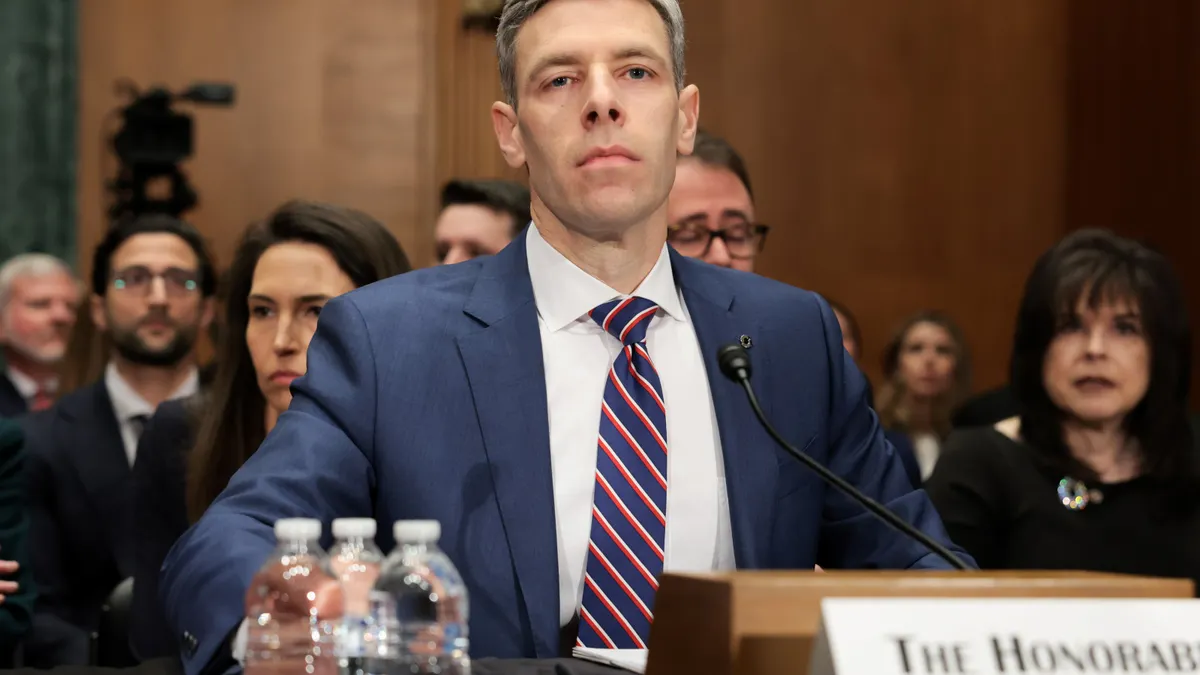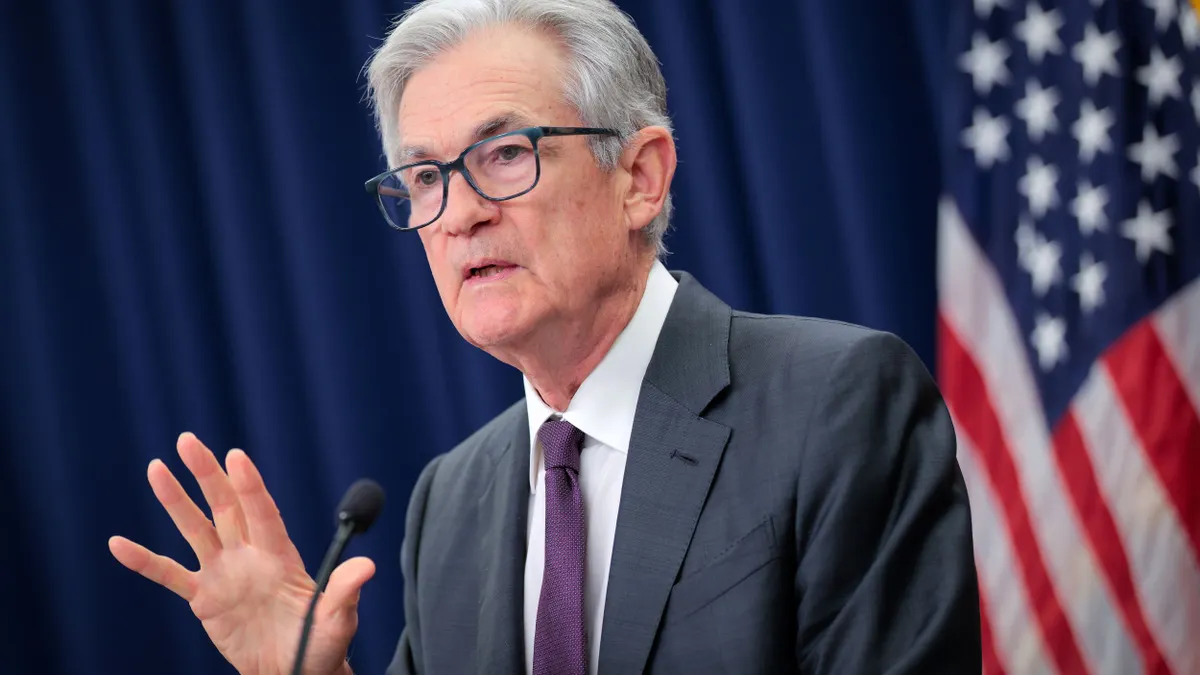
Federal Reserve Gov. Jerome Powell – who, until last week, led the U.S. central bank – received the John F. Kennedy Library Foundation’s Profiles in Courage Award on Sunday for what the organization saw as his resistance to pressure from President Donald Trump to lower interest rates.
“Few have done more under more difficult circumstances,” said Jack Schlossberg, Kennedy’s grandson and a Democratic candidate for a House seat now occupied by retiring Rep. Jerry Nadler, D-NY.
The award, presented annually, usually goes to an elected official – past recipients include former Presidents Barack Obama and George H.W. Bush, former Rep. Gabby Giffords and former Sens. Mitt Romney and John McCain – but “these are not ordinary times,” Schlossberg said.
Powell is not the only recipient of the award this year; another went to the people of Minneapolis and St. Paul, Minnesota, in the face of increased – and sometimes fatal – presence of Immigration and Customs Enforcement agents.
In an acceptance speech Sunday, Powell counted himself among “one of the many whom President Kennedy inspired to serve the public.”
Here are five other crucial quotes from the ceremony:
1. “Like many other institutions, the Fed has been undergoing a stress test.”
Powell made a clever call-out here to the yearly scenarios the Fed devises to test liquidity and crisis operations at the nation’s biggest banks. (The tests are less frequent at smaller lenders.) But the former Fed chair credited a system that gives the central bank a deliberate cushion from political pressure.
“Our federated structure is a bit complex, but the legal protections that support the non-political conduct of monetary policy are straightforward,” Powell said. “Fed governors and Reserve Bank presidents hold office with legal protection against removal. We serve long terms unrelated to the four-year presidential election cycle.”
Further, he said, presidential administrations “play no role in the selection or oversight” of the presidents of the Fed’s 12 regional outposts. That means at least five votes on the interest rate-setting Federal Open Market Committee are protected from presidential pressure even if the Fed board were to fall victim to it.
2. “If any administration finds a way to remove Fed officials over policy differences, then future administrations will do so as well.”
If Federal Reserve officials could be removed by the president – as Trump had threatened to do with both Powell and his colleague Fed Gov. Lisa Cook – “the public would lose faith that the central bank will make decisions based only on what's best for all Americans,” Powell said.
“The Fed's credibility would be lost,” he said. “Our credibility has been built and sustained over many decades, and we have a duty to safeguard that priceless asset for our fellow citizens and for generations to come.”
3. “Partisan political differences are normal – indeed essential – in a thriving democracy.”
The common denominator, however, should be a shared commitment to the higher principles that define our nation.
“Chief among them is respect for the rule of law,” Powell said.
During his eight years as Fed chair, Powell endured name-calling and blame at Trump’s hands – first, in his response to the COVID-19 pandemic. But pressure intensified during Trump’s second term. While Trump demanded lower interest rates in a frequently repeated social media blitz, he at times publicly tested the concept of firing Powell. His administration questioned the cost of renovations at two Fed buildings, and the Justice Department subpoenaed Powell. The then-Fed chair went public with the investigation, which was later dropped.
Powell’s term as Fed chair expired last month. Rather than retire, however, Powell chose to remain on the Fed board, who can serve through January 2028.
“Work to preserve and strengthen our own democracy can be noisy, frustrating and, at times, embattled,” Powell said.
4. “Democratic institutions take much time, effort, and patience to build but can be torn down all too quickly.”
Powell quoted the economic philosopher Edmund Burke here, but added, “it is essential that we preserve what is good about these institutions, even as we strive to improve them.”
5. “What the public has every right to expect is that we will make our decisions based only on our best economic analysis of what would most benefit the people we serve.”
This most potently drives home that, for Powell, the mission comes first, not politics.
“We do not take into account the fortunes of any political party or politician in making those decisions,” Powell said.
For what it’s worth, administration officials, in the week since Powell has left the Fed chair post, have made their own comments toward his successor, Kevin Warsh.
Trump, at Warsh’s swearing-in ceremony, said he wanted the new Fed chair “to be independent and just do a great job.”
“Don’t look at me, don’t look at anybody. Just do your own thing,” Trump said May 22.
Treasury Secretary Scott Bessent, meanwhile, called Warsh “a new sheriff in town” who would return “to basics in terms of accountability, credibility, and what’s the purpose of the Fed.”
In an introduction Sunday, Schlossberg quoted Powell as saying: “None of us has the luxury of choosing our challenges. Fate and history provide them for us. Our job is to meet the tests we are presented.”