The banks most at risk related to artificial intelligence-driven cash optimization concerns are online-only lenders – “the ones that have nothing but pricing defining their value propositions,” Fifth Third CEO Tim Spence said Monday.
“For the rest of us, there's enough interplay here,” whether that’s physical distribution and branches or added value within certain products and services, Spence said during the bank’s third-quarter earnings call.
The launch of Meta’s AI assistant Muse has reignited conversation around agentic AI cash sorting concerns for lenders and the threat such activity could pose to their deposit businesses. Citi and Bank of America have joined JPMorgan Chase in blocking customers’ external AI agents from accessing bank accounts, Financial Times reported.
JPMorgan CEO Jamie Dimon said consumers need to understand the risks of using AI agents, because “there’s a liability transfer.”
“You’ve got to make sure customers aren’t hurt by it, and so that is of concern,” Dimon said during the bank’s third-quarter earnings call Oct. 13. “You don’t want rogue agents, and there could be thousands of them.”
On Monday, Fifth Third CFO Bryan Preston said concerns around AI-driven cash optimization are “likely overblown” and adoption timelines probably accelerated, but the $301 billion-asset bank isn’t dismissing the issue.
Fifth Third’s median household checking account balance is $3,000, so there’s little excess that might be moved around in search of higher yield, Preston said. Commercial clients’ deposits are also largely operational, and the attached services the bank provides are core to customer relationships in both segments, he said.
Fifth Third doesn't currently allow AI agents to initiate transactions in customer accounts, and accountability questions need to be settled before agents carry out transactions on behalf of customers, Preston said.
“Every time you have a new platform like this, the battle for a market comes down to whether incumbents get the innovation faster than the insurgents get distribution,” Spence said during the Cincinnati-based bank’s earnings call.
“We're going to take every valuable service that you can get done on Muse, whether that's looking at subscriptions and finding opportunities to generate savings or budgeting or otherwise, and we're all going to build them into our apps,” Spence said.
The benefit for customers will be “bank-grade information security as a perimeter, and no blending between the information that exists in your financial graph with the information that exists in your social graph, which today is monetized by basically selling you to third parties for ad purposes and otherwise,” he said.
“I just think the incumbents have a lot of leverage here, provided that we respond,” Spence added.
Preston added that Fifth Third keeps tabs on what its customers value, and if they’re turning to external entities for services the bank could provide, the lender works to add those capabilities.
That “puts you in the spot to be able to differentiate, to strengthen those relationships, and win those relationships away from other institutions that potentially aren't making those same kind of investments,” Preston said.
Competition for deposits has been more intense this year than the last few years, as banks seek to fund loan growth, Preston said. One of Fifth Third’s top priorities is to be “strongly differentiated in core deposit growth,” Spence said during the call.
The bank’s average core deposits grew 3% sequentially to $236 billion, according to an earnings release. Third-quarter deposit costs rose 10 basis points to 1.64%; interest-bearing deposit costs increased 11 basis points to 2.24%. Fifth Third’s third-quarter net interest margin was 3.34%, down two basis points.
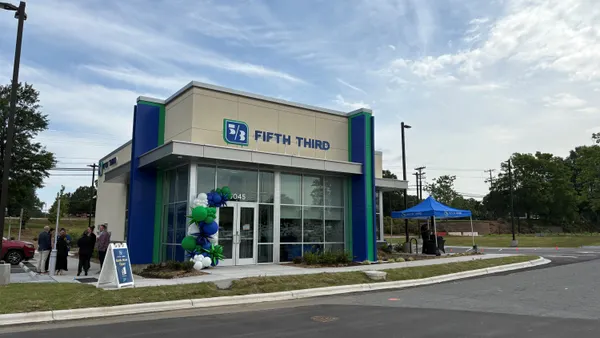
Fifth Third sees gains coming through its continued branch expansion in the Southeast and Southwest, as well as its recently launched innovation banking platform, Spence said.
“If you’re going to get low-cost deposits, it has to come from some structural investment that accumulates over time,” Spence said.