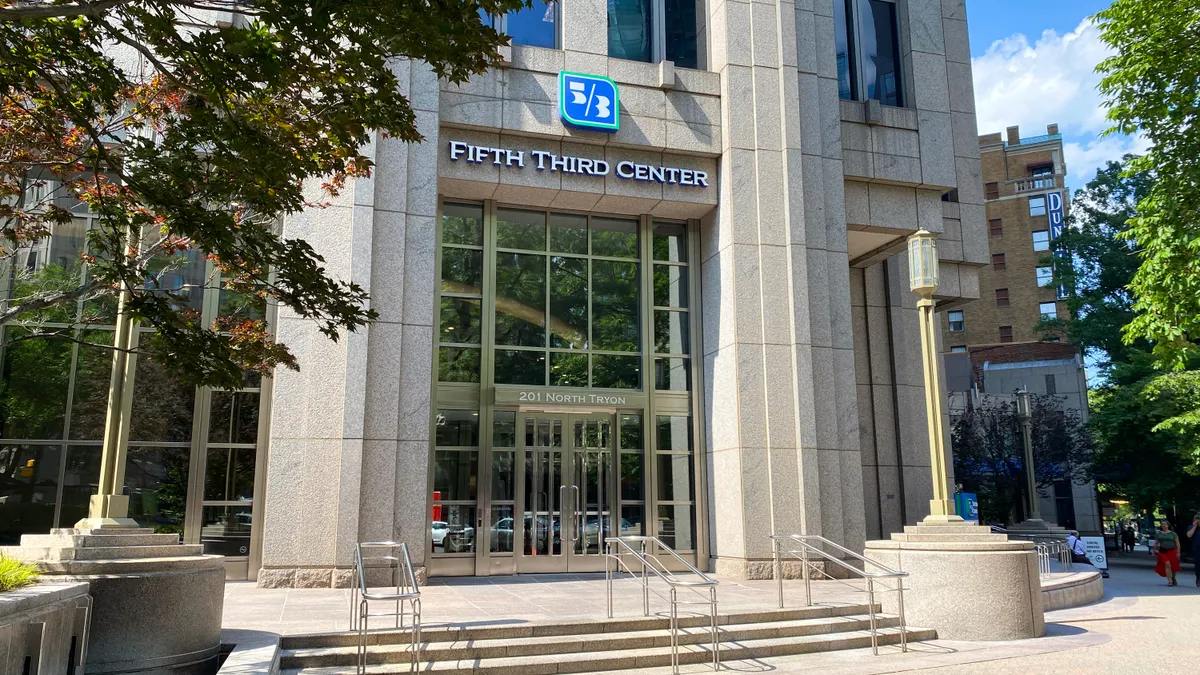
Fifth Third CEO Tim Spence is “not worried at all” about the bank’s bid to acquire Comerica, even as an activist investor has taken aim at the $10.9 billion deal.
At the Goldman Sachs U.S. Financial Services Conference on Wednesday, Spence was asked about hurdles in the way of the projected first-quarter deal closing, and whether he has any concerns that the lawsuit filed against Fifth Third and Comerica by activist investor HoldCo Asset Management could delay that timeline.
In October, Cincinnati-based Fifth Third said it was acquiring Dallas-based Comerica. HoldCo prodded Comerica to sell itself, but the investor then blasted the bank over the agreement with Fifth Third and faulted Comerica for ignoring a bid from another suitor, reported to be Regions.
HoldCo sued Comerica and Fifth Third over the “rushed” deal and its “draconian” deal provisions late last month. A judge in the Delaware Court of Chancery has ordered Comerica to provide additional information, American Banker reported.
Spence noted regulatory applications were filed in October and bank executives have been in “constant dialogue” with the Federal Reserve and the Office of the Comptroller of the Currency about the proposed combination. Nothing has come up that’s caused concern, he said.
“The experience we're having is consistent with what we have been hearing from others who were ahead of us in line, in terms of these transactions moving through in a sort of 90 day-ish type time frame,” Spence said.
Shareholders for both banks are scheduled to vote on the deal Jan. 6.
“If the worst thing that our shareholders are going to say about the deal is that there could have been more tangible book value dilution, I think we're probably in really good shape,” Spence said. “And frankly, given the feedback that we've gotten from Comerica shareholders, and the way that the market is trading the deal in general, it's pretty clear to me that the shareholder vote’s going to be very smooth on that front.”
That leaves resolution of HoldCo’s lawsuit, he noted.
“Having not spent a lot of time paying attention to this, I was a little bit surprised to learn that strike suits have been filed for basically every major deal that has been done over the course of the past several years, and I expect that'll work its way out through the courts in due time,” Spence said.
Fifth Third has identified $850 million in cost savings through the merger, mainly through “the elimination of facilities, systems, vendors, and some headcount reductions concentrated in overhead and noncustomer-facing roles,” Spence said.
As $213 billion-asset Fifth Third plans and prepares for the expected closing and conversion next year, the CEO indicated “job No. 1” is “first, do no harm.”
With $78 billion-asset Comerica, “the expense synergies paid for the deal,” but the targeted bank’s markets, vertical expertise and middle-market franchise, among other aspects, “are really the foundation for, like, a decade of organic growth opportunities at Fifth Third,” Spence said. “So we’ve got to make sure that we handle the conversion sensitively.”
The Cincinnati regional plans to employ the playbook used during its acquisition of MB Financial in 2019. That deal received regulatory approval in about nine months and conversion occurred in the roughly eight weeks that followed, Spence said.
“It just made sense to us, as we did our initial planning with Comerica, that we take the same approach here,” he said.
For the largest commercial relationships, especially those with complex treasury needs, Fifth Third plans to “onboard them the way that we would if we were winning new business over the course of the period of six months, and that makes the weekend system conversion much less fraught,” Spence said.
He expects that to occur toward the end of the third quarter of 2026 or beginning of the fourth.
From there, Fifth Third plans to fill out Comerica’s branch network in Texas and California, and bolster marketing for consumer deposits, since it’s something Comerica hasn’t directed attention to for years, Spence said.
“We get about 35% of our monthly household and deposit production from the branch through marketing-linked activity,” he said, and that’s a level the bank aims to achieve with legacy Comerica locations. Adding 150 de novo branches to Texas through 2029 is designed to help the bank chase a $10 billion deposit opportunity in that state, he said.
Spence also touched on how the consumer strategy in California will differ slightly.
“From a consumer perspective, the nice thing about California is it's an incredibly deep pool of liquidity, and because we have such a small share across the state, the net incremental relative to cannibalization on rate offers will work very much in our favor,” he said. “So the strategy there will be more deposit balance-driven than it would be conventionally household-driven, although we will do some household marketing in places where we have the right level of density.”
On the commercial side in that state, Spence said he sees added branches supporting the lender’s middle-market banking activity, and envisions growth opportunities in serving the innovation economy.
Fifth Third on Tuesday said it’s acquiring Mechanics Bank’s Fannie Mae delegated underwriting and servicing business line, which includes a team of employees and a $1.8 billion portfolio.
“This capability has been a notable gap in our commercial real estate capital markets offering, and we expect it to generate strong fees, some incremental loan growth and stable deposit balances as we build the platform out over time,” Spence said Wednesday.
Spence said the bank had been trying to acquire a DUS license for the past decade and passed on other options for various reasons. Fifth Third plans to add employees and licenses to the business unit and integrate it into its and Comerica’s multifamily businesses, he said.
Fifth Third is paying $130 million in cash for the business, according to a Mechanics Bank securities filing. The acquisition is subject to certain approvals including by Fannie Mae.