
Dive Brief:
- Fintechs would gain access to the FedACH and FedNow payments rails under a House bill introduced Tuesday by two California lawmakers pushing for expanded services. The bill has no Senate companion legislation yet.
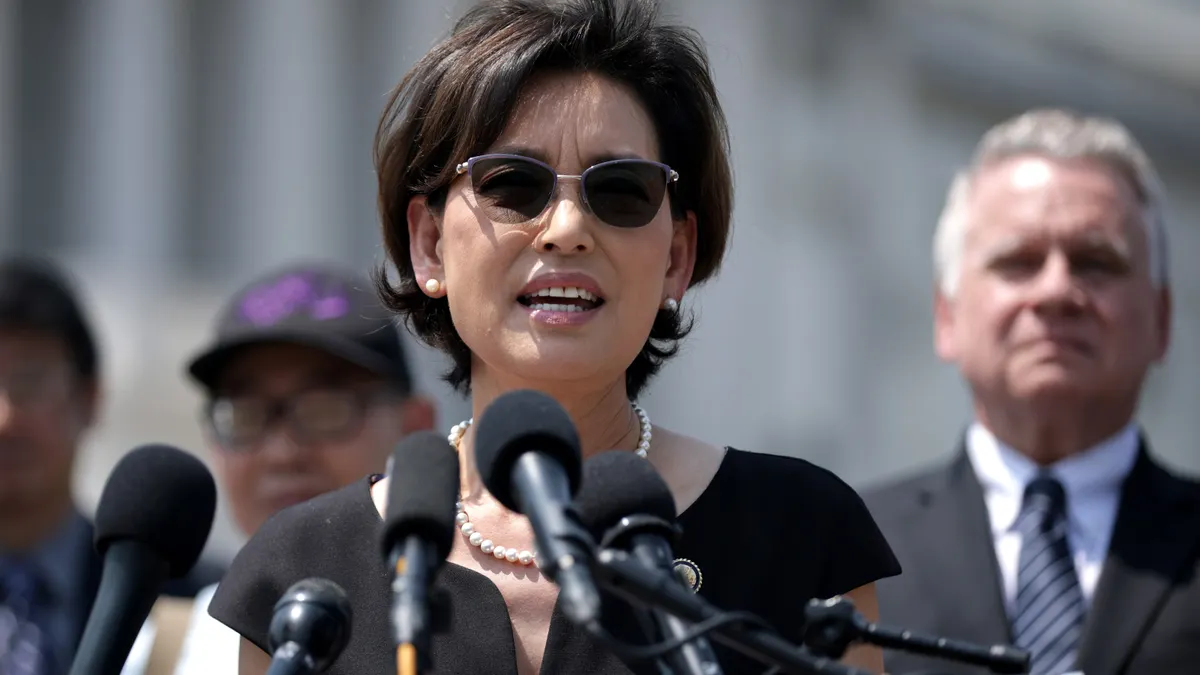
- The Payments Access and Consumer Efficiency (PACE) Act is designed to widen fintechs’ access to the U.S. electronic payments systems and lower the cost of payments, according to a Tuesday press release from Rep. Young Kim, the bill’s Republican sponsor.
- “Allowing regulated payment firms access to federal payment rails will enable faster transactions, lower costs, and more seamless experiences on par with other leading economies,” Penny Lee, CEO of the Financial Technology Association, said in the press release.
Dive Insight:
Kim, from Orange County in Southern California, introduced the bill with Rep. Sam Liccardo, a Democrat who represents a Silicon Valley district that includes part of San Jose. A Senate companion bill is under discussion, a spokesperson for Kim said Monday in an email.
“Hardworking Americans shouldn’t have to wait days to access their own money or pay extra just to move it,” Kim said in the press release. “My PACE Act modernizes our system to deliver faster payments, lower costs, and helps families and small businesses keep more of their hard-earned money.”
Under the bill, a payment provider that wanted to access the Fed rails would need to become a “registered covered provider” with approval from the Office of the Comptroller of the Currency, according to the text of the bill.
Applicants would need to have money transmitter licenses from at least 40 states and maintain 1:1 reserves, along with meeting OCC-prescribed risk management and record-keeping requirements. A covered provider would also need to comply with the Bank Secrecy Act and be subject to the Equal Credit Opportunity Act.
An applicant would also need to demonstrate “benefit to the public, including with respect to innovation, competition, and enabling widespread access and use of payment services,” according to the bill.
Banks have sometimes expressed a generally dim view of the concept of startup payment firms accessing Fed payment rails. For instance, the American Bankers Association argued in February that regulators should move cautiously given the potential consumer risks.
The bill seeks to strike the proper balance between OCC oversight of payments players with the “right-sized activity” the business is conducting, Jaliya Nagahawatte, Kim’s senior policy adviser, said Monday in an interview.
“This isn’t going to be a willy-nilly type process where any fintech that walks into the OCC gets a bank charter,” he said.
The legislation represents a parallel effort to one begun last year by the Federal Reserve that fintechs have criticized.
In December, the Federal Reserve called for public comments on a new prototype payment account – often dubbed a “skinny” account – that would let fintechs use the Fed’s payment rails without gaining full master account benefits that traditional banks have.
Under the Fed’s proposal, fintechs could access only its instant payments system, FedNow, and its FedWire rail for high-dollar amount payments – not the high-volume FedACH, the most-used U.S. payment rail.
That decision led to criticism by the FTA and other fintech trade groups, because it requires them to continue relying on partners to access the ACH network.
Nacha, the nonprofit that oversees the ACH network, has two operators for that network, the Federal Reserve and The Clearing House. The latter is owned by a consortium of banks. The ACH network processed 35.2 billion payments with $93 trillion value last year, according to Nacha data.
The Federal Reserve has limited authority under the National Bank Act to govern fintech activities, Nagahawatte said. “So that’s where we’re trying to solve and redesign the system” with the PACE Act, he said.
The OCC would have 180 days to determine whether an application is complete and then no more than 180 additional days to grant or deny a complete application, under the measure. If the comptroller doesn’t notify an applicant of a decision within the latter 180-day period, the application would be granted automatically.
“By creating a pathway for qualified payments companies to access a subset of Federal Reserve payment services through a tailored account structure, the bill would help ensure our payments infrastructure evolves alongside innovation in a safe and responsible way,” Cody Carbone, chief executive of The Digital Chamber, said in the press release.
The Digital Chamber is a trade association for blockchain technology and other digital currency companies.