Every August, the eyes of the financial world turn to Wyoming. In the past, that’s meant the Federal Reserve Bank of Kansas City’s annual Jackson Hole summit. But ever since the Cowboy State has become entrenched in digital-asset innovation, the Wyoming Blockchain Symposium, too, has grown into recommended viewing.
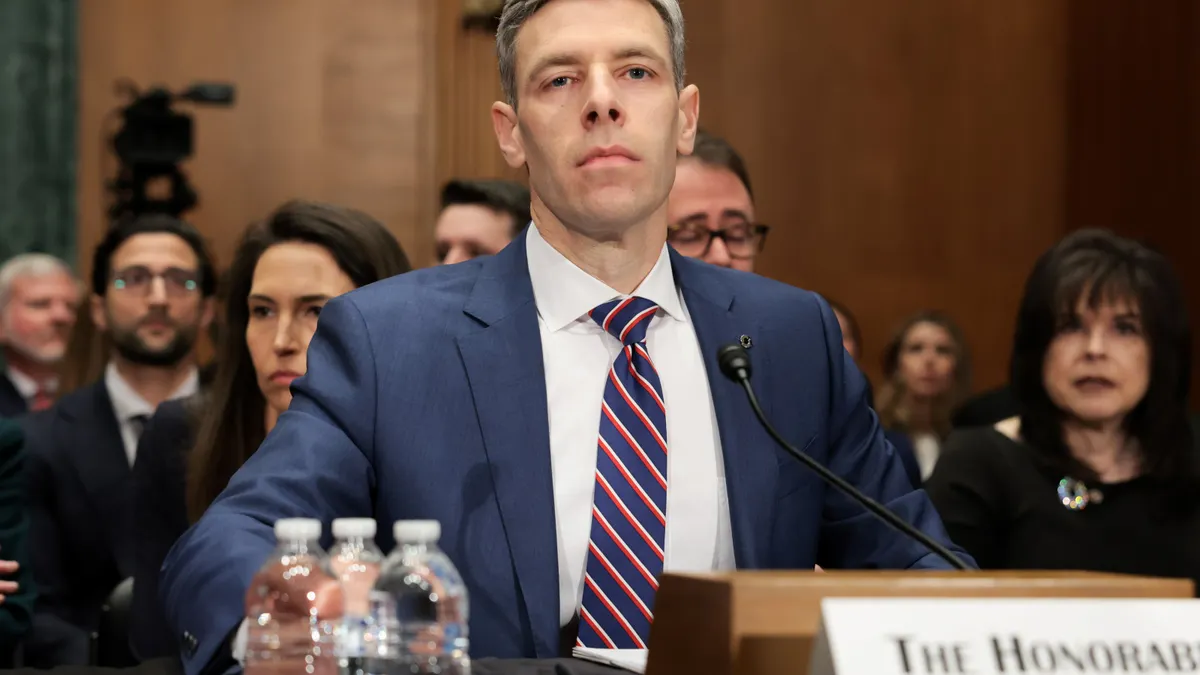
By the same, er, token(?), digital assets received arguably momentous validation when Comptroller of the Currency Jonathan Gould addressed the gathering Wednesday. Here are four critical takeaways from his appearance.
1. “Crypto is part of the business of banking.”
Gould did not hold a fence around traditional banking, or signify any asterisks when he discussed digital-asset activities. The Office of the Comptroller of the Currency has received 40 applications for new-bank charters in the past 18 months, and 23 of those incorporate digital assets, Gould said.
“It is becoming ordinary course to involve and integrate payment stablecoins, etc., in the business plans that we are now seeing presented to the OCC for consideration,” he said.
While he didn’t verbally separate crypto and banking, Gould did take pains to distinguish the Trump administration’s treatment of digital asset innovation from its predecessor. For one, he cited an eightfold increase in applications with a digital-asset component, compared with the Biden era.
2. “There was a strategy taken of risk elimination with respect to crypto and trying to shield the banking system from crypto activities, digital asset activities and blockchain technology. I think that was extremely shortsighted.”
That’s Gould’s assessment of the OCC during the Biden administration.
“Because of that approach … we at the OCC have been playing catchup and we should have been learning over those last four years,” he said.
Gould said he wants to make sure the OCC is “welcoming and embracing innovative activities,” and working with banks to harness technological developments safely and soundly.
He contrasted that with the Biden-era approach, which he characterized as having “a cloud of reputation risk associated [digital-asset activity] even though it was legally permissible.”
“We're willing to take on that burden. We recognize that's a shared burden with those banks that are … interested” in digital assets, adding that the OCC has “excised” reputational risk from its “lexicon.”
3. “My job is not about incumbent protection.”
Gould said his job, in leading the OCC, is “about the integrity of the banking system as a whole and making sure that it remains relevant over time.”
He noted the 163-year history of the agency, adding, “it would be extremely myopic, from our perspective, if we didn't acknowledge and give banks the tools they need, including the new technologies they need, to continue to … deliver services to their customers and meet the changing needs of the markets that they serve.”
With regard to the Genius Act, he said, the OCC intends to have a final rule in place by November and begin processing applications at the start of 2027
“In parallel to crafting the regulatory framework for those payment stablecoin issuers within our jurisdiction, [we] have also been very busily designing the supervisory framework,” he said, adding he aims for the agency to have that “ready to go” once the Genius Act takes effect Jan. 18.
4. “What keeps me up at night is the possibility that I won't have enough people at the OCC who stand up and hear what I'm saying and respond to it with enthusiasm and vigor.”
A document seen by Politico in June indicates the OCC will be cutting staff. Its headcount now is roughly 2,600 – about 1,000 less than in 2024. It’s unclear whether Gould was referring to that Wednesday.
“Thirteen months in, I'm finding that there are a lot of folks at the OCC who are very excited about the innovation and dynamism that needs to occur within the financial services system,” he said. “So that concern of the declining relevance of the banking system is abated because of the behavior I'm seeing at the OCC.”