Read the news today, and you’ll likely find the term “populism” being bandied about – with varying definitions.
Merriam-Webster calls it “a political philosophy that represents or is claimed to represent the interests of ordinary people, especially against the Establishment.”
For the sake of argument, let’s take out the last clause because established banks would not typically, voluntarily conduct business against their own interest.
But in the past week or so, two giant banks have taken what Merriam-Webster might qualify as populist turns.
Bank of America last week announced it would hire an extra 1,000 apprentices over the next two years and commit $150 million to workforce development organizations by 2031.
Barclays, for its part this week, made a partial concession on a demand that U.K.-based employees return to the office three days a week – four, if you’re a managing director or above – starting Oct. 5.
After facing fervent pushback from a workers union, which issued an open letter with its own demands, Barclays on Tuesday pushed the effective date for more frequent office attendance to 2027.
“We are extending the implementation period for UK colleagues to ensure colleagues have the right support as we move through the transition,” the bank’s executive committee wrote in an email to employees, seen by Banking Dive. “We are also reviewing our flexible working policy.”
By the same measure, Barclays still encouraged staff to comply with the new requirement next week. And workers must still ask and receive permission from their line manager to delay compliance, the bank said.
Barclays said it has “continued to listen to colleague feedback to ensure colleagues have the right support while enabling us to deliver the benefits of working together in person.”
Unite, the workers union that represents roughly 80% of the bank’s U.K. staff, demanded that employees be exempt from the three-day-a-week mandate if their commutes are more than 40 minutes or 35 miles each way. The union also asked that employees be allowed to work split shifts or be given flexible start or end times if they’re responsible for childcare, or when it’s feasible to avoid “peak” commute times.
Unite also fought for employees to receive a one-off payment by March 2027 to offset the increased costs of more in-office time.
Barclays and Unite both said this week they would continue discussing the matters.
For whatever reason Barclays adjusted its time frame, it clearly believes it will get what it wants eventually. Maybe that’s not populism so much as a projection that the “employers market” we’ve been living in might be softening a little.
Likewise, Bank of America clearly sees the value in its amplified apprenticeship effort. The 1,000 new apprentices come in addition to more than 800 the bank said it already hires every year as a pathway to consumer banking, technology and operations roles. Apprenticeships generally last about a year and can provide industry-recognized, portable credentials or licensing, the bank said.
BofA is aiming to spotlight its focus on skills-based hiring and career mobility – particularly for work that doesn’t require a bachelor’s degree, the bank said. Roughly 40% of the bank’s hires do not have a bachelor’s degree.
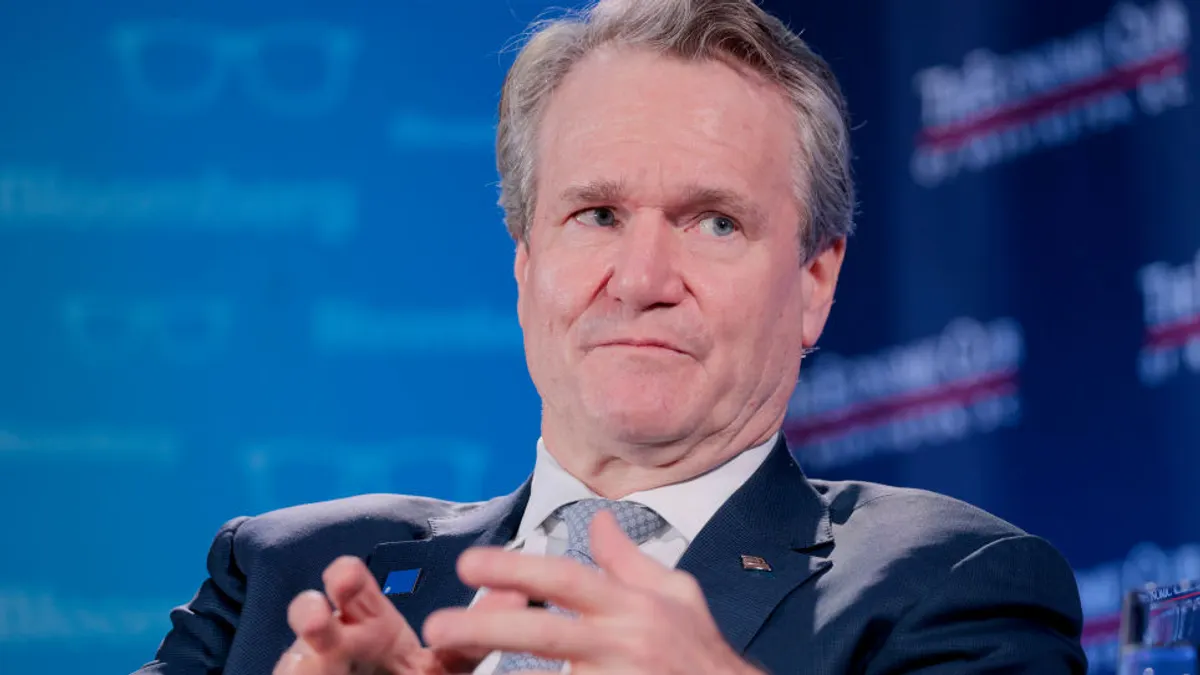
“Our apprenticeship and workforce development programs underscore our continued commitment to expanding opportunity and helping talented individuals develop the skills to succeed,” Bank of America CEO Brian Moynihan said in a statement Sept. 24. “This is one more way for us to do what we can to help create a skilled American workforce for tomorrow.”
Any discussion of the future is likely to come with the recognition that artificial intelligence will play a greater role in banking – and that employees, even at the apprentice level, will need to know how to use it.
“We as managers have to realize one of our jobs is to make sure this transition works for everybody,” Moynihan told Punchbowl News last week, of the embrace of AI.
In a separate interview with American Banker, Moynihan stressed the benefits of creating a talent pipeline through the apprenticeship program.
"You want that career path because, frankly, you don't have to retrain them,” Moynihan said. “Having you leave and I go hire someone else to replace you is just turmoil. … “[Creating a career path is] the right thing for businesses to do.”
The timing of the apprenticeship expansion should be noted, too. Bank of America, for the past several years, has used early fall as a time to raise awareness of another long-running effort to provide a hand up to its lowest-paid employees. The bank’s initiative to boost its pay floor from $20 per hour to $25 typically saw incremental, $1-per-hour raises announced every September.
As populist as Merriam-Webster may define BofA’s expanded apprenticeship, it may have simply been driven by the calendar: After BofA reached its $25-per-hour goal in 2025, the bank may have realized it wanted to throw an opportunity to its lowest rung at this time of year because it’s tradition.