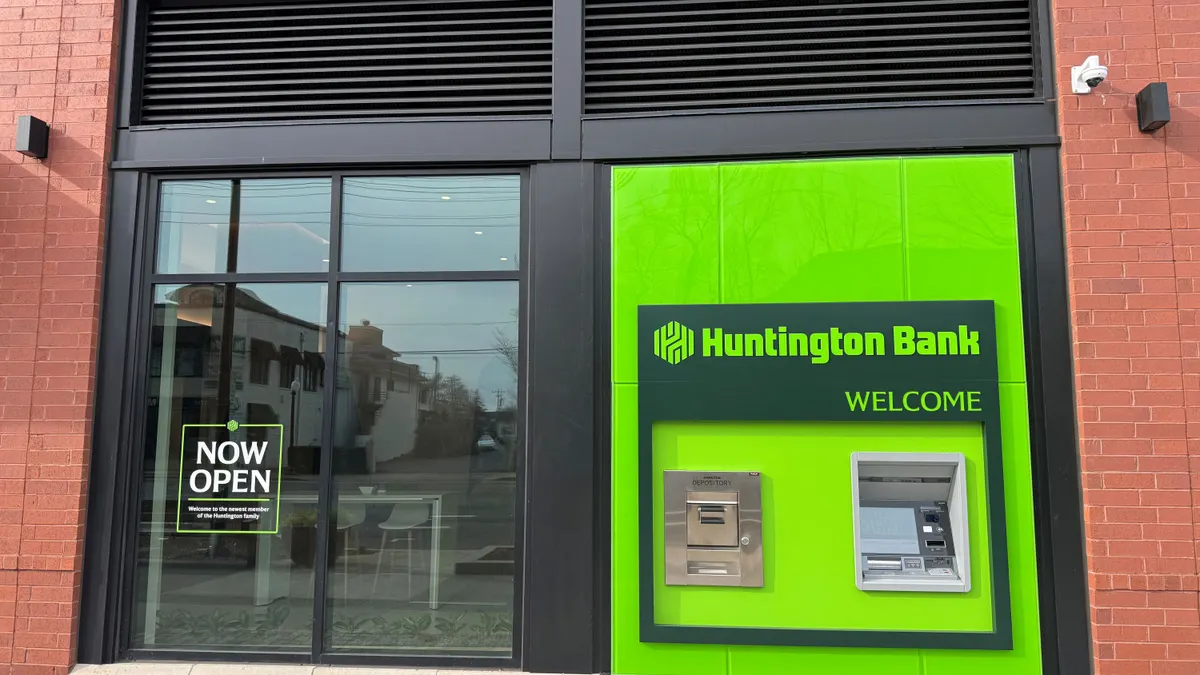
Larger lenders like PNC may see a coast-to-coast pursuit as the path to success, but Huntington CFO Zach Wasserman countered that a tighter focus is the way to win in banking.
The Columbus, Ohio-based regional, days from closing on its second Texas-based bank acquisition in six months, isn’t interested in a bank purchase that would take it beyond the geographic footprint it’s set to gain with Houston-based Cadence, Huntington CEO Steve Steinour has indicated.
PNC CEO Bill Demchak, though, recently labeled a regional bank’s position as “a tough place to be,” as the Pittsburgh-based lender and larger banks push into more markets.
“To succeed, particularly with a retail platform, you have to have a national and ubiquitous presence and share in each market that allows you a fair fight,” the PNC CEO said Jan. 16. “Long-term survivability, at least in our view, is dependent on the ability to take the fight to all the markets in the U.S. and win.”
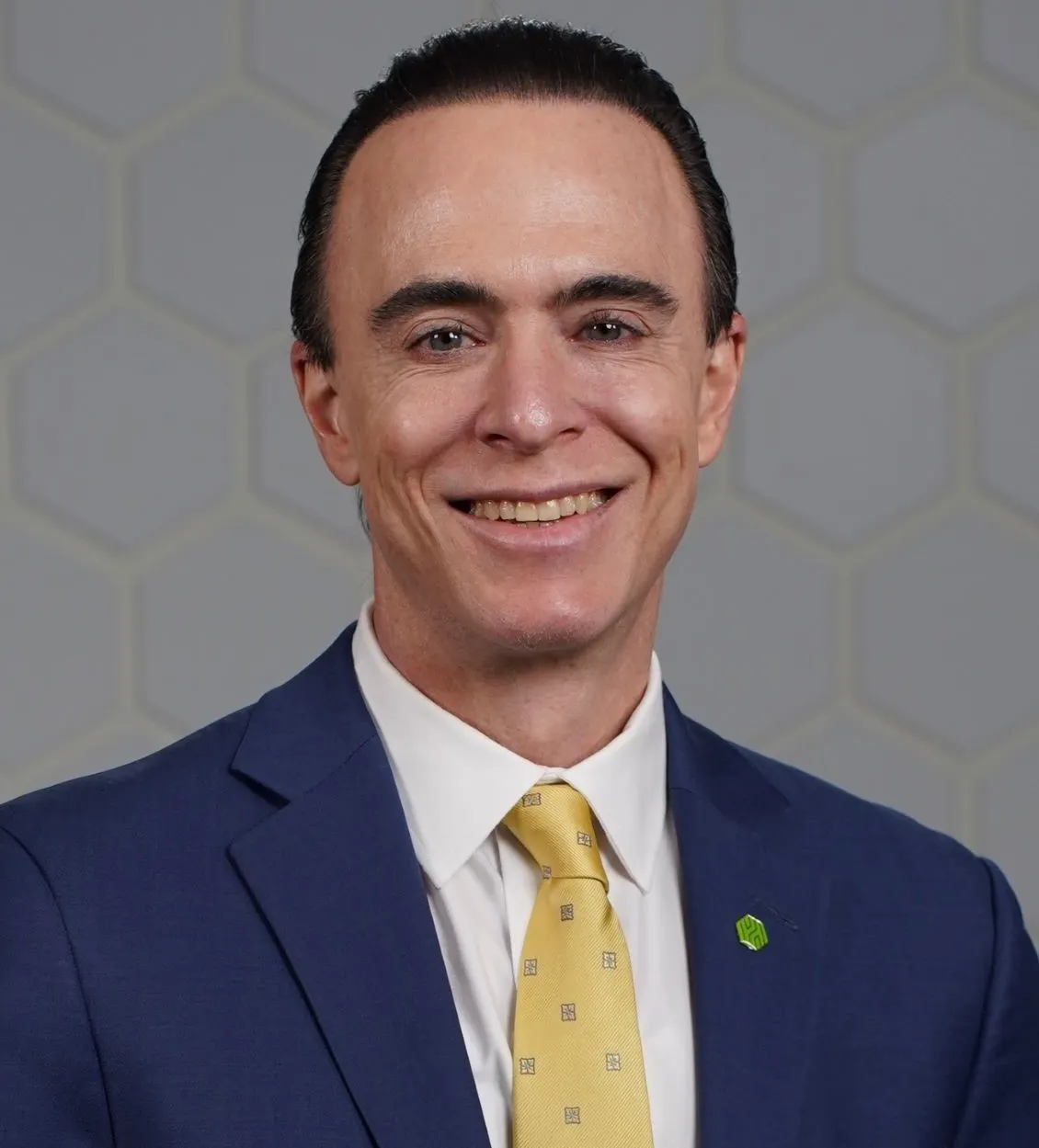
Huntington’s Wasserman sees some truth in Demchak’s assertion: Greater scale offers more revenue and cost efficiencies, the CFO said, and brand-building investments can stretch further with a broader footprint.
Yet “the reality in banking is, it’s very much focused on distinct segments, distinct geographies – that’s where you win,” Wasserman said in a Thursday interview. “I don’t need to be national to win; I need to be very focused on certain customers and certain segments.”
“By far, the predominant factor in success is the focus one, and so that's where we're doubling down,” Wasserman said. It’s “much better to be in the top five in a smaller geography, than to be 20th across the country.”
During the bank’s fourth-quarter earnings call Thursday, Huntington executives didn’t rule out another acquisition. But one wouldn’t be necessary for the $225 billion-asset bank’s growth, Wasserman said.
“Acquisitions are so binary. They will either meet all of our stringent criteria, or they don’t,” Wasserman said, when asked if the bank might pursue a Carolinas acquisition with similar rationale as the $1.9 billion purchase of Dallas-based Veritex and $7.4 billion Cadence deal for Texas.
“It’s hard to say, I want to go do something in a certain place,” he said. “There really aren’t that many attractive partners that would meet all of the criteria that we have. It’s much more opportunistic than that.”
The bank’s 2025 non-interest expenses totaled $5 billion, up 10% from 2024. For the full year, revenue rose 11% year over year, to $8.2 billion, and net income also jumped 14%, to $2.2 billion.
The regional is projecting 2026 revenue growth between 11% and 14%, and expense growth between 10% and 11%.
Wasserman expressed confidence the bank can balance profit growth with reinvesting in business, and investments this year are geared toward digital and technology capabilities, marketing and employees.
“The supermajority of the investments goes towards technology,” with a focus mainly on customer-facing digital capabilities, Wasserman said. That includes bolstering self-servicing capabilities, as well as new payments functionality, deposit products and wealth management capabilities.
The bank also plans to open another 20 to 25 branches in North and South Carolina in 2026, as it chases growth in those states and Texas, he noted.
The Cadence acquisition – set to close Feb. 1 and bolster Huntington’s presence to 21 states – will add about $1.1 billion to Huntington’s expense base, executives said Thursday.
Huntington expects to start seeing cost synergies from Veritex in the second quarter and from Cadence in the fourth quarter.
After announcing the Cadence acquisition, Huntington cut just over 1,000 jobs, since the merger presented some staffing redundancies, Wasserman said. Employees were notified in mid-December. The combined company’s headcount moving forward will be about 26,000, Wasserman said.
“Ultimately, the entire combined organization is looked at to see where the efficiencies should be,” he said. “There are impacts on both Huntington’s and Cadence’s sides.”
Huntington also has about 1,000 open roles, and the bank aims to help those whose jobs have been eliminated determine if an open position could be a good fit, Wasserman said.
The Veritex deal closed in October and systems conversion occurred during the Martin Luther King Jr. weekend, Wasserman said. That acquisition added about 50,000 customers.
The Cadence integration, however, will be more complex, adding about 1.5 million customers, he said. Huntington has been working on product mapping, charting Cadence’s products, general ledger and financial statements to its own, to understand how to ingest Cadence’s financials into Huntington’s, Wasserman said. The Cadence systems migration is scheduled for midyear.
Steinour has said the bank views M&A as a “springboard” for – not an alternative to – Huntington’s organic growth ambitions. Similar to what it recorded last year, the bank is projecting loan growth of about 8% this year, not including Veritex or Cadence.
Wasserman is confident in the lender’s ability to meet its organic growth goals, since the teams focused on that effort and the integrations of Veritex and Cadence are distinctly different.
Still, some analysts see the cluster of moving parts as obscuring the bank’s growth picture.
“It is very challenging from the outside to understand [Huntington’s] organic momentum and trajectory, despite the company’s best efforts,” Piper Sandler analyst Scott Siefers wrote in a Thursday note. “And given that (prior to commencement of [Huntington’s] deal announcements last summer) investors considered the differentiated organic growth profile as the story’s main distinguishing characteristic, this could remain a sticking point until deal noise subsides.”